

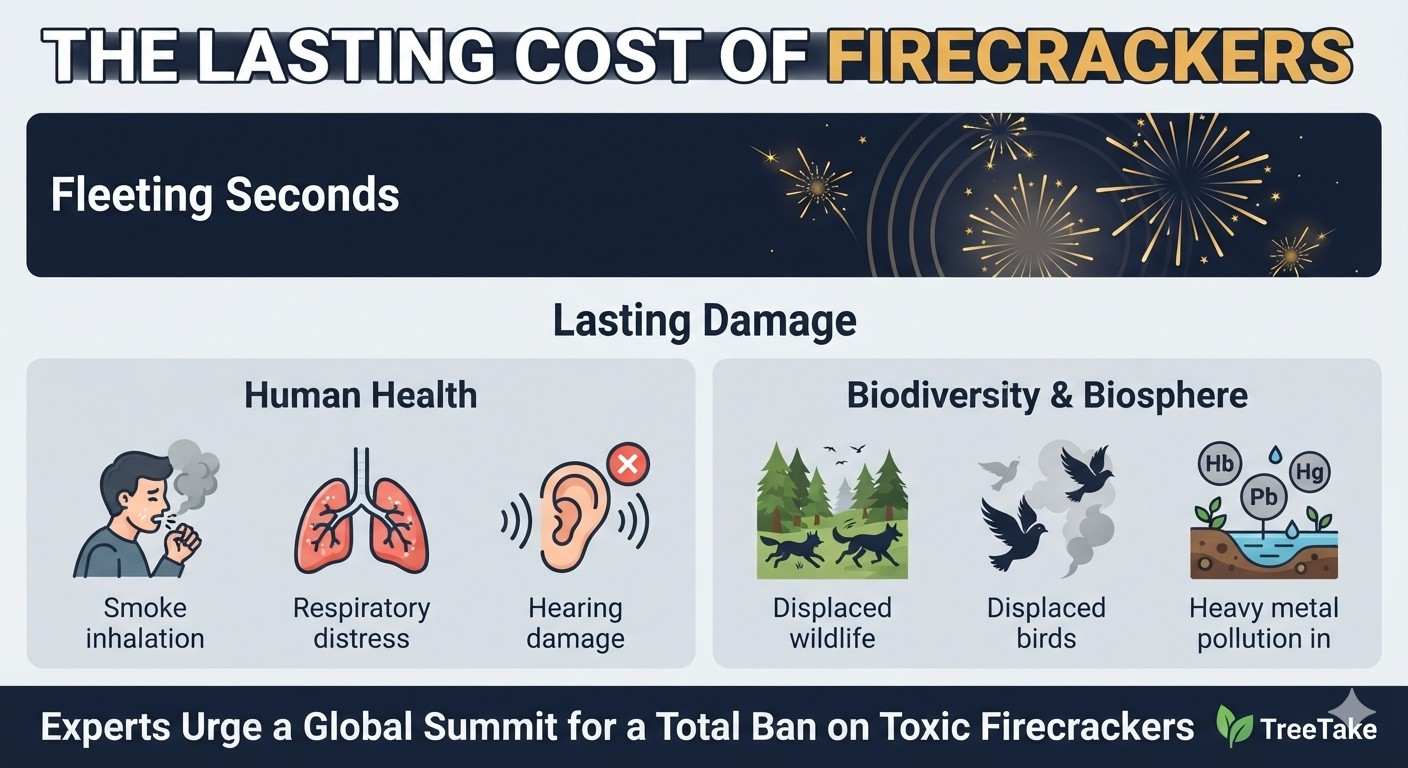
The sparkles are for a fleeting few seconds, the deafening boom for even less than a second, but the damage is lasting. Though rampant use of firecrackers during celebrations has a hazardous effect on human health and biodiversity, curbs prove to be toothless. Hence, experts are urging a global summit to enforce a total global ban on toxic firecrackers to protect public health and the biosphere. TreeTake takes a look…
It is 1.40 AM on Diwali night. Sexagenarian Savita lies awake despite taking her sleeping pill, for there are loud booms of crackers outside. Elderly Govind Pandey is wheezing, clutching his inhaler with one hand, for the air is thick with fumes and the acrid smell of explosive powder. Vivek, 40, sitting in his apartment, is cuddling his two small dogs, trying to soothe them as they tremble with each boom and bang. With rockets and bombs going off and the ubiquitous ‘chatai’ imitating a machine gun volley, the atmosphere does not look like, but certainly sounds like, a war zone. It is celebration for some, but an ordeal for many others. Governments, environmental agencies and judicial bodies are actively enforcing a transition to ‘green’ fireworks, strict operational time windows and public awareness campaigns to mitigate the severe environmental, noise and health impacts of traditional pyrotechnics.
Global and national actions to curb these ill effects are focused on four primary strategies:
1. The transition to ‘green crackers’
Regulatory frameworks are shifting from blanket bans to promoting certified green crackers developed by environmental research bodies like the Council of Scientific and Industrial Research (CSIR-NEERI).
Chemical reductions: Green crackers either heavily reduce or entirely eliminate toxic elements like barium, lithium, arsenic and lead.
Emission control: These formulations alter the fuel and oxidiser proportions and use dust-suppressing additives (such as hydrogel particles that create steam upon bursting) to reduce particulate matter (PM2.5) and harmful gas emissions by 20% to 30%.
Verification mechanisms: Legal products now require packaging that displays the official CSIR-NEERI logo alongside a verifiable QR code to prevent illegal smuggling and counterfeit goods.
2. Legal restraints & time curfews
High courts and local authorities are relying on high-precision temporal restrictions rather than absolute bans to balance cultural celebrations with public health. For example, during major festive seasons:
Hourly limits: The Supreme Court of India restricted firecracker usage to short, specified daily windows (e.g., 6:00 AM–7:00 AM and 8:00 PM–10:00 PM) before restoring full bans.
Silence zones: Discharging fireworks is strictly illegal within a 300-metre radius of designated silence zones, including hospitals, nursing homes and educational institutions.
3. Stricter manufacturing and supply-chain standards
Chemical bans: Government health and environment ministries have restricted the sale of conventional fireworks that use highly dangerous heavy metal components.
Market accountability: Law enforcement agencies are authorised to audit warehouses and marketplaces to confiscate unapproved or non-QR-coded fireworks. In some countries—such as the Netherlands, Ireland, Chile, and Australia—consumer use is banned completely, confining fireworks exclusively to licensed public displays.
4. Nationwide public health advisories & campaigns
Educational materials: Health ministries routinely issue guidelines highlighting the acute dangers of fireworks, including short-term surges in air pollution, irreversible noise-induced hearing damage and severe ocular trauma (which accounts for significant rates of blindness globally).
Community pledges: Environmental initiatives, such as the Green Diwali Campaign under the global Mission LiFE initiative, actively push citizens to take public pledges to celebrate cracker-free holidays.
However, despite these measures, public health experts continue to emphasise that ‘green\ fireworks are merely a harm-reduction tool and are not entirely pollution-free. Enforcement remains a significant hurdle as illegal, mislabeled fireworks frequently bypass local authorities.
A pollution control board official, speaking on condition of anonymity, said all crackers, whether green or not, cause pollution. Though green crackers were said to reduce emissions by 30-40% per cracker, the rest still dispersed into the air. That is the reason experts feel the global community must come together in an emergency international summit to draft a binding treaty that enforces a total, uncompromising global ban on firecrackers. This mandate must cover every stage of the supply chain—enforcing zero tolerance for the manufacture, sale, purchase and use of pyrotechnics worldwide. There can no longer be any cultural, religious or social excuses. Be it Diwali, Christmas, New Year, Easter, weddings or functions, the tradition of detonating chemical explosives for fleeting entertainment must end.
Dr Shailendra Kumar Yadav, assistant professor, Department of Environmental Science, School of Earth and Environmental Science, BBAU, Lucknow, said: “Under current conditions, unified international standards and multilateral agreements on consumer pyrotechnics are needed, because firework products are traded across borders and their emissions (PM2.5, metals, perchlorates) affect shared regional airsheds. However, how rigorously these frameworks are implemented will matter far more than how they are written. In my view, the effort should work at three stages. First, regulation and standardisation at the manufacturing and distribution level, with harmonised limits on chemical composition, mandatory certification and labelling and traceable supply chains. Second, rules on the timing and location of celebrations, guided by meteorology: use would be allowed when mixing height and wind speed favour dispersion, and restricted during stagnant, inversion-prone conditions. Third, behaviour change, especially among educated and economically affluent people. They are often the largest consumers, and they set social norms, so moving them toward low-emission or community-based celebrations could have a multiplier effect.”
While the global community has rightfully mobilised against plastics, the sudden, concentrated blitz of toxic air and noise pollution unleashed by firecrackers presents a more volatile threat. Just like plastic, these hazardous devices must be completely eradicated from commercial markets to protect our shared biosphere, feel experts.
The scale of environmental degradation caused by a single night of heavy firecracker usage is staggering and backed by alarming scientific data. During major celebratory events like Diwali, atmospheric levels of deadly Particulate Matter 2.5 (PM2.5) regularly skyrocket. Real-world monitoring data shows that hourly PM2.5 concentrations during Diwali can soar up to 900 micrograms per cubic metre—a horrifying number when contrasted against the World Health Organization's safe guideline of just 5 micrograms per cubic metre annually. Similarly, during New Year's Eve, cities worldwide experience drastic pollution spikes; in Munich, Germany, particulate levels hit 26 times the recommended daily limit on a single night, as national displays ejected roughly 4,000 tonnes of particulates into the sky—amounting to 15% of the entire country's yearly vehicle emissions in just a few hours.
Whether it is a dense series of wedding celebrations or festivals, , the heavy metals used to colour the explosions—such as toxic barium, strontium, copper and propellants like potassium nitrate—disintegrate into inhalable soot. Unlike industrial emissions that dissipate higher up in the troposphere, these heavy, dense pollutants settle entirely at ground level, trapping hazardous chemicals directly in the biosphere where living organisms breathe. This ground-level concentration makes firecrackers uniquely fatal to public health, acting as an immediate trigger for severe medical crises and skyrocketing fatalities. The sudden, intense acoustic shock from high-decibel explosions—frequently exceeding 120 to 140 decibels—triggers an immediate spike in acute cardiovascular failure.
Medical experts warn that this intense noise shock causes an abrupt surge in adrenaline and cortisol, causing sudden coronary artery spasms, severe cardiac arrhythmias and immediate fatal heart attacks in vulnerable individuals, particularly those already suffering from sound-induced trauma or existing heart conditions. Epidemiological data track a distinct rise in emergency room admissions and deaths due to heart attacks and strokes during these major festive windows. The invisible cloud of fine particulates bypasses the body's natural filtration systems, entering the bloodstream directly through the lungs. The respiratory system bears an equally brutal burden, as the chemical smoke induces severe asthma attacks, chronic obstructive pulmonary disease (COPD) flare-ups and irreversible lung tissue damage. Furthermore, the settling of chemical dust irritates human skin, causing severe contact dermatitis, rashes and allergic reactions, while the intense noise pollution inflicts psychological trauma and physical distress on infants, the elderly, and domestic and wild animals whose sensitive hearing cannot tolerate the concussive blasts.
To truly understand the cruelty of this noise pollution, one must look at the profound psychological trauma it inflicts. Environmental and medical experts have consistently voiced their alarm over this ongoing public health crisis. Leading cardiologists point out that "The sudden, concussive noise of firecrackers does not just cause temporary discomfort; it acts as a direct physiological trigger that drastically elevates blood pressure and can precipitate fatal cardiac arrests in patients with underlying heart vulnerabilities." Furthermore, public health researchers emphasise that "By releasing highly concentrated toxic heavy metals directly into the breathing zone of the biosphere, firecrackers create an immediate, acute health hazard that is far more violently concentrated than long-term plastic pollution.
An expert said: "Those who passionately defend firecrackers, arguing for their right to burst explosives for entertainment, display a complete lack of empathy for the vulnerable. A powerful, necessary remedy to this ignorance would be to compulsorily send these pro-cracker individuals to active war-torn areas or force them to serve on hostile international borders. Only by living in an environment where explosive blasts signify immediate death, destruction, and terror will they finally realise how traumatising a single loud sound can be.”
For millions of people and animals living with trauma every day, these sudden, violent concussions are not a celebration; they are a terrifying trigger. Forcing these enthusiasts to experience the grim reality of explosive sounds in a conflict zone would shatter their casual indifference and make them realise the sheer cruelty of bursting explosives for a few moments of fleeting amusement, he said.
The difficulty in regulating these episodic pollution events highlights the structural challenges faced by regional environmental frameworks. Analysis of localised enforcement data indicates that temporary restrictions and the introduction of alternative standards often face substantial compliance hurdles due to decentralised supply chains and persistent consumer demand. Every year, the Supreme Court of India issues strict directives, imposes temporary bans and mandates the transition to less harmful green crackers in an effort to protect public health. However, these judicial rulings are routinely flouted. The directives fail fundamentally at the execution stage, as local police forces and law enforcement agencies lack the resources, political will, or operational capacity to police millions of households simultaneously.
The black-market manufacturing, illicit sale and widespread use continue largely unabated due to deeply entrenched cultural resistance and weak enforcement mechanisms. This gap between policy objectives and actual air quality outcomes demonstrates that regional measures frequently struggle to contain trans-boundary environmental impacts. Consequently, policy experts increasingly look toward unified international standards and multilateral environmental agreements as the more effective mechanism for managing global atmospheric quality and establishing consistent market regulations for consumer pyrotechnics.
Former CPCB official R K Singh said: “At a global level, the most important thing to do is to talk about where the problem is. In India, the Supreme Court has made it very clear that the authorities who have been given the responsibility should fulfil their responsibility. The type of firecrackers that are banned should be checked strictly. Firecrackers cannot be completely banned.”
He added, “The Supreme Court has given its verdict. So, what I'm saying is that the responsibilities that are defined at the production stage, enforcement stage, ways that are banned, ways that are permitted, should be underlined and 100% enforced. If that is not done, then we will only be able to include this in our books and discussions. We will not be able to put it on the ground. Lack of manpower for enforcement etc are all excuses. Why don't we do all these things in the remaining days of the year? For instance, when Diwali comes, then all this discussion takes place. I say that in the remaining 364 days of the year, why didn't we think about these things? And they happen every year. The Central Pollution Control Board, as an ethics body, has made its point clear. States and authorities concerned should fulfil their responsibilities in this regard.”
Why world action is necessary
Global cooperation is essential to curb the dangers of firecrackers because the environmental, safety, and health risks they pose easily cross national borders, making localised bans only partially effective. Public health experts and law enforcement agencies advocate for tighter international cooperation for several critical reasons:
Dismantling transnational illegal networks: Illegal and unregulated fireworks represent a massive global black market. Unregulated distribution creates severe explosive risks during shipping and cross-border transport. International operations involving agencies like Eurojust and Europol demonstrate that shutting down sophisticated organised crime groups, blocking illicit webshops and tracking hazardous shipments requires coordinated, multi-country police and customs intelligence.
Preventing trans-boundary air pollution: The toxic chemicals ignited in fireworks—such as sulfur dioxide, heavy metals (like radioactive barium and copper), and fine particulate matter (PM2.5)—do not stay contained within one region. Massive festive events can trigger a 4- to 6-fold spike in localised air pollution that lingers for days, eventually dispersing into the global atmosphere and contributing to transboundary smog and acid rain.
Standardising global manufacturing safety: A significant portion of the world's consumer fireworks are manufactured in low- and middle-income nations. A lack of unified global manufacturing standards leaves factory workers vulnerable to exploitation, severe skin burns, inhalation injuries, heavy metal poisoning and fatal industrial explosions. Global supply chain regulations are required to hold manufacturers accountable.
Addressing the shared biodiversity crisis: The intense noise and chemical debris from firecrackers trigger severe trauma, disorientation and death in wildlife, migrating birds and domestic animals worldwide. Furthermore, as climate change accelerates hotter and drier conditions globally, stray sparks from fireworks increasingly ignite destructive transboundary wildfires, destroying shared global ecosystems and habitats.
Harmonising consumer restrictions: While some nations (such as the Netherlands, Ireland, Chile and Australia) enforce strict consumer bans on fireworks, neighbouring countries often have lax regulations. This regulatory patchwork makes smuggling incredibly easy, weakening the domestic safety laws of stricter nations.
Directly connecting momentary celebration and enjoyment with the long-term health and environmental consequences of fireworks, Neuroscientist and author Abhijit Naskar rightly said: “…never forget, my friend, every cracker you burn becomes the ink in the pen that will sign the death warrant for your children and all the children in the world."
Acid rain
When firecrackers explode, they release large amounts of sulfur dioxide (\(SO_{2}\)) and nitrogen oxides (\(NO_{x}\)) into the atmosphere. These toxic gases mix with moisture, oxygen and other chemicals in the air to form sulfuric acid and nitric acid. When it eventually rains, these acidic compounds fall back to the earth as acid rain. This acidic precipitation lowers the pH level of lakes, rivers and soil, which harms aquatic plants, kills fish, and damages local crops and trees.
Beyond acid rain, firecrackers directly contaminate water sources through toxic chemical fallout and physical litter. Fireworks contain hazardous heavy metals like barium, lead, copper and strontium, along with perchlorates used as propellants to create bright colours and sparks. After a celebration, unburnt chemical ash and heavy metal dust settle on streets, rooftops and open land. Rainwater runoff and wind then carry these pollutants directly into nearby ponds, rivers and groundwater reserves, poisoning aquatic ecosystems and making the water unsafe for wildlife and human consumption.
As for human health, experts say coughing, wheezing, asthma flare-ups, bronchitis and reduced lung function, systemic inflammation, elevated blood pressure, increased heart rate and heightened risk of heart attacks or strokes are common hazards. Children, older adults, pregnant individuals, and people with pre-existing heart or lung conditions face severe short-term and long-term health decline from smoke exposure.
Sudden, high-intensity noise (reaching up to 137 dB or more) can cause temporary discomfort, tinnitus, and permanent hearing damage. Sparks, falling debris and chemical residues also lead to skin burns, eye injuries, and mechanical trauma. Loud blasts and bright flashes induce panic, disorientation, habitat abandonment, and stampedes among pets, birds, and wild animals, alongside triggering accidental forest and brush fires.
Ironically, the hazardous impacts notwithstanding, as per reports, Supreme Court restrictions on firecrackers were largely ignored on the ground this Diwali. Despite strict guidelines limiting sales and bursting windows, conventional fireworks and late-night bursting continued unchecked in many cities, leading to severe air quality spikes. Expressing dismay, an environmentalist requesting anonymity said, “Pollution does not carry a passport, and the toxic fallout of our celebrations recognises no borders. A global push to regulate firecrackers is not an attack on culture; it is a defence of our shared biosphere. We must transition from an era of chemical smoke to one of sustainable innovation, proving that our joy does not require the poisoning of the very air that connects us all."
Way Forward
Indeed, fireworks cannot be wiped out completely. But experts feel a global regulatory framework is achievable by targeting manufacturing, international trade and chemical composition rather than relying on total bans. Currently, fireworks are governed by fragmented national and local laws, but international models used for hazardous chemicals, plastics and aviation safety show how a unified global standard could work. Instead of banning fireworks outright, an international framework can phase out the most toxic and unstable ingredients while standardising safer alternatives. Public awareness is also needed. Before igniting a cracker, let us pause and think: what are we celebrating- a festival or an aged person’s asthma, an occasion or a mute, hapless animal’s angst? The spirit of the celebration should hinge on not causing pain to others.



Leave a comment