

TreeTake Network
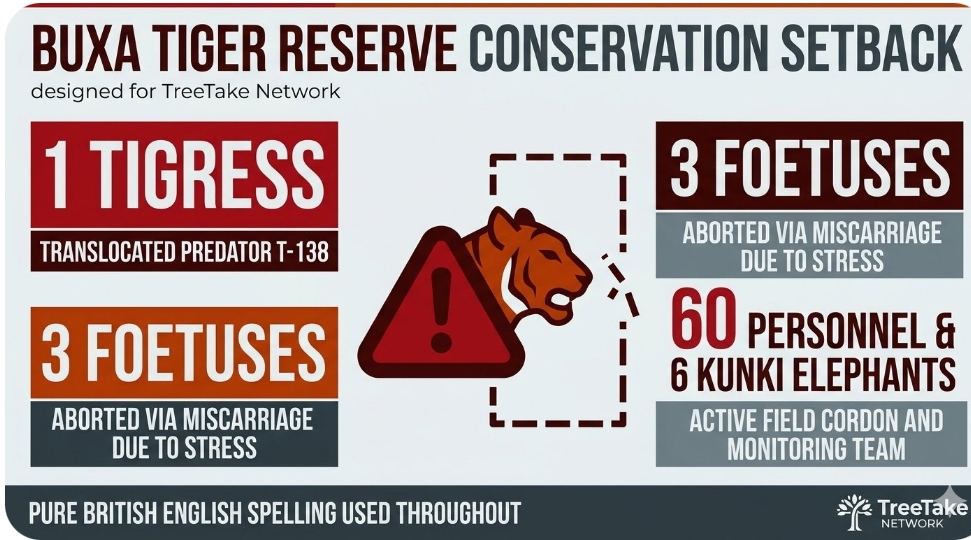
The high-profile tiger reintroduction programme at the Buxa Tiger Reserve has encountered a severe and highly controversial ecological setback following the sudden successful escape of a recently translocated three-year-old Royal Bengal tigress. Identified by wildlife databases as T-138 and popularly referred to by field teams as Dooars Rani, the apex predator managed to break out of her specialised acclimatisation enclosure by burrowing deep into the earth beneath the perimeter fencing structure. This second escape occurred merely days after a massive interstate operation successfully tracked, tranquilised, and returned the animal from neighbouring Assam. The situation has escalated dramatically following a grim medical discovery by veterinary teams, who confirmed that the repeatedly tranquilised tigress suffered a complete miscarriage, aborting three foetuses estimated to be roughly two months into development.
Enclosure Vulnerabilities and the Escape Blueprint
Field tracking data confirmed that the tigress’s disappearance from her 2.2-hectare acclimatisation holding pen went unnoticed until approximately 2:00 PM. Despite the installation of what local authorities deemed a secure perimeter fence, the animal utilised her natural instincts to dig a deep escape burrow directly beneath the structural baseline. Wildlife officers from neighbouring jurisdictions have raised serious technical concerns regarding the overall quality of the holding facility, noting that vital structural reinforcement bars were driven directly into loose soil matrices instead of being properly anchored into reinforced concrete block foundations. The oversight left the subterranean boundaries of the containment zone highly vulnerable to large carnivore manipulation, facilitating an effortless breakout.
The Tragic Miscarriage and Veterinary Controversy
The critical flashpoint under review by the National Tiger Conservation Authority involves the medical status of the tigress during her initial capture and subsequent translocations. A detailed medical examination conducted on September 29 by a six-member panel of senior veterinary doctors from the Wildlife Institute of India and local state bodies had originally declared the animal fit for her initial aerial transport from Bihar’s Valmiki Tiger Reserve. However, following her subsequent escapes and three distinct sedation cycles using heavy tranquilising agents, the tigress’s body rejected three foetuses. Experts emphasise that early-stage pregnancy in large felids remains nearly impossible to detect through visual observation alone, requiring specialised hormonal faecal analysis or advanced ultrasound imaging, which was apparently omitted during the initial pre-transport screening.
Interstate Tracking Dynamics and Field Deployment
Despite the physical breakout, the animal's satellite radio collar continues to actively transmit signals through the dense canopy cover of the Alipurduar landscape. Ground teams indicate that the tigress is currently moving within a seven-kilometre radius of the primary enclosure site, charting a clear course that mirrors her previous 100-kilometre migration route toward the Sankosh River and Assam's Raimona National Park. To prevent another complex interstate border crossing, the West Bengal Forest Department has deployed an emergency force consisting of 60 armed frontline personnel and six trained kunki elephants. These specialised domestic elephants are being utilised to form a moving cordon, attempting to carefully guide the big cat away from local community villages and keep her strictly contained within the interior boundaries of the reserve.
Expert Operational Perspectives
"The loss of three foetuses transforms a flagship conservation success story into a deeply concerning study of planning failure," stated a prominent wildlife biologist specialising in large mammal translocations. "Subjecting an early-term pregnant tigress to multiple tranquilisation procedures, helicopter transport, and subsequent recapture operations creates an unmanageable level of physiological stress. Moving forward, the complete absence of concrete foundations beneath a quarantine pen built for a highly adaptive wild predator demonstrates an unacceptable oversight in field engineering that has actively compromised the genetic future of the Buxa reintroduction programme."
Evaluating the veterinary response, an independent veterinary expert noted: "The chemical formulation used for repeated sedations carries a high embryotoxic risk when administered consecutively over a short duration. The field protocols followed during emergency recaptures must be completely overhauled to include mandatory non-invasive pregnancy screening before any major chemical immobilisation is sanctioned. We cannot afford to prioritize rapid containment over basic maternal biology if our ultimate goal is the expansion of critically endangered wild gene pools."
Official Declaration by State Leadership
Addressing the growing conservation controversy and the subsequent multi-agency investigation, West Bengal State Forest Minister Manoj Kumar Oraon stated: "The tigress is doing well and her movements are being actively monitored every hour. While such wide-ranging exploratory movements are entirely natural for a wild animal adapting to a completely new landscape, we have initiated a comprehensive, high-level probe to investigate the structural security lapses of the enclosure. We are working in absolute coordination with central authorities to stabilise this animal, and once she fully settles down into her territory, we will proceed with our original long-term plan to introduce a healthy male tiger to ensure a viable breeding population."
Adding further details regarding field operations, a senior field director of the Buxa Tiger Reserve remarked: "Our standard operating procedures for large carnivore tracking have been completely activated. Tracking teams are utilising real-time satellite telemetry arrays alongside manual pugmark identification sweeps along the local riverbeds. The local panchayat bodies have been adequately briefed to prevent panic, and we have ordered an immediate suspension of all domestic cattle grazing permissions within the buffer zones until the tigress is successfully guided back into the secured core forests."
Editor's Note
The structural breakdown and tragic reproductive loss at the Buxa Tiger Reserve expose the fragile limits of forced wildlife translocation frameworks when executed without exhaustive diagnostic and engineering protocols. Attempting to accelerate big-cat reintroduction targets to meet administrative timelines without deploying subterranean concrete barriers or non-invasive pregnancy testing sets a dangerous precedent for future conservation initiatives across India. To restore the scientific credibility of the reintroduction project, the National Tiger Conservation Authority must mandate a complete suspension of future translocations until an independent structural audit of all acclimatisation facilities is completed. Frontline management must transition away from reactive, elephant-led containment lines and focus on creating a secure, completely undisturbed core wilderness zone that allows translocated predators to establish natural territories without experiencing repetitive human intervention.



Leave a comment