

Talking Point
TreeTake Network
In the quiet diplomatic corridors of New Delhi’s Lodhi Estate, a historic shift in global wildlife governance is taking shape. Even as the international conservation community awaits fresh dates for the inaugural Global Big Cat Summit, India’s flagship ecological diplomacy initiative—the International Big Cat Alliance (IBCA)—has moved decisively from diplomatic vision to permanent institutional reality.
Originally slated to convene in New Delhi on 1 and 2 June 2026 at Bharat Mandapam and Hotel Taj Palace, the first-ever IBCA Summit was postponed by the Government of India following high-level consultations with the African Union. Yet, far from slowing momentum, the months since have seen the Alliance inaugurate its permanent global headquarters at 55 Lodhi Estate, expand its treaty membership across Asia, Africa, and the Americas, and establish a lasting global architecture safeguarding apex predators.
Why the inaugural summit was postponed
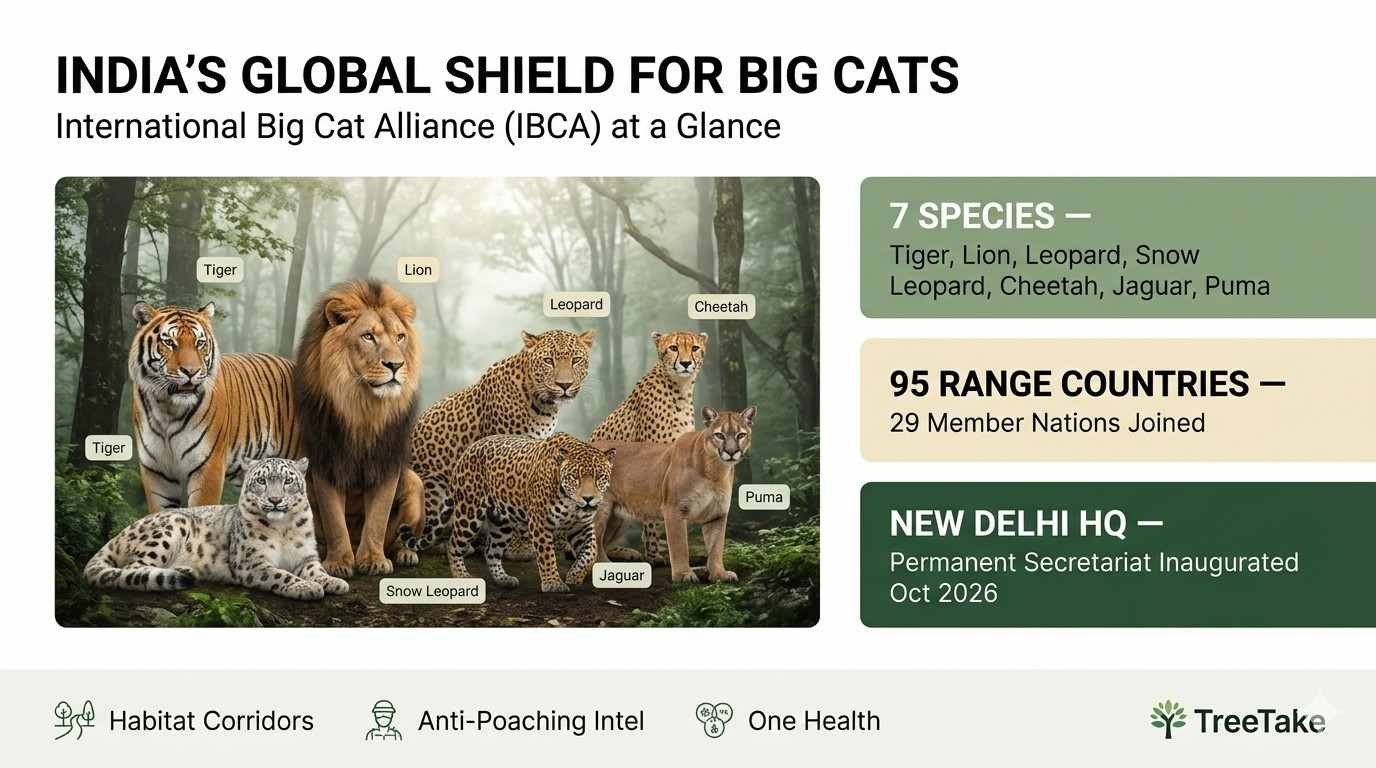
The strategic logic behind the postponement lies in the geography of the world’s big cats. Dedicated to conserving seven iconic species—the tiger, lion, leopard, snow leopard, cheetah, jaguar, and puma—the IBCA spans 95 range countries, a substantial proportion of which lie across Africa. New Delhi had deliberately planned the inaugural summit alongside the Fourth India–Africa Forum Summit (IAFS IV) to maximise ministerial participation from African range nations. Following consultations with the African Union, a joint decision was taken to defer both gatherings to a later date, while public health concerns surrounding an Ebola outbreak in parts of Africa further underscored the necessity of rescheduling major multilateral meetings involving African delegations.
Institutional growth and treaty milestones
The summit’s deferral has not stalled the Alliance’s operational rise. Envisioned by Prime Minister Narendra Modi and launched on 9 April 2023 in Mysuru to mark fifty years of Project Tiger, the coalition secured Union Cabinet approval in March 2024 with an initial commitment of ₹150 crore (approximately $18 million) over five years. Its Framework Agreement entered into force as a treaty-based intergovernmental body in January 2025.
On 12 October 2026, Union Minister for Environment, Forest and Climate Change Bhupender Yadav inaugurated the Alliance’s permanent secretariat at 55 Lodhi Estate alongside Director General Dr S.P. Yadav and global representatives from the UN, UNDP, World Bank, UNEP, IUCN, WWF, and FAO. Twenty-nine countries have formally joined as members, with five holding observer status.
Speaking on the Alliance’s collaborative mission, Union Minister Bhupender Yadav stated, “We must collaborate, not compete. We must find strength not in isolation, but in solidarity.” Highlighting how domestic conservation informs global action, he added, “India’s success in wildlife conservation demonstrates that science-based conservation, community participation, and sustained monitoring can deliver measurable results.”
Conservation mandate and the Delhi declaration
Operating as a keystone conservation framework, the IBCA aims to centralise anti-poaching intelligence, standardise wildlife health tracking under the ‘One Health’ model, and curb illegal wildlife trade. India’s leadership is anchored in harbouring over 70 per cent of the world’s wild tigers, the sole Asiatic lion population in Gir, thriving leopards, and reintroduced cheetahs in Kuno National Park.
As Yadav noted regarding the ecological imperative, “In securing the big cats’ future, we are securing our future too. Apex predators and ‘umbrella species’ maintain ecological balance, protecting vast landscapes, biodiversity, and water resources.” Once the rescheduled summit convenes, the draft Delhi Declaration will formalise commitments on transboundary habitat connectivity, green livelihoods, and coordinated disease monitoring, cementing a permanent global shield for Earth’s apex predators.



Leave a comment