

TreeTake Network
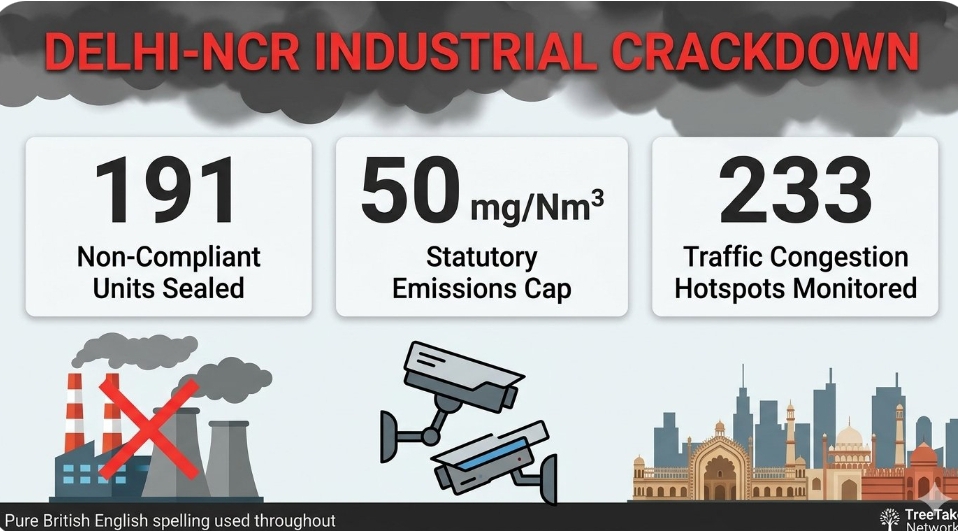
The Ministry of Environment, Forest and Climate Change has initiated an unprecedented winter regulatory crackdown across the National Capital Region to counter rapidly deteriorating air quality indices. Chairing an emergency high-level ministerial review session, Union Environment Minister Bhupender Yadav issued a direct mandate to the Central Pollution Control Board to immediately shut down and seal 191 heavily polluting industrial facilities operating across Delhi, Haryana, Uttar Pradesh, and Rajasthan. The aggressive intervention targets manufacturing installations that have flagrantly disregarded multiple statutory directives to acquire or install specialised Air Pollution Control Devices. The regional enforcement sweep marks a sharp transition towards strict criminal prosecution and absolute field-level accountability as northern India enters its most volatile seasonal pollution window.
Industrial Disobedience and Central Enforcement Metrics
The enforcement data presented by the Central Pollution Control Board revealed that whilst 2298 of the 2345 targeted heavy industries across the region have successfully integrated their operations with Online Continuous Emission Monitoring Systems, a stubborn pocket of 47 units had already faced forced closure. The remaining 191 non-conforming industrial facilities, however, had failed to even place formal procurement orders for mandatory emissions reduction technology despite extended compliance timelines. Yadav ordered that any industrial facility failing to strictly adhere to the statutory particulate matter emission cap of 50 milligrams per normal cubic metre must face instantaneous suspension of operations, immediate disconnection of electricity grids, and permanent physical sealing.
The Pan-India Pollution Spike and the Crisis in Uttar Pradesh
The current environmental crisis extends far beyond the borders of the national capital region, manifesting as a severe pan-India spike in pollution levels that has blanketed the major urban centres of the Indo-Gangetic plains. The state of Uttar Pradesh has emerged as a primary zone of concern, with toxic smog layers settling heavily over its major industrial and municipal belts. The capital city of Lucknow in particular has registered hazardous ambient air quality readings, with particulate matter levels surging well past permissible safety limits. Local health authorities in Lucknow have reported an acute rise in respiratory emergency admissions, directly linking the spike to a combination of stagnant meteorological conditions, festive emissions, unpaved road dust, and uncontrolled local garbage burning. The sharp decline in visibility across the city has disrupted regional transport and forced provincial administrators to consider emergency structural curbs on construction activities.
Zonal Prohibitions on Construction and Mixed-Use Residential Areas
To tackle localised fugitive dust emissions, the Union Ministry has simultaneously formalised strict zonal prohibitions targeting mixed-use municipal pockets. Under the new executive directive, an absolute ban has been enforced against all construction and demolition activities taking place within high-density residential areas that house commercial godowns, storage facilities, or illegal manufacturing operations. This emergency clause strips away previous local permissions, completely freezing civil masonry work, structural excavations, and transit material offloading in mixed residential-commercial corridors. The measure aims to prevent large-scale material trucks from kicking up heavy ambient dust in concentrated living quarters where micro-climate stagnation traps toxic fine particles close to the ground.
Administrative Reprimands and Bureaucratic Accountability
In a significant departure from standard diplomatic bureaucratic protocols, the Union Minister formally requested the Commission for Air Quality Management to issue immediate, legally binding notices to non-performing administrative officers who have failed to curb open-air violations within their respective jurisdictions. To ensure continuous ground-level monitoring, the central directive mandates that state governments nominate dedicated secretary-level officials specifically tasked with overseeing enforcement across seven cities in Haryana, four in Uttar Pradesh, and four in Rajasthan. These senior personnel are legally required to conduct rigorous field inspections and submit weekly performance compliance logs directly to the commission to eradicate local enforcement gaps.
Transport Restructuring and Technological Surveillance
The central anti-pollution layout also introduces a hard deadline of December 31, 2026, for state transport departments to execute an exhaustive traffic and logistical overhaul across the national capital to eliminate persistent vehicular bottlenecks. State administrations have been ordered to install extensive networks of Automatic Number Plate Recognition cameras across all primary transport corridors. Under the current executive order, if transport departments fail to operationalise these automated tracking networks by November 30, 2026, the commission will initiate immediate criminal prosecution against the delinquent transport officials. Additionally, regional authorities must deploy immediate containment mechanisms across 233 pre-identified critical traffic congestion hotspots.
Expert Operational Perspectives
"Enforcing a rigid 50 milligram industrial emissions threshold is a critical structural necessity, but its success relies entirely on preventing the leakage of production to unregistered suburban units," noted a senior environmental policy specialist monitoring regional winter action frameworks. "The decision to hold field officers directly accountable for monitoring lapses represents the first genuine attempt to dismantle systemic administrative inertia. If the state boards fail to assist micro-enterprises in accessing clean-fuel transition funds simultaneously, we risk closing essential manufacturing chains without resolving the regional airshed crisis, which is now impacting areas as far downwind as Lucknow."
Official Declaration by Ministerial Leadership
Articulating the government's stringent regulatory stance, Union Environment Minister Bhupender Yadav stated: "Air pollution does not recognise artificial state boundaries, and our regional agencies must completely move beyond mere planning to ensure rigorous, time-bound, and coordinated ground-level enforcement. Allowing unchecked construction and heavy commercial haulage inside residential setups whilst children breathe toxic fumes is an administrative failure we will no longer tolerate. Coordinated efforts, absolute field-level accountability, and visible punitive action on the ground are the only methods available to effectively address this severe environmental challenge. We will not hesitate to enforce permanent closures or pursue criminal prosecution against any official or industrial operation failing to protect public health."
Editor's Note
The emergency sealing of 191 industrial facilities serves as a necessary but reactive containment measure for an environmental crisis that requires deep structural adjustments rather than seasonal panic mechanisms. While targeting large-scale industrial non-compliance yields immediate reductions in localised particulate matter, the broader national capital airshed remains heavily impacted by secondary cross-boundary pollutants that cannot be sealed away by executive fiat. Moving forward, the Ministry of Environment must shift its primary focus from late-stage manufacturing penalties towards the rapid, subsidised modernisation of industrial fuel infrastructure for small and medium enterprises. True air quality stabilisation can only be achieved when regional actions move past short-term vehicular restrictions and focus on creating a permanent, round-the-year transition to piped natural gas across all bordering states.



Leave a comment