

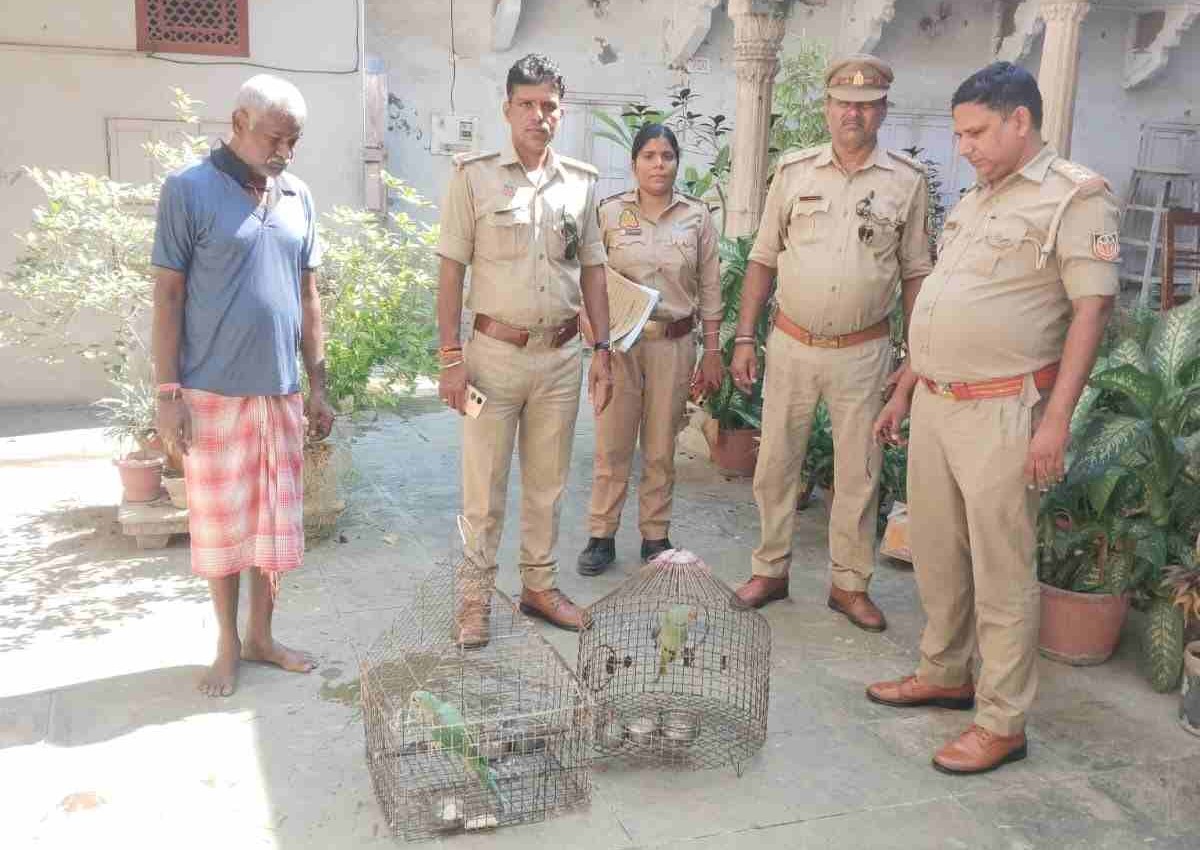
After receiving a concerned citizen’s report that Alexandrine parakeets were being confined in cages at a residence in Varanasi, People for the Ethical Treatment of Animals India (PETA India) immediately alerted the Varanasi Forest Division of the Uttar Pradesh Forest Department. Acting on the complaint, forest officials raided the property and discovered three parakeets, all of whom were seized and rescued. Following their rescue, the birds underwent veterinary health assessments and, once declared fit for release, were returned to their natural habitat.
Alexandrine parakeets are protected under Schedule II of the Wildlife Protection Act (WPA), 1972. Illegally capturing or possessing these birds can be punishable by a fine of up to Rs 1 lakh, a jail term of up to 3 years, or both. The Forest Division registered a Preliminary Offence Report (POR) against two accused persons under Sections 2, 9, 39, 48, 49B(4), 50, 51, and 57 of the WPA, 1972, for illegally keeping the parakeets.
“PETA India is grateful to the Varanasi Forest Division, particularly Smt Nidhi Chauhan, IFS, Divisional Forest Officer (DFO), Varanasi, and Shri Rajkumar Gautam, Range Forest Officer, for acting swiftly to rescue the parakeets and making clear that keeping caged wildlife is a crime,” says PETA India’s Cruelty Response Assistant, Vamsi Krishna. “Wild birds are an integral part of nature and should be admired in their natural forest homes, never kept as pets.”
In the bird trade, countless birds are taken from their families and denied everything natural and important to them so that they can be sold as pets or used as bogus fortune-tellers. Fledglings are often snatched from their nests, and others panic as they’re caught in traps or nets that can seriously injure or kill them as they struggle to break free. The mortality rate of captured birds is thought to reach as high as 80%, especially as many of them die in transit from broken wings and legs, thirst, or sheer panic. Those who survive face a bleak life in captivity, suffering from malnutrition, loneliness, depression, and stress.
PETA India – whose motto reads, in part, that “animals are not ours to use for entertainment or abuse in any other way” – points out that the WPA, 1972, prohibits the capture, possession, and trade of protected indigenous birds and that non-compliance can result in imprisonment, a fine, or both. In addition, confining birds in cages that deny them a reasonable opportunity for movement violates the Prevention of Cruelty to Animals Act, 1960, which prohibits such confinement under Section 11(1)(e) – a particular concern for birds, whose natural movement includes flight.


.jpg?resize=120%2C90&ssl=1)



Leave a comment