

TreeTake Network
The United Nations Climate Change Executive Secretary, Simon Stiell, has delivered an uncompromising directive to global ministers assembled at the Antalya Expo Centre in Türkiye, warning that the current international financial architecture is systematically trapping climate-vulnerable countries in an unsustainable spiral of mounting debt and compounding environmental disasters. Speaking at the Seventh Biennial High-Level Ministerial Dialogue on Climate Finance on 13 November 2026, Stiell asserted that incremental adjustments to existing funding channels have completely failed to match the actual scale of global economic adaptation costs and that a massive collective endeavour is required to restructure global finance.
The high-level negotiations, unfolding under the joint co-presidency of Turkish Environment Minister Murat Kurum and Australian Climate Change Minister Chris Bowen, brought core systemic vulnerabilities to the forefront of the summit. Official data scrutinised during the ministerial tracks confirmed that developing nations are spending an increasing proportion of their gross domestic product on high-interest debt servicing following extreme meteorological events, fundamentally impeding their capacity to execute national decarbonisation strategies or favour long-term environmental protection.
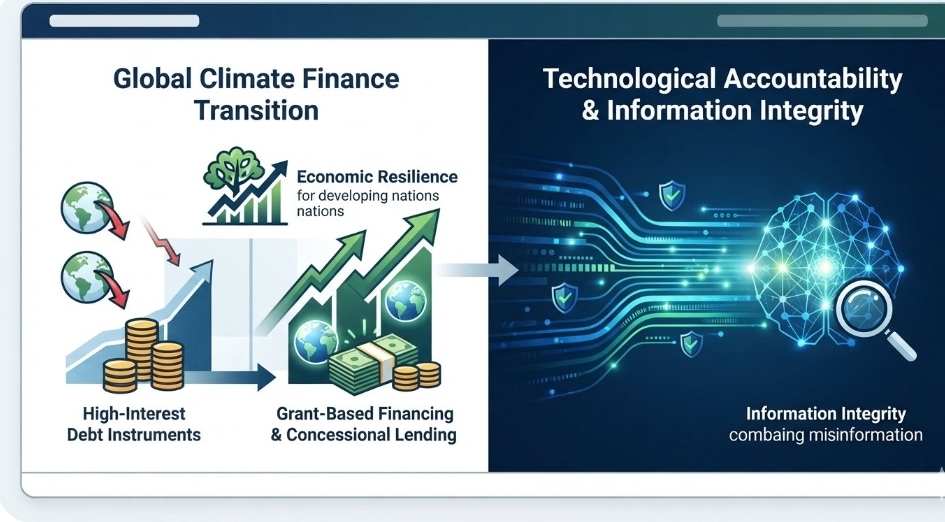
"A new chapter in climate finance is needed to help developing countries break free from a cycle of debt and climate disasters," Stiell stated directly to the gathered ministerial delegations. "This dialogue must feed directly into concrete operational frameworks for the upcoming year. We cannot allow the economic burden of ecological survival to be borne by high-interest debt instruments that penalise the very communities most affected by global temperature overshoot."
Technological guardrails established for artificial intelligence and climate data integrity
Parallel to the structural finance tracks, the Global Initiative for Information Integrity, supported by the United Nations and UNESCO, officially launched its foundational operational framework at the Antalya venue, titled "Priorities for Action on AI and Climate Information Integrity". The targeted regulatory framework establishes strict international protocols to monitor the physical energy and water footprints of rapidly expanding artificial intelligence infrastructure, while creating explicit mechanisms to combat algorithmic climate misinformation campaigns that emphasise climate change denial.
The framework mandates that multi-national technology corporations implement transparent tracking metrics for localised power grids feeding massive data centres. Highlighting the data, technical experts on the panel noted that the unrestricted expansion of generative technology models has caused a significant surge in localised power grid consumption, directly conflicting with the carbon reduction pathways of host countries that are internalising clean energy targets.
"Climate action relies entirely on data integrity and verified scientific consensus," observed United Nations Under-Secretary-General for Global Communications Melissa Fleming during the framework unveiling. "This multilateral mechanism provides the international community with explicit tools to hold digital platforms accountable, ensuring that artificial intelligence does not serve as an unmonitored source of engineered climate scepticism and unchecked, resource-intensive infrastructure demands."
Insurance sector activates framework to mitigate escalating uninsured climate losses
The macroeconomic focus of the summit was expanded by the United Nations Environment Programme’s Principles for Sustainable Insurance initiative, which convened a dedicated meeting with international insurance executives to implement an immediate global action plan to penalise carbon-heavy practices and favour vulnerable communities. The collaborative strategy directly addresses the systemic risk of soaring uninsured climate losses, which currently threaten the fiscal stability of sovereign regional economies.
The systemic action plan establishes baseline criteria to integrate climate risk models directly into commercial underwriting standards. Insurance experts at the Antalya session emphasised that without a co-ordinated public-private expansion of risk-transfer pathways, low-income regions will remain entirely exposed to catastrophic fiscal shocks after severe weather events, preventing them from utilising their own domestic revenue for conservation.
"The insurance sector is a critical element of global economic resilience," remarked Inger Andersen, Executive Director of the United Nations Environment Programme, following the technical briefing. "By aligning underwriting practices with explicit sustainability targets and expanding risk-pooling models for highly vulnerable zones, we can actively mitigate the intense macroeconomic shocks that threaten to destabilise regional commercial markets."
European Commission formalises ecological preservation pact for the Mediterranean
Solidifying the regional adaptation track of the summit, the European Commission formally presented a comprehensive series of environmental interventions under the newly ratified "Pact for the Mediterranean". The framework structures cross-border ecological preservation efforts between Southern European states and North African nations, focusing specifically on marine biodiversity protection and shared climate resilience models centred around mutual ecological aid.
The framework prioritises joint maritime monitoring, coastal ecosystem restoration, and the creation of unified ecological corridors to protect fragile marine species from rapid sea temperature spikes. The initiative establishes a dedicated financial allocation structure to support cross-border adaptation projects in vulnerable coastal zones, ensuring that neighbouring states can co-ordinate their conservation steps effectively.
"The Mediterranean is an immediate climate hotspot experiencing rapid ecological transformation," stated European Commissioner for Climate Action Wopke Hoekstra during the ministerial presentation. "Through the Pact for the Mediterranean, we are establishing a binding cross-border framework that pools scientific expertise and structural resources to protect critical biodiversity and build a resilient regional ecological model."
Editor's Note
The synchronised structural updates on 13 November 2026 at COP31 mark a necessary transition from abstract emission targets to the concrete restructuring of global economic, digital, and regional systems. By binding macro-finance reform with technological accountability, institutional insurance frameworks, and explicit cross-border ecological pacts, the international community is finally acknowledging that climate adaptation cannot succeed in isolation from economic realities. The true measure of these frameworks will depend entirely on the willingness of developed states to institutionalise these mechanisms into binding domestic legislative policies before the Antalya summit concludes.


.jpg?resize=120%2C90&ssl=1)



Leave a comment