

TreeTake Network
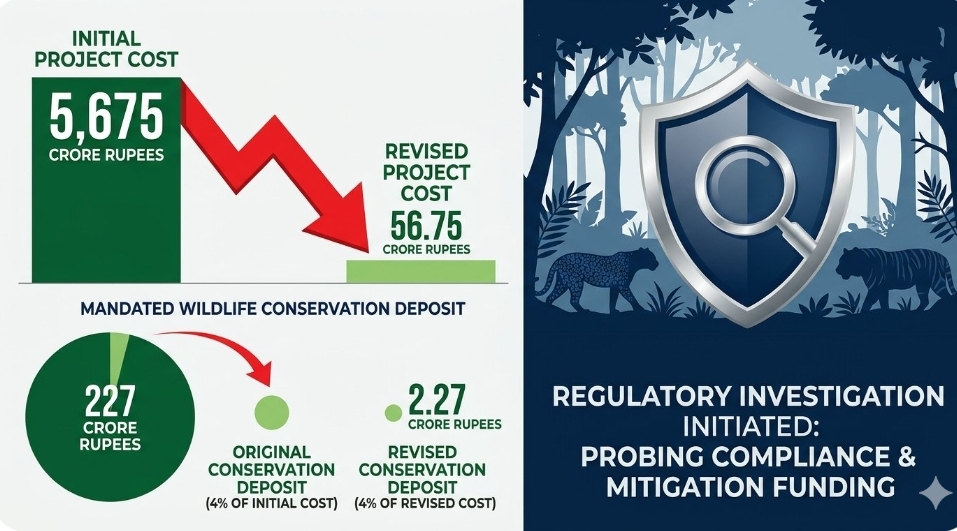
The Central Government has initiated an immediate, high-level regulatory investigation into Adani Green Energy Limited following a dramatic 99% reduction in the estimated project cost for its 1,500 MW Tarali pumped storage hydro project in the Satara district of Maharashtra. The sudden fiscal recalculation, which slashed the projected cost from an initial ₹5,675 crore down to just ₹56.75 crore, has effectively downsized the company's legally mandated wildlife conservation deposit from ₹227 crore to a mere ₹2.27 crore. This unprecedented drop has triggered immediate alerts within the Ministry of Environment, Forest and Climate Change regarding potential compliance evasion in a highly sensitive ecological corridor.
The 1,500 MW hydro facility is situated within the Western Ghats, a globally recognised biodiversity hotspot that serves as a critical habitat for several endangered species, including the Bengal tiger and the Indian leopard. Under existing environmental statutes, infrastructure developers operating within designated eco-sensitive zones are legally required to deposit exactly 4% of their total project cost into a dedicated state-managed wildlife conservation fund to mitigate structural disruptions.
"The ministry has taken note of this extreme mathematical deviation and has ordered a complete operational audit of the project documentation," stated a senior official within the Ministry of Environment, Forest and Climate Change, speaking on condition of anonymity due to the ongoing nature of the inquiry. "A 99% drop in estimated infrastructure costs for a massive 1,500 MW project raises serious structural questions. We must ensure that corporate accounting methodologies do not circumvent statutory obligations designed to protect our most fragile forest ecosystems."
Severe regional ecological alarms raised over financial downsizing
The project site sits directly adjacent to the Koyna Wildlife Sanctuary and the Sahyadri Tiger Reserve, areas where intensive infrastructure development threatens to permanently fragment critical wildlife movement corridors. Environmental scientists and regional conservationists have expressed intense concern over the development, pointing out that reducing local conservation funding by more than ₹224 crore will leave regional forest departments entirely under-equipped to manage human-wildlife conflict and habitat restoration.
Legal experts specialising in environmental jurisprudence have noted that calculating the wildlife deposit based on an artificially deflated initial asset valuation could set a dangerous precedent for large-scale infrastructure projects across India. The regulatory probe will focus-orient its efforts on examining whether the company segmented its cost reporting or internalised specific structural assets to deliberately minimise its statutory financial obligations to the state.
"This is a blatant attempt to bypass the spirit of environmental protection laws through creative accounting," asserted Stalin Dayanand, Director of the Mumbai-based environmental non-profit organisation Vanashakti. "You cannot physically construct a 1,500 MW pumped storage project for ₹56.75 crore; that figure would barely cover the cost of basic turbine components. The government must treat this as a severe violation of the environmental clearance framework and halt all preliminary field site works until a transparent, independent financial assessment is concluded."
Corporate accountability and systemic oversight under scrutiny
The investigation comes at a time when the central government is facing heightened international scrutiny over its enforcement of corporate environmental, social, and governance standards. The regional forest department of Maharashtra has been directed to submit a comprehensive field status report detailing the exact land requirements and the projected ecological footprint of the Tarali facility.
Officials within the state forest department confirmed that their conservation planning for the Satara region had heavily relied on the originally anticipated ₹227 crore fund to establish advanced anti-poaching camps and construct dedicated wildlife underpasses. The sudden structural reduction in capital has halted several long-term biodiversity programmes designed to stabilise local leopard populations.
"The conservation frameworks for the Sahyadri corridor cannot be compromised for commercial convenience," remarked Praveen Pardeshi, former global conservation strategist and current president of the Wildlife Conservation Trust. "When a developer scales down their ecological commitment so drastically, it directly jeopardises decades of state-funded habitat management efforts. Corporate entities must realise that addressing wildlife mitigation costs is an essential component of infrastructure deployment, not a variable accounting ledger that can be modernised to favour quarterly profit margins."
Editor's Note
The regulatory probe into the Tarali project highlights a critical systemic flaw in how corporate environmental liabilities are calculated and monitored in India. Allowing infrastructure developers to self-report project valuations for wildlife mitigation deposits creates an inherent conflict of interest that can easily be utilised to minimise environmental overheads. For India to maintain its international biodiversity commitments, the Ministry of Environment must institutionalise a rigid, independent financial verification mechanism that prevents corporate entities from altering their fiscal projections to bypass conservation laws.


.jpg?resize=120%2C90&ssl=1)



Leave a comment