

TreeTake Network
Global climate diplomacy entered a critical operational phase on November 12, 2026, as world leaders, institutional chiefs, and polar scientists convened at the 31st United Nations Climate Change Conference (COP31) in Antalya, Türkiye, to accelerate net-zero accountability, confront climate-driven security threats, and warn against overshooting the 1.5 degrees Celsius global warming limit. Across high-level plenaries and technical briefings, delegates emphasised that voluntary climate pledges must immediately transition into verifiable implementation to safeguard vulnerable ecosystems and human populations from irreversible planetary damage.
Operational Rollout of the Net-Zero Recognition Framework
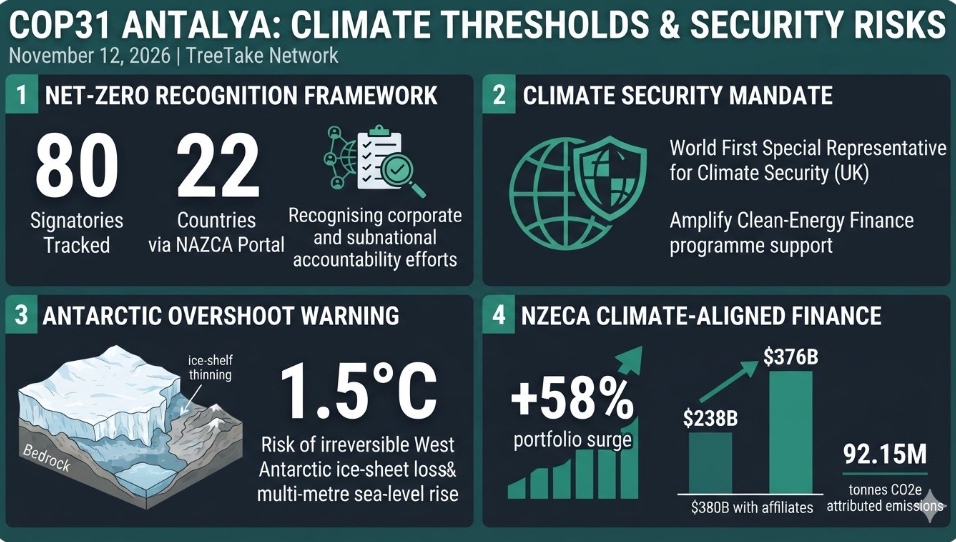
UN Climate Change Executive Secretary Simon Stiell formally launched the active implementation phase of the Net-Zero Recognition Framework during the Caring for Climate high-level event in Antalya on November 12, 2026. Supported by an upgraded Global Climate Action Portal (NAZCA) designed to standardise corporate and subnational accountability, the framework currently tracks nearly 80 signatories across 22 countries to ensure net-zero commitments translate into measurable emissions reductions rather than unverified pledges.
"The world is moving from promises to implementation, and credibility is the currency that will determine whether our collective climate architecture succeeds," said Simon Stiell, Executive Secretary of the United Nations Framework Convention on Climate Change. "Through the operationalisation of the Net-Zero Recognition Framework, we are establishing clear, transparent benchmarks so that every business, city, and financial institution can be held to rigorous, science-aligned standards."
"Transparency is no longer optional in the decisive decade for climate action," added Dr Mahmoud Mohieldin, UN Climate Change High-Level Champion, during the Antalya transparency briefing. "By harmonising verification protocols across jurisdictions, we empower regulators and investors to distinguish genuine decarbonisation pathways from superficial accounting."
United Kingdom Establishes World First Climate Security Envoy Role
Addressing heads of state and government at the COP31 leaders' summit on November 12, 2026, British Prime Minister Andy Burnham highlighted the escalating geopolitical and humanitarian toll of extreme weather, referencing the devastating wildfires witnessed globally during 2026. During his address, Prime Minister Burnham announced the appointment of former Joint Intelligence Committee chair Dame Madeline Alessandri as the United Kingdom's first Special Representative for Climate Security, alongside expanded British backing for the Amplify clean-energy finance programme.
"Climate change is no longer a distant environmental forecast; it is an immediate threat to national resilience, food supply chains, and international stability," stated British Prime Minister Andy Burnham in his COP31 plenary address. "By appointing Dame Madeline Alessandri as the world's first Special Representative for Climate Security, the United Kingdom is placing environmental risk at the very centre of our foreign policy and defence planning while mobilising clean-energy investment through the Amplify programme."
"Environmental degradation, resource scarcity, and extreme weather events act as powerful threat multipliers across every continent," noted Dame Madeline Alessandri following the announcement of her appointment. "My mandate will focus on integrating climate intelligence into international security frameworks so nations can anticipate ecological shocks before they escalate into humanitarian crises."
Antarctic Researchers Warn Against Temporary Temperature Overshoot
Complementing the diplomatic announcements in Antalya, polar specialists from the Australian Antarctic Division (AAD), the Australian Antarctic Program Partnership (AAPP), and the Australian Centre for Excellence in Antarctic Science (ACEAS) presented stark scientific evidence at COP31 on November 12, 2026, regarding the dangers of exceeding the 1.5 degrees Celsius temperature threshold. Their peer-reviewed assessments demonstrate that even a temporary overshoot above 1.5 degrees Celsius risks triggering self-sustaining ice-sheet collapse in West Antarctica, locking in multi-metre sea-level rise over future centuries and severely disrupting Southern Ocean marine biodiversity.
"There is a dangerous misconception that the Earth system can temporarily overshoot 1.5 degrees Celsius and simply bounce back once atmospheric carbon concentrations are reduced," warned Prof Nathan Bindoff, physical oceanographer and programme leader at the Australian Antarctic Program Partnership. "Our observations across the Southern Ocean and Antarctic ice shelves confirm that crossing critical thermal thresholds sets off irreversible physical processes that will reshape global coastlines for generations."
"The stability of the Antarctic ice sheet and the vitality of polar marine ecosystems depend directly on decisions taken at COP31 this week," emphasised Dr Tas van Ommen, chief scientist at the Australian Antarctic Division. "Every tenth of a degree of warming avoided today preserves vital sea-ice habitats and prevents cascading disruptions to global ocean circulation."
Export Credit Agencies Report 58 Per Cent Surge in Climate-Aligned Portfolios
In parallel with the Antalya negotiations, the Net-Zero Export Credit Agencies Alliance (NZECA) published its 2026 Progress Report on November 12, 2026, documenting substantial shifts in sovereign-backed trade finance toward low-carbon infrastructure. The assessment revealed that net-zero committed portfolios among alliance members expanded by 58 per cent over the reporting period, rising from 238 billion US dollars to 376 billion US dollars—and reaching 380 billion US dollars when including affiliate institutions—while collective attributed portfolio emissions declined to 92.15 million tonnes of carbon dioxide equivalent.
"Public export finance institutions possess the financial leverage to de-risk clean-technology deployment in emerging markets at unprecedented scale," said Marie-Anne Birckenstaedt, Co-Chair of the Net-Zero Export Credit Agencies Alliance. "Expanding our net-zero committed portfolios to 376 billion US dollars demonstrates that disciplined climate governance and international trade growth reinforce one another."
"Reducing attributed portfolio emissions to 92.15 million tonnes of carbon dioxide equivalent is an encouraging milestone, yet the pace of capital reallocation must accelerate further," observed Dr Patrick Schroeder, senior research fellow in international climate finance. "Aligning sovereign credit guarantees with strict Paris Agreement benchmarks remains essential to phasing out high-carbon infrastructure lock-in."
Editor's Note
The convergence of diplomatic, security, financial, and polar scientific interventions on November 12, 2026, underscores that COP31 in Antalya represents a decisive inflexion point between rhetorical ambition and enforceable governance. Integrating intelligence-led climate security planning with standardised net-zero verification and sovereign trade finance reform offers a coherent blueprint for systemic resilience. Moving forward, national governments must translate these institutional frameworks into binding domestic legislation and rapid fossil-fuel phase-out schedules before irreversible Antarctic and oceanic tipping points are breached.


.jpg?resize=780%2C450&ssl=1)


.jpg?resize=120%2C90&ssl=1)



Leave a comment