

TreeTake Network
A comprehensive ecological status update compiled by conservationists on October 21, 2026, has highlighted the intense evolutionary survival strategies and escalating structural threats faced by the blackbuck (Antilope cervicapra), widely recognised as the ultimate endurance runner of the open plains. As the sole living member of its genus, this specialised herbivore relies entirely on expansive, unobstructed grassland habitats where its primary defence is sheer physical stamina. Historically capable of sustaining immense speeds to outrun native predators like the Asiatic cheetah, the species now faces a vastly different landscape dominated by anthropogenic fragmentation and systemic habitat misclassification.
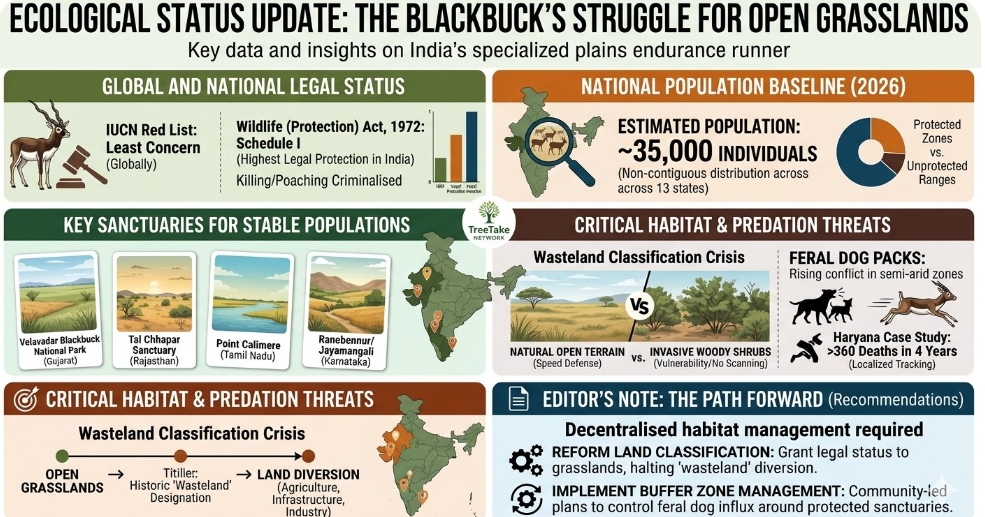
The current baseline assessments indicate that the countrywide blackbuck population stands at approximately 35,000 individuals, dispersed non-contiguously across 13 states. Stable populations are tightly confined within a few key protected sanctuaries, including the Velavadar Blackbuck National Park in Gujarat, the Tal Chhapar Sanctuary in Rajasthan, Point Calimere in Tamil Nadu, and the specialised Ranebennur and Jayamangali reserves in Karnataka. The species receives the highest level of statutory safeguarding, listed under Schedule I of the Wildlife (Protection) Act, 1972, which explicitly criminalises hunting, poaching, and commercial transit.
The wasteland classification crisis
Ecologists point out that the most severe, ongoing threat to the long-term survival of these animals is the historical and institutional practice of classifying open grasslands as ecological "wastelands." This designation has frequently facilitated the rapid diversion of vast tracts of native savannahs for massive agricultural expansions, infrastructure corridors, and industrial developments. Furthermore, these open ranges are increasingly being overrun by aggressive, invasive woody plant species that fundamentally alter the open terrain the blackbucks depend upon to scan for dangers and outrun threats.
"Blackbucks are key indicators that grassland species cannot do well in any other habitats," emphasised Mihir Godbole, founder of The Grasslands Trust, during a field conservation review. Biological data tracks that female blackbucks form tight, light-brown maternal herds occasionally coordinated by a single mature male, whereas younger males cluster in separate bachelor groups until they mature enough to claim territory. Because their entire social structure and survival mechanisms are tied to open vistas, their displacement into dense scrub or agricultural fringes inevitably leads to population stress and heightened mortality rates.
The rising threat of feral predators
Compounding the loss of space is a sharp spike in mortalities caused by domestic animal conflict, particularly from packs of feral dogs tracking wildlife outside protected zones. Local field monitoring in semi-arid zones reveals an alarming trend; in a single district of Haryana, over 360 blackbucks were documented as killed by stray dog attacks over a brief 4-year span. While the International Union for Conservation of Nature (IUCN) currently categorises the blackbuck as a species of Least Concern globally due to its wide cumulative footprint, localised populations are undergoing rapid, severe contractions wherever the open plains are altered.
Editor's Note
The conservation status of the blackbuck demonstrates that legislative protection via species listing is useless without explicit habitat preservation. To secure the future of the endurance runner of the plains, India must urgently reform its land classification systems to legally protect grasslands from being treated as vacant development zones, while simultaneously implementing community-led buffer management to curb the deadly influx of feral dog packs around protected sanctuaries.



Leave a comment