

TreeTake Network
A coalition of distinguished climate scientists who were systematically dismissed from the official national climate report framework published an independent, comprehensive global warming research assessment on October 20, 2026. Working entirely outside government-managed bodies, the expert panel successfully released their peer-reviewed findings through an autonomous scientific consortium. The publication marks a major point of friction in environmental science, demonstrating the capacity of the academic community to advance critical climate tracking despite structural shifts in national administrative agendas.
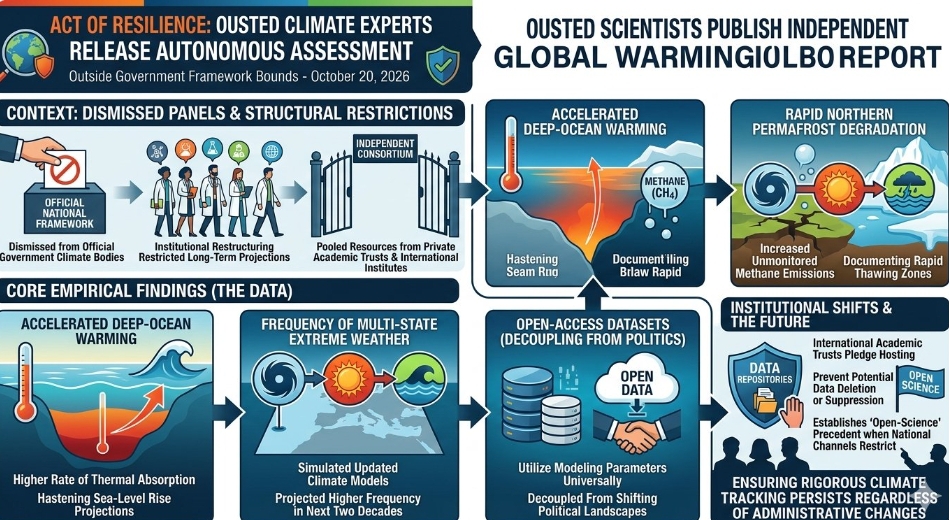
The researchers were removed from their advisory panels earlier this year following institutional restructuring that restricted long-term atmospheric projections. Rather than halting their analysis, the independent group pooled resources from private academic trusts and international research institutes to complete their multi-year modelling of global temperature trajectories.
Core empirical findings and data metrics
The newly published independent report details several critical planetary anomalies that the scientists argue were omitted from recent narrowed government summaries:
- Identifying an accelerated rate of deep-ocean thermal absorption that could hasten sea-level rise along coastal boundaries.
- Simulating updated climate models that project a higher frequency of multi-state extreme weather systems over the next two decades.
- Documenting the rapid degradation of northern permafrost zones and the resulting increase in unmonitored methane emissions.
- Providing open-access datasets to ensure global research institutions can utilise the modelling parameters without administrative restrictions.
A leading atmospheric physicist who served as the consortium's primary coordinator said on October 20, 2026, that scientific data must remain decoupled from shifting political landscapes. The physicist emphasised: "The physical reality of atmospheric carbon accumulation does not alter because of administrative changes. By publishing these findings independently, we are ensuring that city planners, regional emergency services, and the global scientific community retain access to unedited, rigorous climate projections."
Institutional shifts and open science alternatives
The publication has sparked widespread discussion about the future of publicly funded climate research and the vulnerability of state scientist panels to sudden policy reversals. Several international academic institutions have pledged to host the independent framework's data repositories permanently to prevent the potential deletion or suppression of historical ecological records.
Global policy monitors note that the move establishes a new precedent for "open-science" alternatives when national channels become restricted. An international climate governance analyst, reviewing the framework's launch on October 20, 2026, highlighted the institutional significance of the event, stating: "This initiative proves that the infrastructure of modern climate science is highly decentralised. When formal state channels close, scientists now possess the digital networks and independent funding backing to present their data directly to the global public."
Editor's Note
The independent publication of this global warming assessment represents a vital act of scientific resilience against administrative constraints. By finding alternative paths to release peer-reviewed data, these ousted scientists have protected the integrity of long-term climate modelling. However, while autonomous consortiums offer a critical fallback, they cannot fully replace the systematic funding and regulatory influence of an official national framework. Moving forward, the scientific community must work to establish permanent legal protections for public research bodies, ensuring that essential environmental monitoring remains insulated from shifting political cycles.



Leave a comment