

TreeTake Network
A severe deadlock over finance targets has stalled critical negotiations on the opening days of the United Nations Biodiversity Conference (CBD COP17). Delegates, world leaders, and ecological experts representing 196 nations have gathered to track progress on the Kunming-Montreal Global Biodiversity Framework. However, the assembly has quickly devolved into intense procedural disputes over how to bridge the massive multi-billion-pound funding gap needed to halt global ecosystem collapse by 2030.
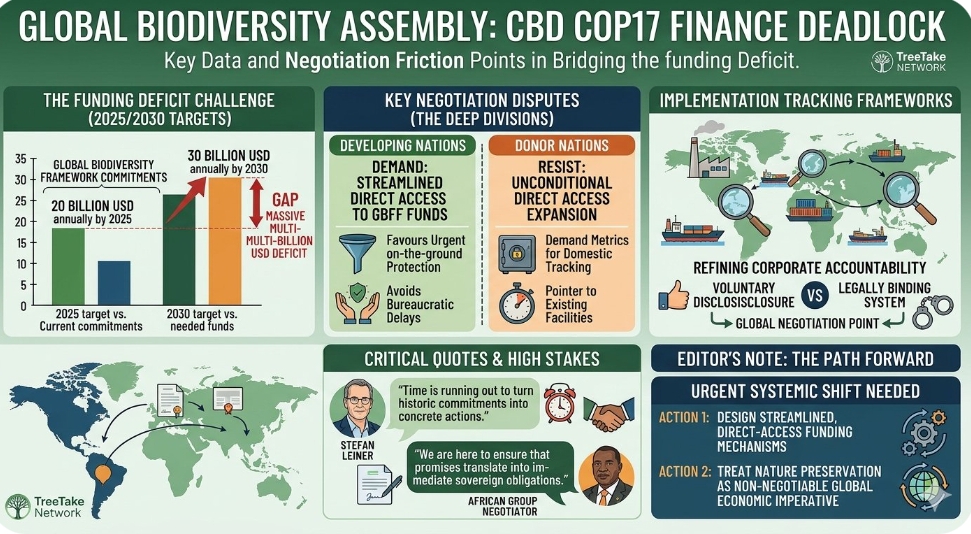
The primary point of contention centres on the operational structure of the Global Biodiversity Framework Fund (GBFF). Developing nations argue that the current financial architecture restricts direct access to resources, favouring bureaucratic delays over urgent on-the-ground ecosystem protection. Conversely, donor nations have resisted expanding direct unconditional financial commitments, pointing to existing institutional facilities and demanding more transparent metrics for domestic biodiversity tracking before releasing additional capital.
The scale of the funding deficit
Under the historic agreements signed in 2022, developed nations committed to collectively providing at least 20 billion US dollars annually to developing countries by 2025, a figure legally mandated to scale up to 30 billion US dollars per year by 2030. Current ledger audits presented to the assembly show that total verified international public biodiversity finance allocations remain well below the intermediate targets, leaving global conservation strategies dangerously underfunded.
"We are here to ensure that nature-related financial promises translate into immediate sovereign obligations," noted a senior negotiator from the African Group of nations during an active plenary session. Observers note that without a breakthrough on resource mobilisation, compliance mechanisms for mapping out protected national ecological zones will be impossible to execute across sub-tropical eco-regions.
Implementation tracking frameworks
The administrative friction has also slowed progress on refining the monitoring framework used to evaluate corporate supply chain impacts on global wilderness areas. Whilst more corporations are voluntarily disclosing their ecological footprints, negotiators are struggling to establish a legally binding system that holds transnational industries accountable for localised habitat destruction.
Stefan Leiner, a prominent international biodiversity policy coordinator attending the summit, highlighted the immense high stakes during a briefing on the assembly floor. He warned that "time is running out to turn the historic commitments into concrete actions, and the financial deadlock risks completely undermining our ability to protect what remains of global biodiversity."
Editor's Note
The gridlock over biodiversity financing underscores a fundamental systemic flaw in modern environmental diplomacy: setting ambitious ecological targets without establishing enforceable, legally binding financial pipelines. To break the current stalemate, the assembly must move away from rigid geopolitical blocking strategies and design a streamlined, direct-access funding mechanism that treats nature preservation not as voluntary foreign aid, but as an immediate, non-negotiable global economic imperative.



Leave a comment