

TreeTake Network
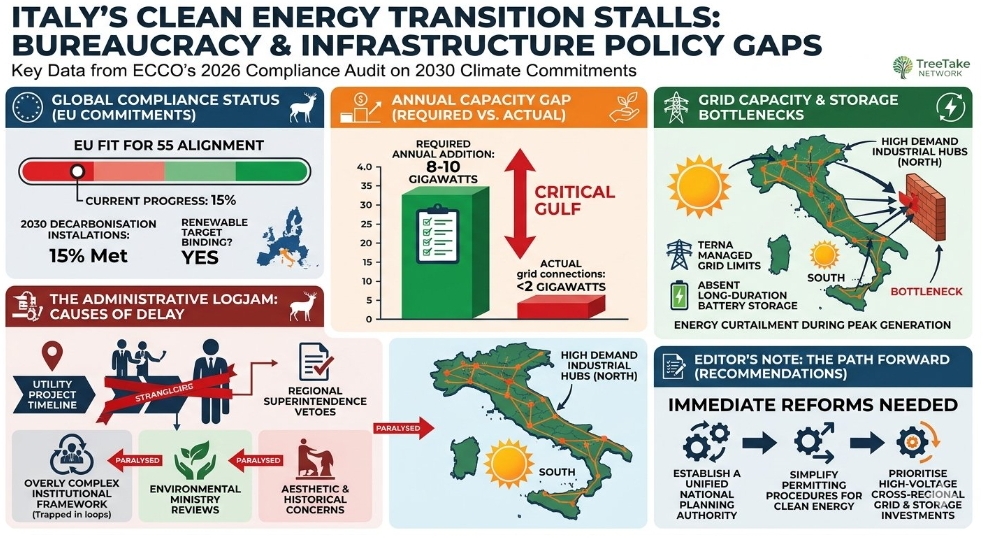
A severe policy and infrastructure deficit has crippled progress across Italy's energy transition sector, leaving the country heavily misaligned with its binding European climate commitments. A comprehensive compliance audit published on October 21, 2026, by ECCO, an independent Italian climate change think tank, reveals that the nation has successfully met just 15 per cent of its required renewable energy and decarbonisation installations targeted for 2030. The data paints a bleak picture of administrative stagnation, where prolonged regional permitting processes and conflicting municipal zoning regulations continue to paralyse the large-scale rollout of utility wind and solar networks.
The underlying metrics highlight a widening gulf between official state declarations and the actual physical expansion of clean generation capacity. According to the tracking indexes, Italy must add approximately eight to 10 gigawatts of new renewable capacity each year to fulfil its contributions to the European Union's Fit for 55 package. However, the cumulative grid connection rate over the past fiscal periods has consistently hovered under two gigawatts annually, showcasing a fundamental failure to accelerate project execution timelines across the southern peninsula.
The administrative logjam
Energy analysts point out that the structural delays are primarily driven by an overly complex institutional framework. Hundreds of clean infrastructure initiatives remain trapped in bureaucratic review loops managed by regional superintendences and environmental ministries, often due to aesthetic or historical landscape protection concerns. This regulatory friction has effectively choked off private investment flows, steering international capital away from domestic green energy projects.
"Italy is moving at a snail's pace on renewables while the climate crisis accelerates," emphasised Francesca Andreolli, a senior energy and climate policy researcher at ECCO, during the presentation of the report. She further observed that "without a profound simplification of the governance and permitting structures, achieving the 2030 decarbonisation milestones will remain mathematically impossible, locking the industrial sector into long-term dependence on imported fossil fuels."
The grid capacity bottleneck
Compounding the bureaucratic inertia is a severe deficit in transmission infrastructure and utility-scale storage systems. The Italian national electricity transmission grid, managed by Terna, faces significant grid-capacity bottlenecks, particularly when transferring solar energy generated in the resource-rich southern regions up to the high-demand industrial hubs of the north. The absence of long-duration battery storage systems means that substantial portions of clean energy face curtailment during peak generation periods, reducing overall system efficiency.
Editor's Note
The critical delay in Italy's transition milestones demonstrates that setting statutory environmental targets is meaningless without an equivalent overhaul of administrative regulatory machinery. To unlock its stalled green economy and achieve its 2030 climate obligations, Italy must immediately establish a unified national planning authority that supersedes localized regional vetoes, simplifies permitting procedures for verified clean energy infrastructure, and prioritizes massive public-private investments into cross-regional high-voltage grid storage facilities.



Leave a comment