

TreeTake Network
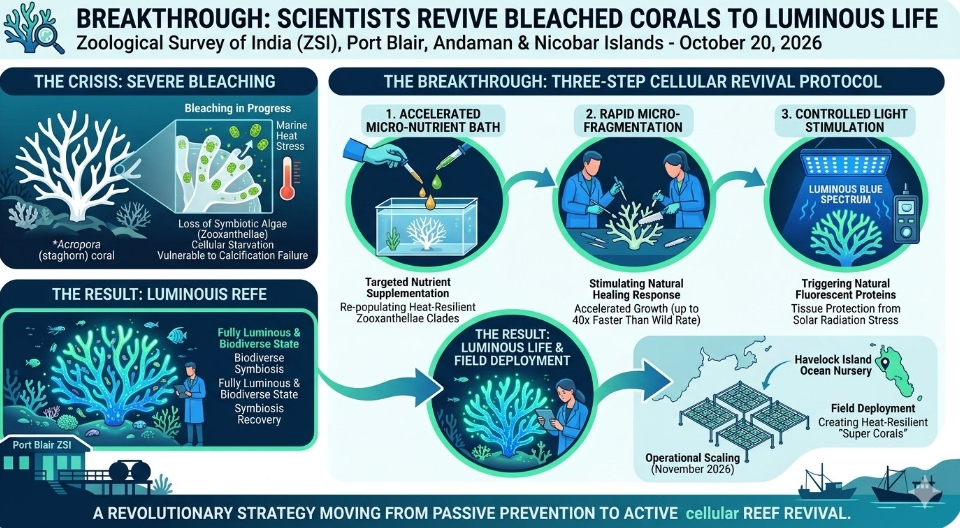
A specialised team of Indian marine biologists operating from the central laboratory facilities of the Zoological Survey of India (ZSI) in Port Blair, Andaman and Nicobar Islands, achieved a critical breakthrough in marine reef restoration on October 20, 2026. The researchers successfully brought severely bleached Acropora (staghorn) coral samples back to a fully luminous, biodiverse life state within controlled tanks. The peer-reviewed laboratory trials mark a fundamental shift in marine conservation, moving the scientific focus from passive bleaching prevention to active, expedited cellular reef revival.
Rising ocean temperatures across the Andaman Sea have caused unprecedented mass bleaching events over the past three years. This volatile heat stress has systematically forced symbiotic zooxanthellae algae out of host coral tissues, leaving reefs structurally vulnerable to calcification failure. The newly developed Indian protocol introduces a precise combination of micronutrient acceleration, micro-fragmentation, and controlled light-spectrum stimulation to reverse cellular starvation in dying coral hosts.
The cellular mechanics of luminous revival
The team achieved rapid restoration by targeting the disrupted metabolic relationship between the coral animal and its algal symbiont. In the controlled laboratory chambers, biologists subjected the bleached specimens to three specific interventions:
- Accelerating the re-population of heat-resilient clades of zooxanthellae via targeted nutrient baths.
- Implementing micro-fragmentation techniques that stimulate the coral's natural healing response, causing it to grow up to 40 times faster than its standard wild rate.
- Utilising specific wavelengths of luminous blue light to trigger natural fluorescent proteins, protecting the fragile recovering tissues from solar radiation stress.
A senior scientist leading the coral restoration division at the ZSI Port Blair facility stated on October 20, 2026, that traditional monitoring methods are no longer sufficient to keep pace with accelerating ocean warming. The researcher emphasized: "We cannot simply watch these vital marine ecosystems collapse. Our laboratory intervention proves that even severely bleached coral tissue possesses the cellular plasticity to recover if provided with the exact thermodynamic and nutrient triggers required to rebuild its symbiotic bond."
Operational scaling and field implementation
The primary objective of these successful trials is to scale the laboratory protocol into practical field operations. Biologists plan to transition the revived colonies from indoor tanks to ocean-based nurseries located off the coast of Havelock Island by early November 2026.
By mapping the thermal threshold limits of these laboratory-reared specimens, researchers aim to create resilient "super corals" capable of surviving future marine heatwaves. This provides a blueprint for restoration teams working across the wider Indo-Pacific region.
A lead researcher from the Marine Biology Regional Centre, detailing the field deployment logistics on October 20, 2026, warned that laboratory success is only the foundational phase of the initiative, stating: "The transition from sterile, controlled laboratory tanks to the volatile, open-sea environments of the Andaman Sea is where the true test lies. We are preparing specialised structural frames to anchor these revived colonies, ensuring they maintain their heat-resilient characteristics under natural oceanic pressures."
Editor's Note
This laboratory breakthrough provides a tangible tool for active marine ecosystem intervention. By demonstrating that severely bleached coral tissue can be cellularly stimulated back to health rather than left to decay, Indian scientists have opened up new possibilities for global reef management strategies. Moving forward, the ultimate challenge will be transitioning these laboratory-grown super corals into open, volatile marine environments. Success will require significant scaling of ocean-based nurseries, long-term monitoring of genetic diversity, and global action to curb the underlying oceanic warming that causes bleaching in the first place.



Leave a comment