

TreeTake Network
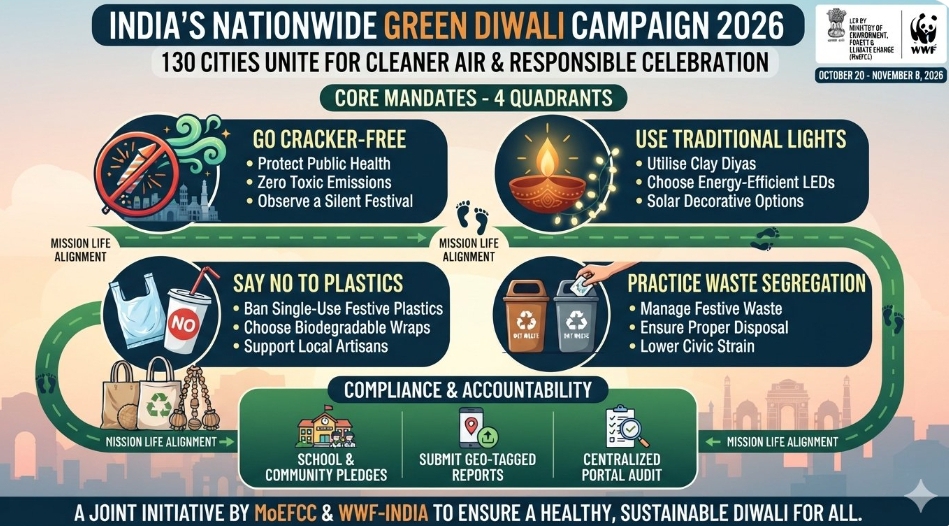
The Union Ministry of Environment, Forest and Climate Change (MoEFCC), in direct coordination with the World Wide Fund for Nature-India (WWF-India) Environmental Information, Awareness, Capacity Building and Livelihood Programme (EIACP) Programme Centre, officially launched a massive nationwide "Green Diwali Campaign" on October 20, 2026. The initiative, scheduled to run comprehensively until November 8, 2026, aims to curb seasonal atmospheric degradation by encouraging clean, cracker-free public celebrations.
The operational focus of this campaign spans urban spaces across the country, with structured attention directed at the 130 highly vulnerable cities designated under the National Clean Air Programme (NCAP). Organisers are deploying extensive educational and civic mobilisation networks to reach schools, colleges, resident welfare associations, and local municipal bodies to systematically transition populations away from hazardous pyrotechnics.
Strategic alignment with Mission LiFE
The intervention integrates festive practices with central policy goals under India's overarching Mission LiFE (Lifestyle for Environment) framework. Rather than focusing solely on a firecracker ban, the joint directive establishes specific sustainable behavioural metrics for citizens:
- Exclusively utilising traditional earthen clay diyas and energy-efficient LED or solar lighting systems.
- Eradicating single-use festive plastics, non-biodegradable decorations, and chemical wrapping materials.
- Practising strict household waste segregation during peak festival weeks to lower civic strain.
- Prioritising locally produced, artisan-made goods to drastically reduce supply-chain carbon footprints.
An official public statement released by the Ministry of Environment, Forest and Climate Change on October 20, 2026, explicitly outlined the core philosophy of the drive, stating: "The campaign aims to foster a sense of shared environmental responsibility. By making conscious choices, individuals can help safeguard both the environment and public health, while upholding the spirit of celebration."
Accountability frameworks and digital metrics
To ensure rigorous transparency and monitor ground-level compliance, participating schools, colleges, and regional community networks are holding formal pledge drives during morning assemblies, classroom hours, and public rallies. All coordinating bodies are required to document and verify their local progress through a centralised digital portal.
Submissions are monitored by regional EIACP hubs and must include the specific organisation name, location coordinates, exact participant metrics, and geo-tagged photographs alongside a brief data summary. Selected regional models will be publicly broadcasted across state channels to incentivise national compliance.
Concurrently, WWF-India has open-sourced its digital Carbon Footprint Survey. This analytical tool enables urban households to assess how their personal consumption patterns directly contribute to regional climate strain, offering a transparent mirror to seasonal domestic emissions.
A spokesperson representing the WWF-India EIACP division during the rollout on October 20, 2026, emphasised the critical nature of the timeline, stating: "Through its 'Green Diwali' Campaign, WWF EIACP invites all citizens to take a pledge for a clean, green, and plastic-free Diwali—a festival that brings light not just to our homes, but to the planet as a whole."
Editor's Note
The activation of this targeted 130-city campaign represents a logical shift from late-stage reactive emergency measures to proactive behavioural intervention. By embedding air quality parameters directly into community networks and educational institutions, the MoEFCC and WWF-India are addressing festive pollution at its consumer source. Moving forward, the real success of this framework will depend on how effectively municipal bodies penalise illicit firecracker supply chains in high-emission NCAP zones and whether the digital geo-tagged reporting system is subjected to strict independent audits rather than simple self-reporting.



Leave a comment