

TreeTake Network
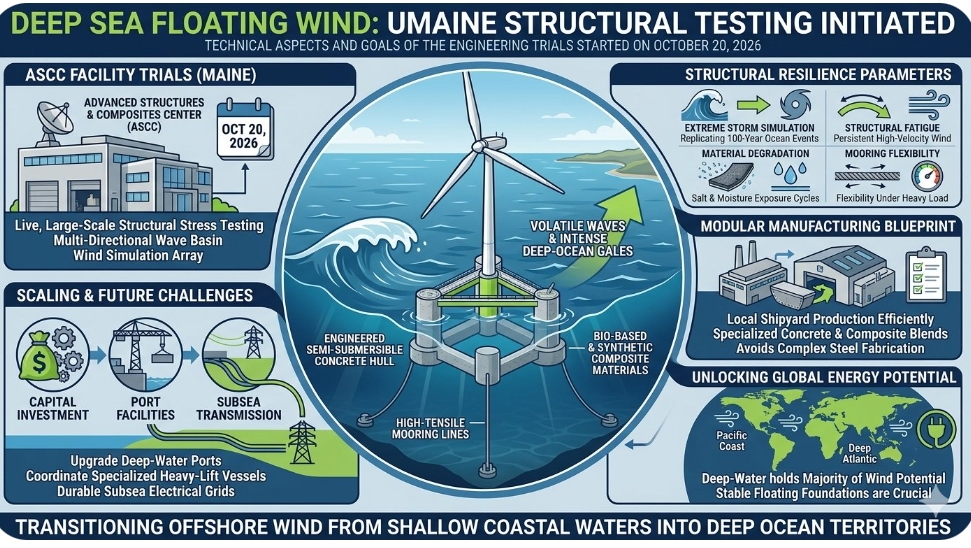
The Advanced Structures and Composites Centre (ASCC) at the University of Maine officially initiated live, large-scale structural stress testing on innovative floating offshore wind turbine foundations on October 20, 2026. This critical engineering phase focuses on evaluating how full-scale hull designs, composed of advanced bio-based and synthetic composite materials, respond to simulated extreme maritime environments. The initiative represents a significant technological leap for the renewable energy sector, transitioning offshore wind power from shallow coastal waters into deep ocean territories previously considered structurally unfeasible.
Traditional fixed-bottom wind turbines are restricted to shallow marine regions where platforms can be directly driven into the seabed. However, deep-water locations hold the vast majority of global offshore wind energy potential. The University of Maine's deep-sea floating design utilises an engineered semi-submersible concrete hull anchored by high-tensile mooring lines, allowing it to remain stable amidst volatile waves and intense deep-ocean gales.
Advanced materials and stress simulation parameters
The structural testing matrix deployed at the ASCC facility uses state-of-the-art multi-directional wave basins and wind simulation arrays to evaluate structural resilience under severe conditions:
- Subjecting scaled models to extreme wave simulations replicating historical 100-year ocean storm events.
- Testing the structural fatigue resistance of the composite hulls under persistent, high-velocity wind shears.
- Measuring the real-time degradation rates of sustainable, bio-based composite materials exposed to intense salt spray and moisture over extended cycles.
- Monitoring the flexibility and load-bearing capacity of the advanced synthetic mooring line designs under heavy tension.
A senior structural engineering specialist coordinating the trials at the ASCC facility stated on October 20, 2026, that modifying the structural materials is essential for deep-sea survival. The engineer emphasised: "Moving wind energy architectures into the open ocean requires a complete overhaul of traditional marine design. Our live laboratory simulations allow us to verify exactly how these advanced composite hulls handle immense hydrodynamic stress, ensuring we can build cost-effective platforms that operate reliably for decades without structural failure."
Scaling offshore energy transitions and manufacturing logistics
The long-term objective of the testing programme is to validate a modular manufacturing blueprint that allows these massive floating foundations to be produced efficiently within local shipyards. By using specialised concrete and composite blends, the design avoids the complex and expensive steel fabrication loops that have historically slowed down maritime renewable infrastructure projects.
Clean energy supply analysts note that developing stable, floating foundations is crucial for unlocking the wind corridors of the Pacific coast and the deep Atlantic. A renewable energy infrastructure director, reviewing the test metrics on October 20, 2026, highlighted the industrial potential of the design, stating: "The engineering data generated by the University of Maine addresses the primary bottleneck facing deep-water offshore wind deployment. By validating a hull design that can be mass-produced in existing ports and towed directly out to sea, we can drastically shorten clean energy deployment timelines."
Editor's Note
The commencement of structural testing on these floating wind turbine foundations highlights a crucial turning point in deep-sea renewable engineering. Shifting wind energy generation into deep ocean waters avoids the local zoning disputes and visual impact concerns common to onshore projects while capturing far more consistent and powerful wind resources. Moving forward, the core challenge will shift from proving laboratory structural resilience to executing large-scale maritime installation. Success will require massive capital investment to upgrade deep-water port facilities, coordinate specialized heavy-lift vessels, and establish durable subsea electrical transmission grids capable of bringing open-ocean energy safely back to land.



Leave a comment