

TreeTake Network
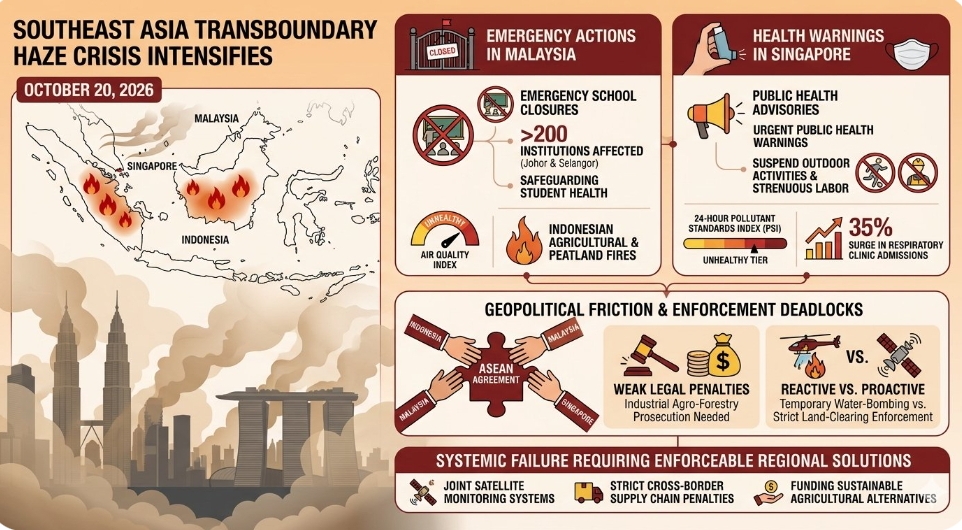
The transboundary haze crisis across Southeast Asia escalated severely on October 20, 2026, as agricultural and peatland fires in Indonesia blanketed neighbouring nations in thick, toxic smoke. The rapid deterioration of atmospheric quality forced the Malaysian Ministry of Education to order emergency school closures across multiple highly affected southern districts. Concurrently, Singapore’s National Environment Agency (NEA) issued urgent public health warnings as particulate pollution metrics breached hazardous limits, posing severe risks to vulnerable demographics.
The regional environmental emergency stems from persistent, illegal land-clearing practices using fire across Sumatra and Kalimantan. Prolonged dry spells linked to a delayed regional monsoon have exacerbated the fires, causing the resulting smoke plumes to drift across the Malacca Strait into dense urban centres.
Regional health impact and municipal disruptions
The cross-border spread of Particulate Matter (PM2.5) has severely impacted public infrastructure and daily municipal operations across the region:
- Malaysia ordered the immediate closure of over 200 primary and secondary educational institutions in Johor and Selangor to safeguard students from hazardous exposure.
- Singapore recorded its 24-hour Pollutant Standards Index (PSI) climbing into the "Unhealthy" tier, prompting state directives to suspend all outdoor school activities and strenuous physical labour.
- Local health departments reported a 35 per cent surge in admissions for acute respiratory infections, asthma exacerbations, and severe conjunctivitis across major metropolitan clinics.
- Aviation authorities across regional transport hubs issued low-visibility alerts, causing minor delays for domestic commercial flight paths.
An official tracking specialist from Malaysia's Department of Environment, reviewing data on October 20, 2026, confirmed the severity of the atmospheric stall, stating: "The current wind vectors are continuously pushing dense smoke plumes directly into our urban corridors. Air quality indexes have crossed critical safety benchmarks, making physical classroom environments unsafe and requiring immediate exposure mitigation."
Geopolitical friction and enforcement deadlocks
The worsening crisis has renewed diplomatic tensions between the Association of Southeast Asian Nations (ASEAN) members regarding the enforcement of the ASEAN Agreement on Transboundary Haze Pollution. While Indonesian environmental authorities claim to have deployed water-bombing helicopters to combat hotspots, regional analysts argue that structural corporate enforcement against illegal land-clearing remains insufficient.
Environmental enforcement teams operating near the fire zones noted that tracking illegal peatland destruction requires a coordinated regional response. A regional climate policy adviser, speaking on October 20, 2026, emphasised the systemic failure of seasonal management, stating: "We are witnessing the predictable consequence of weak legal penalties against industrial agro-forestry operations. Water-bombing fires after they ignite is a temporary fix; the regional solution requires strict legal prosecution of land-clearing violations at their corporate source."
Editor's Note
The escalation of the Southeast Asian haze crisis demonstrates the inadequacy of existing regional environmental agreements when dealing with corporate-driven land degradation. Relying on seasonal reactive measures like school closures and health advisories passes the economic and physiological burden onto citizens while leaving the source of the emissions untouched. Moving forward, ASEAN members must shift from diplomatic avoidance to enforceable legal mechanisms. This transition requires implementing joint satellite monitoring systems, imposing strict cross-border supply chain penalties on companies linked to peatland fires, and funding sustainable agricultural alternatives for local smallholders.



Leave a comment