

TreeTake Network
The United Nations Biodiversity Conference, known as CBD COP17, officially launched its pivotal negotiations today, October 19, 2026, in the capital city of Yerevan, Armenia. Bringing together environmental ministers, conservation experts, and state delegates from nearly 200 countries, the twelve-day summit stands as a high-stakes arena where governments must address severe lag phases in their collective commitments to protect global ecosystems.
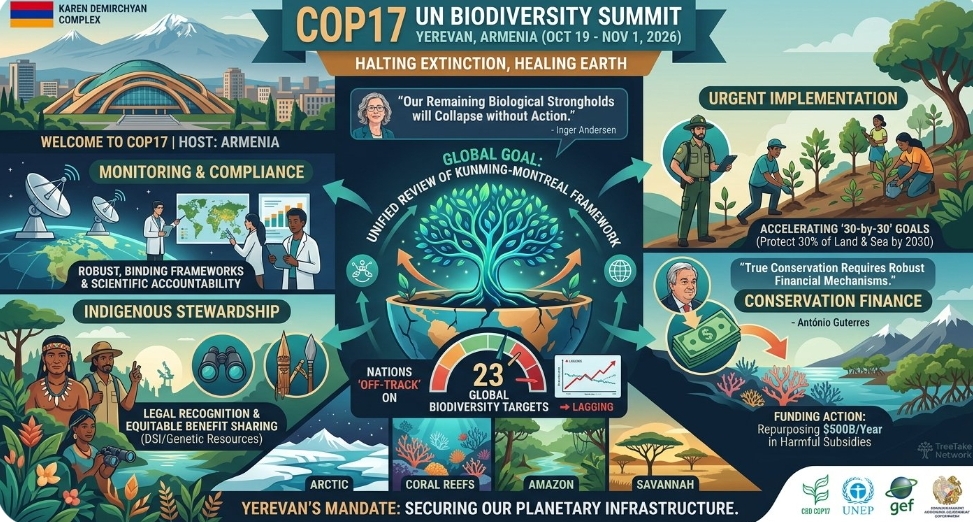
This summit serves as the first official, unified review of collective national progress under the historic Kunming-Montreal Global Biodiversity Framework, which was adopted in 2022. Preliminary scientific assessments tabled during the opening plenary reveal a stark reality: countries are currently off-track on nearly all twenty-three of the quantifiable conservation targets established to halt the global extinction crisis by 2030.
Reassessing the "30-by-30" Preservation Framework
At the heart of the Yerevan negotiations is the landmark "30-by-30" goal, a legal target requiring nations to place at least thirty per cent of the planet’s terrestrial, inland water, and coastal marine systems under formal protection within the decade. While recent United Nations data indicates a marginal increase in paper-based land declarations—now tracking at roughly 27.5 per cent of global land surfaces—delegates are warning that actual, on-the-ground management remains critically deficient.
The current talks follow a tumultuous lead-up, recalling that the prior assembly, COP16 in Cali, Colombia, famously dissolved into logistical disarray when the final plenary ran out of time, forcing supplementary extensions in Rome to piece together a basic monitoring structure. Addressing the opening session, Inger Andersen, Executive Director of the United Nations Environment Programme (UNEP), stated: "Fewer than half of our active national targets are currently aligned with the urgency of this crisis. We cannot afford the luxury of empty rhetoric in Yerevan; without accelerated domestic implementation, our remaining intact biological strongholds will collapse."
The Multi-Billion Dollar Finance Deadlock
Beyond map boundaries, financial resource mobilisation remains the primary diplomatic friction point between developing nations and wealthier economies. The Global Biodiversity Framework originally mandated a substantial restructuring of global financing, including an explicit commitment to phase out or repurpose at least five hundred billion dollars a year in environmentally harmful state subsidies by 2030.
Developing states are aggressively pressing for the operationalisation of direct capital channels, arguing that they house the vast majority of the world's remaining biodiversity but lack the fiscal capital to enforce protected zones. In a joint address during the opening high-level segment, UN Secretary-General António Guterres emphasised the profound inequality of the current ecological trajectory, remarking: "At our current velocity, we will protect only twelve per cent of marine ecosystems by 2030. True conservation requires robust financial mechanisms. If we fail to secure the funding streams needed to support local communities on the front lines of conservation, our planetary infrastructure will fracture."
Centring Local and Indigenous Stewardship
The Armenian presidency has structured the COP17 agenda to elevate the legal recognition of indigenous peoples and local communities, positioning them as the direct custodians of high-integrity ecosystems. Over the next two weeks, focus will centre on building benefit-sharing frameworks for digital sequence information on genetic resources, ensuring that corporate entities utilising localised natural assets pay equitable royalties back to the source territories.
As environmental ministers assume control of the working groups, international negotiating blocs are working against the clock to finalise concrete, binding implementation roadmaps. With the 2030 deadline looming rapidly, the outcomes decided in Yerevan are widely viewed by the scientific community as the final collective opportunity for global policy to successfully reverse the anthropogenic degradation of the biosphere.
Editor's Note
The commencement of COP17 in Yerevan represents a critical turning point where global conservation policy must bridge the widening gap between ambitious diplomacy and localised execution. The structural collapse of the previous summit in Cali serves as a reminder that without explicit financial pledges and enforceable compliance mechanisms, paper targets like the "30-by-30" goal mean very little on the ground. Moving forward, the international community must transition from defining goals to holding individual sovereign states legally accountable for their domestic environmental footprints. For the summit to be a success, wealthier nations must step up with definitive conservation capital, transforming biodiversity from a separate corporate social responsibility exercise into a core element of global economic policy.



Leave a comment