

TreeTake Network
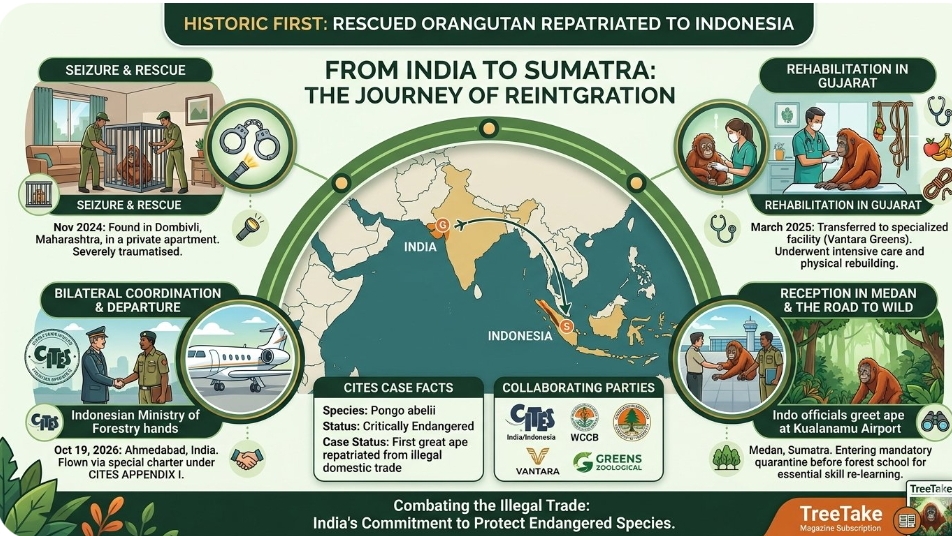
In a milestone victory against transnational illicit wildlife trafficking, a critically endangered juvenile Sumatran orangutan was safely flown out of India today, October 19, 2026, to return to his native rainforests in Indonesia. The complex cross-border operation marks the first time a great ape rescued from the illegal domestic pet trade within India has been successfully repatriated to its natural geographic range.
The young male primate, estimated to be around three years of age, arrived at Kualanamu International Airport in Medan, Sumatra, early this morning via a specially chartered flight from Gujarat. Upon arrival, the juvenile was received by senior officials from Indonesia's Ministry of Forestry alongside a diplomatic delegation from the Consulate General of India.
From a Bathroom Cage to Freedom
The primate's journey began with a dark chapter in November 2024, when enforcement officers from the Thane Forest Division discovered him locked inside a small cage hidden within a residential bathroom in Dombivli, Maharashtra. Seized alongside a broader cache of smuggled exotic wildlife, the infant ape was severely traumatised and entirely dependent on human caretakers.
Following initial stabilisation at the Balasaheb Thackeray Gorewada International Zoological Park in Nagpur, a Supreme Court-appointed high-powered committee, headed by retired Supreme Court Judge Justice Deepak Verma, ordered the primate's transfer to the specialised infrastructure of the Greens Zoological Rescue and Rehabilitation Centre in Gujarat in March 2025. There, under intensive veterinary monitoring, the ape underwent comprehensive medical stabilisation and behavioural rehabilitation while complex international paperwork was synchronised.
Inter-Governmental Coordination Under CITES
Because orangutans are categorised under Appendix I of the Convention on International Trade in Endangered Species of Wild Fauna and Flora (CITES), international commercial trade is strictly prohibited, and legal protocols heavily incentivise repatriation to range states whenever possible. The repatriation was executed via close diplomatic collaboration between the CITES Management Authorities of both New Delhi and Jakarta.
In a significant diplomatic gesture, the Government of India formally waived the recovery of all financial costs incurred for the extensive veterinary healthcare, nutrition, and housing provided to the orangutan over his two-year stay. Discussing the landmark transfer, Dr Satyajan Maharshi, Chief Veterinary Officer at the Greens Zoological Centre, stated: "When the juvenile arrived, he exhibited profound behavioral anxiety and nutritional deficiencies indicative of severe confinement. Our twenty-four-month protocol focused entirely on physical rebuilding and minimizing human imprinting, ensuring he retained his natural arboreal instincts ahead of this transcontinental journey."
Echoing the diplomatic success, Indonesia's Director General of Natural Resources and Ecosystem Conservation, Prof. Dr. Satyawan Pudyatmoko, remarked: "We express our deepest gratitude to the Indian authorities for their meticulous care and enforcement. This successful repatriation stands as a powerful testament to our bilateral treaty commitments under CITES, sending an unequivocal message to global wildlife syndicates that our natural heritage is not for sale."
Next Steps for Wild Reintegration
Following strict global quarantine protocols, the juvenile will undergo an extensive transitional isolation period at a specialised sanctuary run by the Ministry of Forestry in Sumatra. Wildlife specialists intend to slowly introduce him to a rehabilitation forest school, where he can re-learn crucial survival skills—such as foraging and canopy nest building—with the ultimate objective of full rewilding into a protected national park within a few years.
Meanwhile, Indian and Indonesian authorities confirmed that lessons learned from this operation are being actively applied to a second pipeline project: the repatriation of five additional infant orangutans rescued from an illicit trafficking drop in Balasore, Odisha, in September 2026. A specialised team of Indonesian forestry experts is scheduled to visit India in November 2026 to verify their exact genetic strains and fast-track their return.
Editor's Note
The successful repatriation of this juvenile Sumatran orangutan is an undeniable triumph for diplomatic conservation, but it also shines a harsh spotlight on India's rising vulnerability as a destination hub for exotic wildlife smuggling. While domestic species receive stringent protection under the Wildlife Protection Act, holes in enforcement corridors have allowed wealthy private collectors to fuel a black market for rare international primates. Moving forward, India must complement these high-profile repatriations with much tighter border surveillance at ports of entry, mandatory registration of exotic pets, and severe penal actions for possession to dismantle illegal trafficking rings before these animals are pulled from their native canopies.



Leave a comment