

TreeTake Network
India has achieved a historic milestone in its clean energy transition by officially surpassing 300 gigawatts (GW) of installed non-fossil fuel-based electricity generation capacity today, October 19, 2026. This rapid expansion places the nation firmly ahead of its internal timelines, driven by an unprecedented acceleration in utility-scale solar installations and aggressive offshore wind development over the past fiscal year.
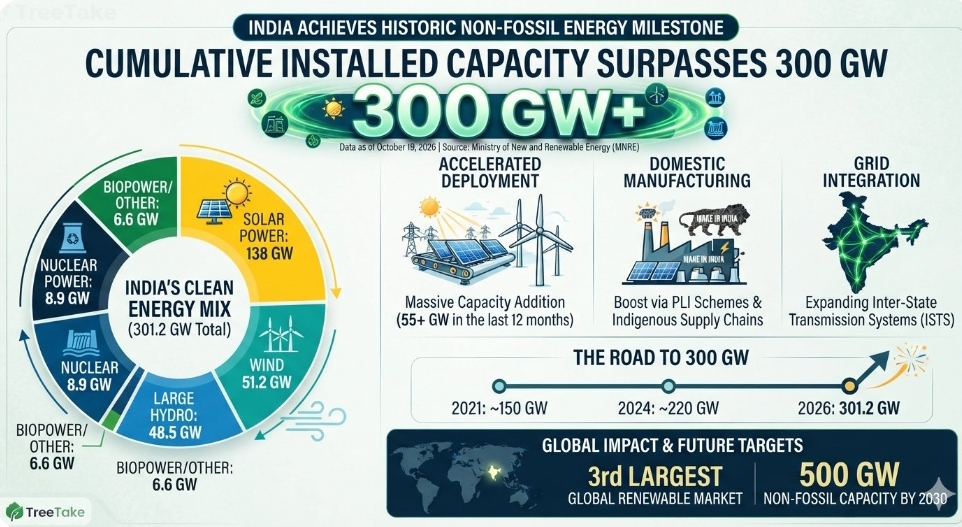
According to data released by the Central Electricity Authority (CEA) and the Ministry of New and Renewable Energy (MNRE) this morning, the country's cumulative non-fossil fuel capacity—encompassing solar, wind, large hydro, biomass, and nuclear energy—now stands at 301.2 GW. This monumental figure accounts for over 46 per cent of India’s total installed power mix, marking a staggering rise from the 150 GW recorded just five years ago.
Decisive Solar and Wind Influx Drives Growth
The push across the 300 GW threshold was clinched by the commissioning of a 750-megawatt (MW) ultra-mega solar project phase in Rajasthan's Thar desert region and a massive 400 MW wind farm cluster off the coast of Gujarat. Solar energy remains the primary engine of this green boom, contributing roughly 138 GW to the total tally, followed closely by large hydroelectric projects at 48.5 GW and wind power at 51.2 GW.
Operational efficiency has been greatly enhanced by the massive expansion of the Inter-State Transmission System (ISTS) green energy corridors, which successfully evacuated peak generation from resource-rich western and southern states to industrial hubs in the north. Analysing the milestone, Ghanshyam Prasad, Chairperson of the Central Electricity Authority, stated: "Surpassing the 300 GW mark is not merely a statistical victory; it is a profound testament to India's scalable infrastructure capability. We are effectively decoupling our rapid economic growth from carbon emissions, demonstrating to the global community that green industrialisation at a massive scale is achievable."
Corporate Capital and Indigenous Supply Chains
A crucial factor behind the rapid capacity additions throughout 2025 and 2026 has been the stabilisation of domestic manufacturing under the Production Linked Incentive (PLI) scheme for high-efficiency solar modules. By insulating the domestic market from international supply chain shocks, domestic developers successfully deployed over 55 GW of fresh clean energy assets in the last twelve months alone.
Institutional capital has followed this regulatory stability. Dr. Ajay Mathur, Director General of the International Solar Alliance (ISA), commented on the development, stating: "India's achievement of 300 GW reflects an incredible alignment of policy certainty, robust domestic manufacturing, and massive grid integration. The velocity at which these projects are coming online serves as a global template for rapidly developing economies looking to secure energy independence while meeting stringent climate pledges."
The Roadmap to 500 GW by 2030
While the 300 GW milestone marks a key victory, grid engineers are already pivoting to address the secondary challenges of this green influx. To ensure grid stability as intermittent solar and wind capacity grows, the Ministry of Power has accelerated the deployment of massive battery energy storage systems (BESS) and pumped hydro storage projects, aiming to add 50 GW of storage capacity by 2030.
This operational momentum keeps India squarely on track to achieve its ultimate climate pledge under the Paris Agreement: reaching 500 GW of non-fossil fuel capacity by 2030. With an active project pipeline of over 95 GW currently under various stages of construction and bidding, sector experts project that the next 100 GW milestone will be crossed in record time.
Editor's Note
Crossing the 300 GW clean energy threshold is a phenomenal industrial feat that solidifies India's role as a global leader in climate action. However, the sheer volume of intermittent renewable energy flowing into the national grid creates an urgent need to modernise our transmission infrastructure. Moving forward, the focus must shift from simply adding generation capacity to building massive energy storage systems and smart grid architectures that can handle peak renewable generation without threatening grid stability. Furthermore, policy frameworks must address regional disparities in clean energy deployment, ensuring that land acquisition and local environmental concerns are balanced against our national decarbonisation goals.



Leave a comment