

TreeTake Network
Severe hydrological drought intensified across Southeast Asia today, October 19, 2026, as an unseasonably prolonged El Niño cycle pushed major river corridors in Sumatra and Kalimantan to historically low water levels. The accelerating crisis has halted vital inland water transport networks, stranded agricultural communities, and significantly elevated the vulnerability of carbon-rich peatland ecosystems to widespread wildfire outbreaks.
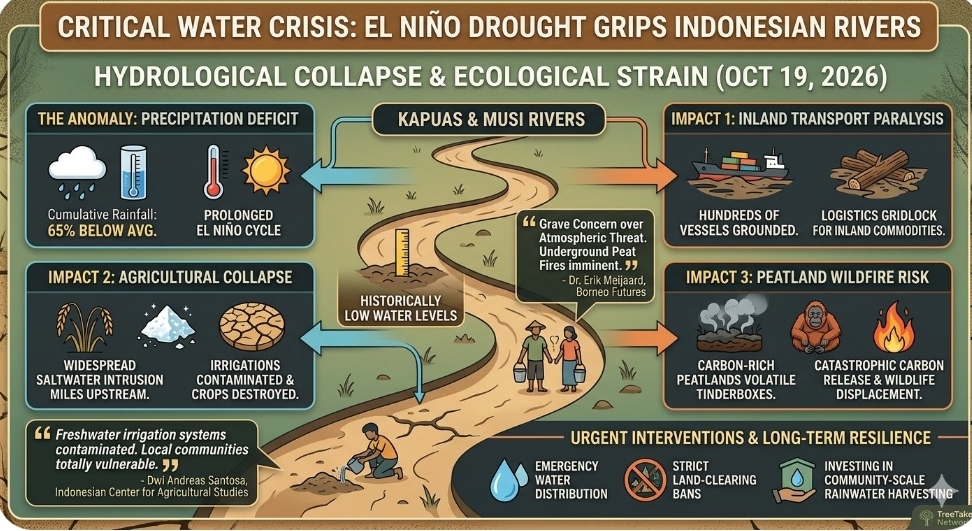
According to hydrological data released this morning by Indonesia's Bureau of Meteorology, Climatology, and Geophysics (BMKG), cumulative rainfall across central and southern provinces has dropped sixty-five per cent below the thirty-year historical average. The extreme precipitation deficit has caused shallow water tables to contract rapidly, reducing river flows along critical trade lifelines like the Kapuas and Musi rivers to fractions of their standard seasonal volumes.
Disruption of Inland Trade and Agricultural Lifelines
The contraction of these major riverways has caused severe logistics gridlock for remote inland communities that rely entirely on watercraft for transit and commercial shipping. Hundreds of shallow-draft cargo vessels transporting local commodities, such as sustainably harvested palm fruits and rubber, remain grounded on exposed mudflats and sandbars due to inadequate draft clearances along standard navigation channels.
The economic and domestic impact is felt most acutely by riverbank farming communities. Dwi Andreas Santosa, Chairperson of the Indonesian Center for Agricultural Studies, detailed the severity of the crisis, stating: "We are observing widespread salt-water intrusion moving miles upstream into agricultural estuaries because the diminished outward river pressure can no longer repel marine tides. This is contaminating vital freshwater irrigation systems and destroying essential food crops, leaving local communities completely vulnerable to severe food and economic insecurity."
Ecological Strain on High-Integrity Peatlands
Beyond the impact on human logistics, conservation biologists are sounding the alarm over the rapid desiccation of the region's protected tropical peat swamps. Under standard weather patterns, these waterlogged soils act as immense global carbon sinks; however, the ongoing drought is exposing deep organic layers to the atmosphere, drying out the dense vegetation and turning entire conservation sanctuaries into volatile tinderboxes.
National park rangers have intensified fire-watch patrols in critical biodiversity zones like Tanjung Puting National Park, where endangered wildlife populations face immediate displacement. Dr Erik Meijaard, founder of the Borneo Futures conservation initiative, expressed grave concern over the atmospheric threat, remarking: "The dropping water tables are physically fracturing these fragile peat domes. If seasonal monsoons continue to experience significant lag phases, we face an imminent risk of underground peat fires that release catastrophic amounts of stored carbon into the atmosphere, completely undermining international climate mitigation targets."
Government Interventions and Emergency Infrastructure
In response to the widening water crisis, the National Disaster Management Authority (BNPB) has mobilised emergency water purification trucks and dispatched static storage tanks to the hardest-hit riverside villages. State engineers are also evaluating the feasibility of targeted cloud-seeding operations to induce localised rainfall over drying reservoirs, though low atmospheric humidity levels continue to limit the effectiveness of these weather modification techniques.
The Ministry of Environment and Forestry has issued strict temporary bans on land-clearing activities involving fire and imposed stiff legal penalties for violations to suppress human-caused ignitions. As emergency teams monitor the drying channels, long-term climate models suggest that these intense dry spells will occur with increasing frequency, forcing a structural reassessment of how Indonesia manages its critical equatorial water resources moving forward.
Editor's Note
The escalating river crisis in Indonesia is a stark reminder that climate-driven anomalies like El Niño are no longer isolated seasonal events, but structural threats to national stability. Relying on emergency water distribution and reactive fire bans is an insufficient strategy when foundational hydrological systems are actively contracting. Going forward, the Indonesian government must shift toward long-term water-resource resilience. This requires making heavy infrastructure investments in community-scale rainwater harvesting systems, enforcing strict legal protections to halt the drainage of natural peatlands, and diversifying inland transport corridors so that rural economies are not entirely dependent on volatile river volumes.



Leave a comment