

TreeTake Network
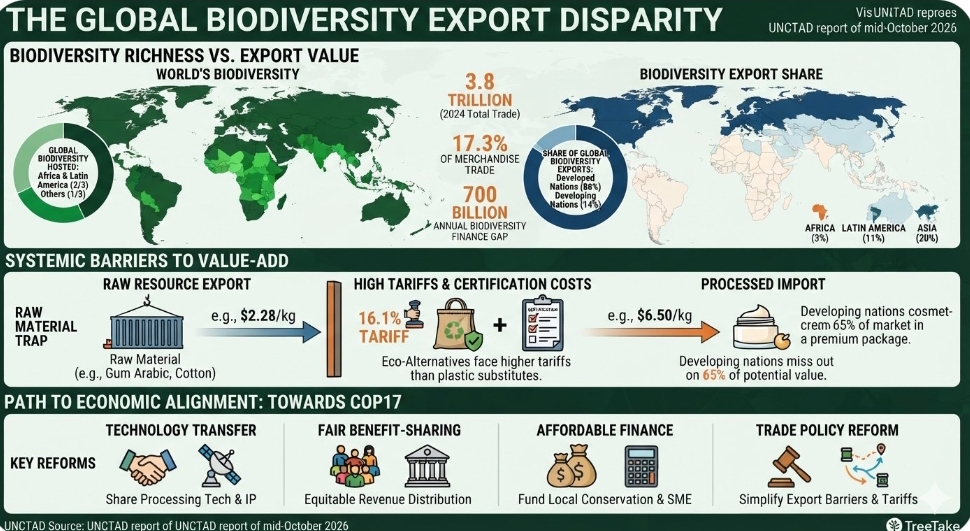
A comprehensive trade assessment published by the United Nations Conference on Trade and Development (UNCTAD) in mid-October 2026 reveals a deep structural imbalance in the global market for biodiversity-based products. Developing countries in Africa and Latin America hold nearly two-thirds of the world's biological diversity, yet they collectively secure less than 14 per cent of the global market for biodiversity-based products.
This stark economic imbalance forms the core of the report, released directly ahead of the 2026 UN Biodiversity Conference (COP17) in Yerevan, Armenia, where nations are reviewing the Kunming-Montreal Global Biodiversity Framework.
Global Market Scale and Regional Disparities
Global exports of approximately 1,800 distinct biodiversity-based products reached nearly 3.8 trillion dollars in 2024, accounting for 17.3 per cent of total merchandise trade. However, participation in this growing market remains highly uneven:
- European Economies: Captured the largest share, dominating the market at 49 per cent of the total value.
- Developing Nations (Total): Accounted for only about 35 per cent of the global export value.
- Asia: Captured 24 per cent of global biodiversity-based exports, valued at approximately 900 billion dollars.
- India’s Footprint: As a vital driver of the Asian biological trade sector, India possesses roughly 8 per cent of global species diversity, despite holding only 2.4 per cent of the world's land area.
- Latin America and the Caribbean: Secured 11 per cent of the global market share.
- Africa: Contributed a mere 3 per cent to global exports.
Highlighting this stark geographic divide, UNCTAD noted that "regions holding roughly two-thirds of global biodiversity account for minimal export shares."
Systemic Barriers and the Processing Value Gap
Developing nations rich in biological resources often miss out on high-value processing and manufacturing, remaining limited to exporting raw materials. Eco-friendly natural alternatives to plastics—such as cotton, jute, hemp, and paper—face import tariffs as high as 16.1 per cent, often matching or exceeding the tariffs on the plastic goods they replace.
Additionally, smallholders and small-to-medium enterprises struggle with strict non-tariff rules like phytosanitary requirements, with producers frequently bearing sole responsibility for compliance and certification costs.
Official Framework for Structural Alignment
This massive trade asymmetry unfolds amid a crippling 700 billion dollar annual biodiversity finance gap. UNCTAD emphasises that rectifying this market failure requires sweeping structural safeguards, stating that "addressing this imbalance requires safeguards, benefit-sharing, technology access, and affordable finance."
Meanwhile, formal BioTrade initiatives—which promote sustainable commercialisation—grew to nearly 50.5 billion dollars in 2024, up from a baseline of just 40 million dollars in 2003, proving that sustainable frameworks work, though they still represent a small portion of the overall market.
Editor's Note: Analysis of Trade Asymmetry and Conservation Economics
Biodiversity richness does not automatically translate to economic gains or conservation funding. Biological wealth fails to ensure economic security for guardian communities when processing revenues concentrate heavily in wealthy consumer nations. Reforming global trade policies to ease tariff and compliance burdens on smallholders is crucial to ensuring fair incentives for local conservation. True equity will only be achieved by investing in local processing infrastructure and developing domestic manufacturing capabilities, rather than treating megadiverse nations merely as raw material suppliers.



Leave a comment