

TreeTake Network
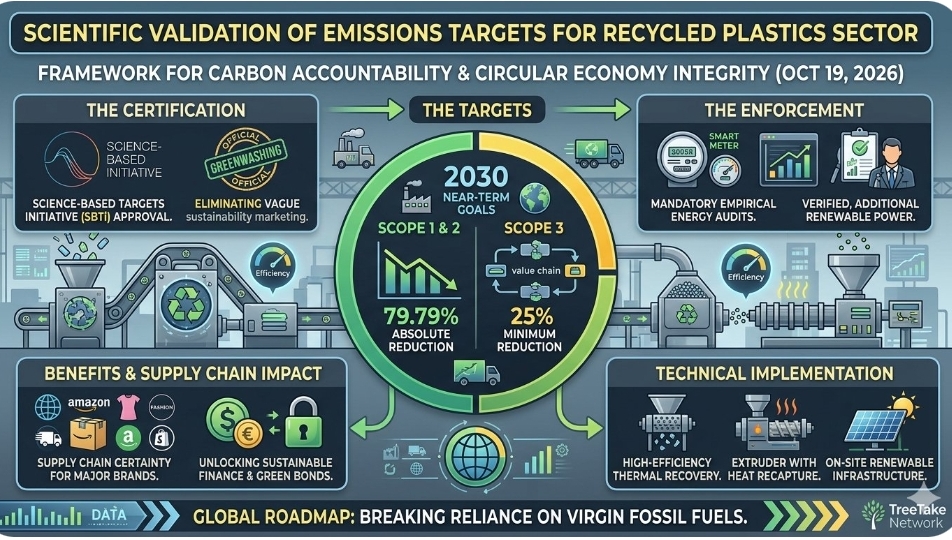
A major international scientific verification authority formally approved the aggressive net-zero validation targets for the global polymer reprocessing sector today, October 19, 2026. The milestone certification establishes a standardised, scientifically rigorous benchmark for circular economy industrial operations, eliminating rampant greenwashing by forcing recycling facilities to verify their core carbon reductions through empirical energy audits.
The comprehensive validation protocol requires participating multinational recycling enterprises to achieve an absolute 79.79 per cent reduction in Scope 1 and Scope 2 operational greenhouse gas emissions by 2030, compared to a baseline established in 2021. Furthermore, companies must actively monitor and reduce their Scope 3 value chain emissions by at least twenty-five per cent within the same timeframe, transforming how secondary raw materials are processed worldwide.
Enforcing Strict Science-Based Operational Standards
The newly approved frameworks dismantle long-standing industry loopholes where reprocessing facilities claimed broad climate benefits while running on high-emission regional electricity grids. Under the strict new criteria, a recycling plant cannot claim a low-carbon product footprint unless its extrusion and pelletising machinery is powered by verified, additional renewable energy infrastructure.
The verification process follows multi-year pilot assessments across prominent European industrial recycling hubs. Commenting on the target approval, Dr Luiz Amaral, Chief Executive Officer of the Science Based Targets initiative (SBTi), stated: "The validation of these near-term targets marks a decisive shift from vague sustainability marketing to absolute carbon accountability. The recycled plastics sector must demonstrate that its internal production loops are inherently low-carbon, ensuring that plastic waste reduction does not come at the expense of accelerating global atmospheric warming."
Transforming Supply Chains and Corporate Accountability
The implementation of these validated targets is poised to create a significant ripple effect across the packaging and consumer goods manufacturing supply chains. Major global brands seeking to satisfy domestic circular economy mandates will now be legally forced to procure their recycled resins exclusively from validated, low-emission processing centres to protect their own corporate carbon accounting.
Industrial experts note that this standardisation brings much-needed clarity to the green bond and sustainable finance markets. Holger Bär, Senior Industrial Decarbonisation Analyst at the European Climate Foundation, remarked: "By enforcing an empirical 79.79 per cent operational emissions cut, this framework successfully separates legitimate circular innovators from superficial operations. It directs critical institutional capital toward advanced mechanical and chemical recycling facilities that are genuinely breaking our systemic reliance on virgin fossil fuels."
Addressing Processing Efficiency and Technical Hurdles
To meet the stringent 2030 milestones, global recycling facilities are rapidly restructuring their internal infrastructure. Companies are integrating high-efficiency thermal recovery systems into their plastic shredding lines and deploying dedicated on-site solar arrays to mitigate the heavy electrical loads required for industrial polymer extrusion.
The scientific validation body confirmed that tracking compliance will involve mandatory, independent quarterly data disclosures to prevent fraudulent reporting metrics. As these strict guidelines take immediate effect across global industrial zones, the initiative establishes a transparent roadmap that firmly establishes low-carbon waste management as a core pillar of international climate mitigation strategy.
Editor's Note
The scientific validation of these strict emissions targets for the recycled plastics sector is a vital intervention that injects much-needed integrity into the circular economy. For too long, the mere act of recycling has been treated as an automatic environmental pass, masking the highly energy-intensive nature of sorting, washing, and reprocessing synthetic polymers. Moving forward, regulatory bodies must back these scientific targets with strict trade policies, ensuring that unverified, high-emission recycled materials cannot undercut genuine low-carbon processors in the global marketplace. True environmental sustainability requires that we clean up the recycling process itself, turning it into a genuinely low-carbon loop rather than a convenient screen for continued plastic overproduction.



Leave a comment