

TreeTake Network
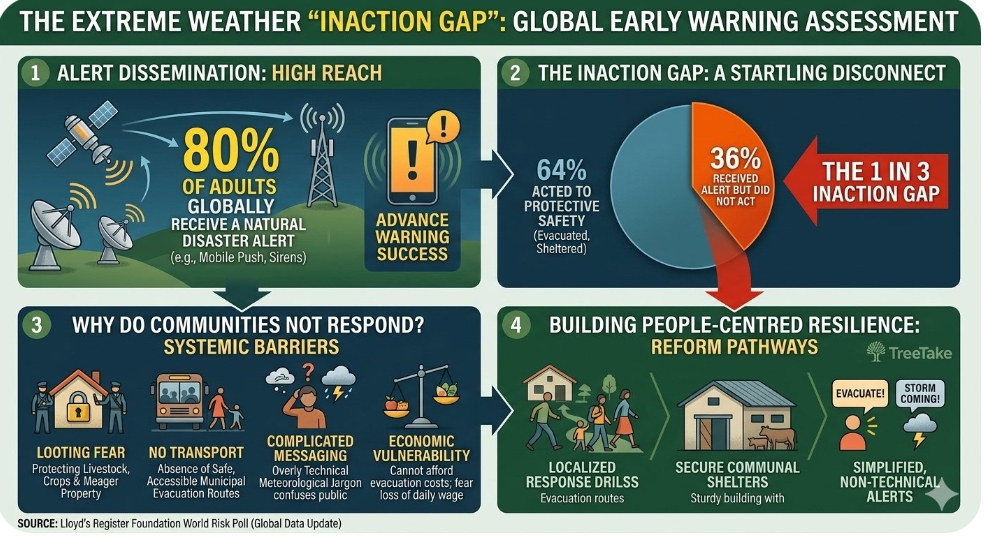
One in three individuals across the world still fails to take protective action during extreme weather events despite successfully receiving early disaster alerts. This critical behavioural breakdown forms the focal point of the global World Risk Poll published in mid-October 2026, uncovering a significant "inaction gap" that severely undermines international multi-hazard emergency frameworks.
The assessment reveals that while global investments have successfully expanded technical dissemination infrastructure—including satellite-linked broadcast systems, automated mobile push alerts, and regional sirens—the human response mechanism remains deeply fragmented. Out of approximately 80 per cent of adults globally who successfully received a warning during a recent natural disaster, a staggering 36 per cent were unable to take protective measures.
Systemic blockages to localised emergency response
The empirical data collected across high-risk ecological zones highlights that failing to act on emergency broadcasts is rarely caused by technological transmission errors. Instead, deep-seated systemic issues, structural poverty, and socio-economic vulnerabilities directly prevent local populations from evacuating or seeking storm shelters.
In vulnerable, low-income settings, families frequently delay vital evacuation processes due to a total absence of safe, accessible municipal transport networks. Many are forced to make perilous trade-offs due to a justified fear of losing their livelihoods, choosing to stay behind to guard their livestock, crops, and meagre property from potential looting. Furthermore, the continued deployment of overly technical meteorological data and dense jargon frequently confuses citizens, leaving them highly uncertain about the immediate physical threat to their households.
Institutional perspectives on people-centred reform
"The numbers show a stark truth: sending a digital notification to a mobile phone does not mean a person has the actual safety nets or physical infrastructure to act on it," observed Dr Sarah Lowe, Lead Data Analyst at the Lloyd’s Register Foundation World Risk Poll. "Our focus must rapidly pivot from simply upgrading the technical transmission towers to systematically addressing the deep financial and structural barriers that pin vulnerable communities to harm's way."
The report stresses that the international community's target of achieving universal multi-hazard warning systems is entirely incomplete without robust localised education, clear community evacuation drills, and transparent institutional trust. Emergency planners note that digital warnings must always be paired with active physical assistance at the grassroots municipal level to ensure complete compliance.
Editor's Note
The findings demonstrate that modern climate resilience cannot be built purely on technological alerting capability. If one-third of a warned population remains physically or economically paralysed during an extreme weather hazard, the alert itself loses its lifesaving value. Moving forward, disaster risk management agencies must bridge the inaction gap by investing heavily in localised response assets, secure communal livestock shelters, and simplified, non-technical alert translations. Scaling up technical forecasting is only half the battle; ensuring citizens are socially and economically equipped to act is what ultimately prevents human casualties.



Leave a comment