

TreeTake Network
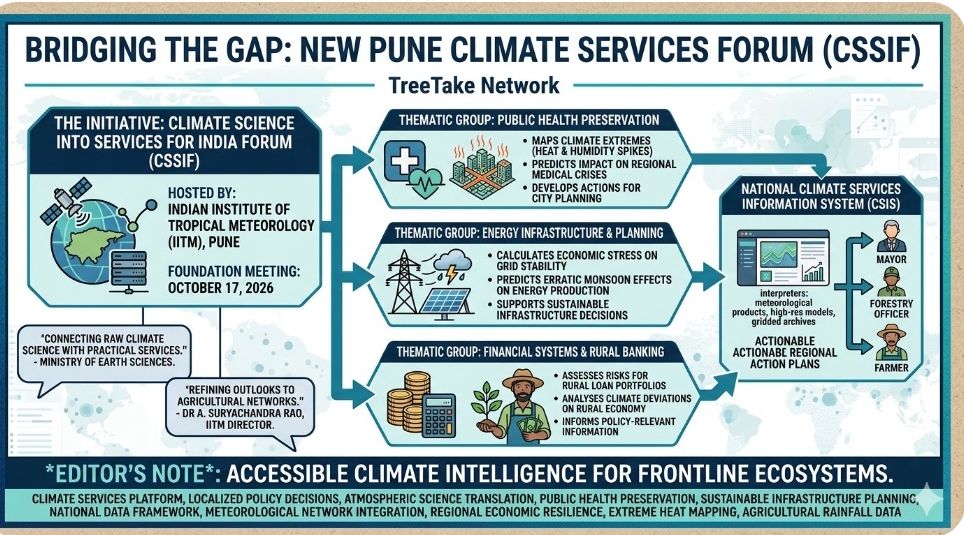
The Indian Institute of Tropical Meteorology (IITM) in Pune has officially taken the foundational step towards shifting the nation's environmental management models from passive monitoring to active, sector-specific protection. On October 17, the premier research institution hosted the first landmark stakeholder consultation meeting for the newly established Climate Science into Services for India Forum (CSSIF). The core mandate of this initiative is to engineer a unified National Climate Services Information System (CSIS) capable of translating complex global climate simulations into localised, everyday guidance for the public and private sectors.
Targeting high-risk sectors
The consultation brought together over 150 elite experts representing more than 80 institutions, spanning central ministries, research academies, non-governmental organisations, and corporate finance entities. Rather than publishing generalised environmental warnings, the forum broke down its operational task into dedicated thematic groups targeting the sectors most vulnerable to rapid climate shifts: health, energy, and finance.
The health division is prioritising the mapping of climate extremes, investigating how sudden, severe spikes in humidity and heat translate into regional medical crises. Concurrently, the energy and finance groups are designing predictive frameworks to calculate the economic stress vectors that rising temperatures and erratic monsoon phases impose upon infrastructure stability and rural banking systems.
"The core focus is connecting raw climate science with highly practical services to support policy-relevant information and informed decision-making," noted a key structural briefing from the Ministry of Earth Sciences. By designing customised mathematical models, scientists intend to give regional administrators the data required to adjust urban planning and economic strategies years before environmental transformations manifest.
Designing the structural blueprint
Technical presentations throughout the day highlighted the integration of multi-layered weather products, high-resolution predictive climate models, and historical gridded archives. In the past, localised bodies struggled to implement preventative ecological policies due to the vast technical gap between raw meteorological readouts and actionable municipal tasks. The CSIS framework plans to systematically bridge this gap by acting as a national interpreter, transforming atmospheric discoveries into clear, targeted regional action plans.
"The thematic sessions provided a platform for brainstorming and highly interactive discussions on sector-specific climate information needs and applications," remarked Dr A. Suryachandra Rao, Director of IITM, during the opening proceedings. The initial technical rollout will focus heavily on refining seasonal and sub-divisional temperature and rainfall outlooks, ensuring agricultural networks receive highly accurate data regarding seasonal deviations.
Editor's Note
The establishment of the CSSIF represents a vital evolution in how modern societies must approach environmental governance. For decades, the global scientific community has excelled at documenting ecological decline, yet translation into preventative local policy has remained dangerously slow. By binding state-level ministries, financial analysts, and environmental researchers to a single interpretive platform, Pune is establishing an essential administrative template. The success of this forum will depend entirely on its ability to democratise its findings—ensuring that deep climate intelligence is freely accessible to small-scale farmers and regional forestry officers, who stand on the absolute front lines of this escalating global crisis.



Leave a comment