

TreeTake Network
Deep within the thick sediment layers of Bianfu Cave in the Yunnan Province of southwestern China, an extraordinary archaeological excavation has revealed how ancient ecosystems provided a vital shield for hominin survival during severe global glacial phases. An international scientific team led by Professor Qiaomei Fu from the Institute of Vertebrate Palaeontology and Paleoanthropology of the Chinese Academy of Sciences has identified the first-ever Denisovan forearm bone from a massive collection of 60,000 fragmented animal remnants. The fossil, along with surrounding environmental evidence, reveals a highly resilient conifer forest ecosystem that served as a prehistoric paradise during intense global cooling events.
A protective ancient habitat
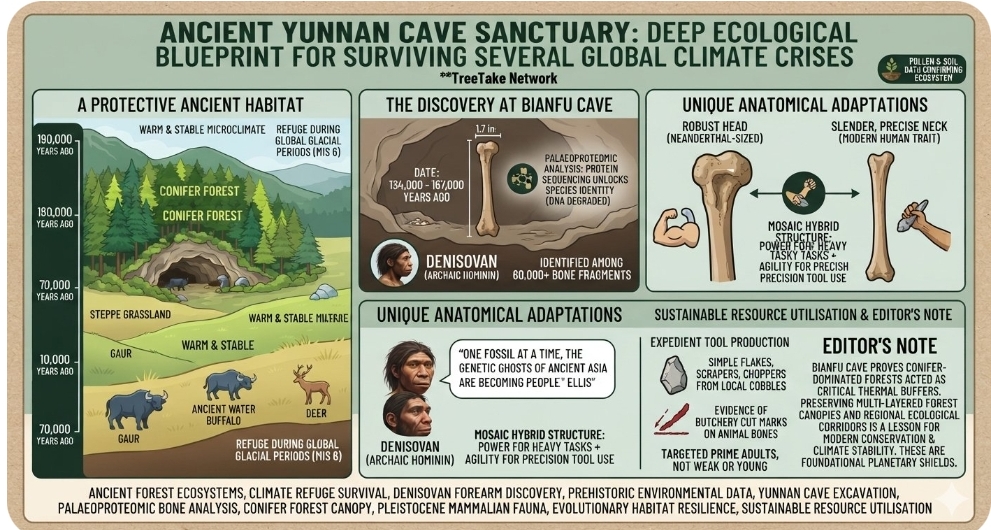
The excavation layers, spanning a deep sequence from 190,000 to 70,000 years ago, have allowed researchers to reconstruct the prehistoric environment of the Yunnan-Guizhou Plateau. Fossilised pollen and soil core data recovered alongside the hominin remains indicate that while higher latitudes suffered under catastrophic glacial sheets during Marine Isotope Stage 6, this southern pocket maintained a stable, mild, temperate climate dominated by expansive conifer forests and productive steppe grasslands.
This microclimate supported a dense population of large mammals, including ancient water buffalo, gaur, and deer. The Denisovans repeatedly occupied the cave over tens of thousands of years, leveraging the dense forest canopy for shelter and implementing highly strategic hunting and processing methods, as evidenced by clear butchery cut marks on the recovered animal bones.
Anatomical adaptations for survival
Because the warm and humid conditions of the cave caused ancient DNA to degrade rapidly, the research team utilised an advanced palaeoproteomic technique to analyse bone collagen proteins, identifying five distinct Denisovan specimens: two skull fragments, two teeth, and the highly significant partial radius forearm bone.
Dating between 134,000 and 167,000 years ago, the 1.7-inch forearm bone provides the world's first direct look at the postcranial limb anatomy of this enigmatic species. The bone exhibits a fascinating anatomical mosaic: it features a robust, thick joint head and muscle attachments that mirror the heavy-duty lifting capabilities of Neanderthals, yet its neck structure displays a slender, advanced geometry closely aligned with modern humans.
"These conditions were completely unsuitable for standard DNA preservation, but our protein analysis successfully unlocked the species identity," stated senior geneticist Professor Qiaomei Fu. The mosaic structure suggests these ancient humans possessed a unique evolutionary adaptation, combining the sheer physical upper-body power required for heavy hunting tasks with the precise manual dexterity needed to shape tools from the surrounding forest resources.
"For years, Denisovans were almost ghosts—known largely from DNA, a handful of teeth and scattered fragments. Now scientists have identified something never confirmed before: part of a Denisovan arm," observed evolutionary chronicler Jason Ellis, highlighting the immense physical significance of the find. "Genetic evidence shows they interbred with our ancestors. But for years, genetics told us far more about Denisovans than their bones ever could. Now that imbalance is beginning to change. One fossil at a time, the genetic ghosts of ancient Asia are becoming people."
Resource utilisation and technology
The Denisovans at Bianfu Cave did not rely on complex, mass-produced weaponry. Instead, the layers yielded nearly 1,400 simple stone and bone flakes, scrapers, and choppers. The hominins engaged in opportunistic, expedient tool production, using local river cobbles and unmodified animal bones to quickly process meat and smash open large herbivore bones for nutrient-rich marrow.
Data show they specifically targeted healthy, prime-aged adult animals rather than the weak or young, displaying a formidable apex-predator status that relied entirely on the surrounding wild ecology. This highly flexible behaviour indicates that their survival was driven by a deep, intimate understanding of their immediate forest habitat, allowing them to thrive sustainably without overexploiting their natural surroundings.
Editor's Note
The rich environmental data recovered from Bianfu Cave offers a profound lesson for modern conservation and forestry governance. This discovery proves that complex conifer-dominated forest ecosystems have historically acted as critical thermal buffers, shielding biodiversity and hominin populations alike from the worst impacts of global climate shifts. As the world faces accelerating modern climate instability, preserving multi-layered forest canopies and regional ecological corridors must be prioritised. Protecting these ancient natural sanctuaries is not just about saving trees; it is about maintaining the foundational planetary shields that have sustained large-scale mammalian and human life across hundreds of millennia.



Leave a comment