

TreeTake Network
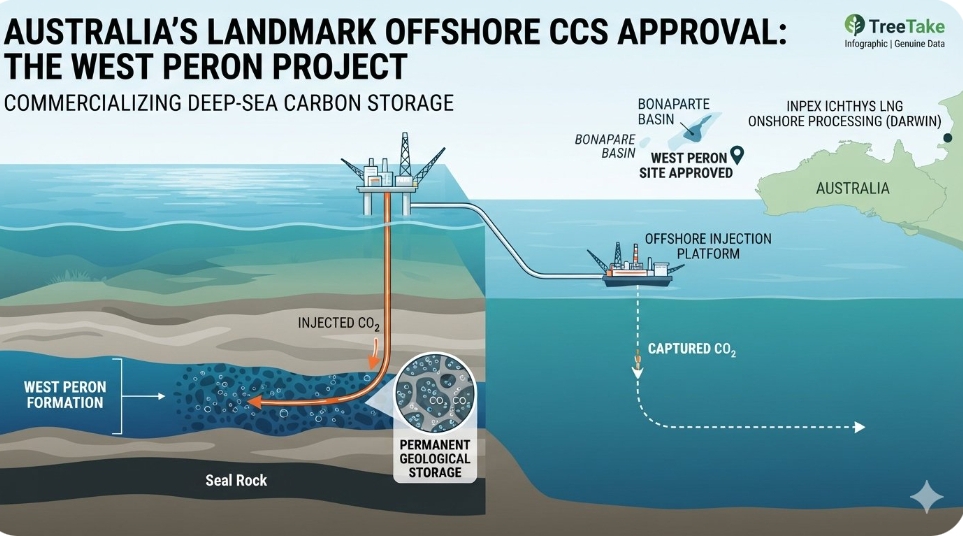
The Australian Federal Government has formally recognised the West Peron deep-sea geological formation within the Bonaparte Basin as an identified greenhouse gas storage reservoir for the massive Bonaparte carbon capture and storage project. Spanning a projected 35-year operational lifecycle, the venture proposes to permanently inject up to 443 million tonnes of compressed carbon dioxide deep beneath the ocean floor. Operating under the anchor sponsorship of Japan’s primary energy explorer, Inpex, alongside partners like TotalEnergies, the venture aims to capture up to 40 per cent of operational emissions originating from the Ichthys liquefied natural gas facilities near Darwin.
The decision represents a major strategic shift in oceanic industrial management, making it Australia's first official designation of an offshore saline aquifer for emissions containment. Presenting the formal decision on October 16, 2026, Australian Resources Minister Madeleine King stated:
"Carbon capture and storage will play an essential role in lowering the environmental footprints of heavy industries where reducing emissions remains fundamentally difficult. This formal declaration ensures that Australia continues to build a robust regulatory pathway toward our net-zero targets while securing long-term regional energy investments."
Commercial operations and preliminary carbon injections are currently being targeted by engineers for the early 2030s, contingent upon forthcoming commercial structures and local Northern Territory environmental clearances.
Editor's Note
This offshore storage framework highlights a critical reliance on geological engineering to offset fossil fuel extraction. The way forward requires strict, continuous monitoring of deep-sea seismic integrity to ensure injected gases do not escape back into the biosphere.



Leave a comment