

TreeTake Network
The United Nations has issued an urgent warning to regional governments regarding a massive, climate-driven demographic shift currently altering the fragile valleys of the Hindu Kush Himalayas. On Oct 17, speaking from New Delhi during a formal regional security assessment, United Nations International Organisation for Migration (IOM) Director General Amy Pope confirmed that accelerating ecological changes, highlighted by a sudden and catastrophic glacial lake outburst flood in late August, are driving thousands of indigenous mountain residents from their ancestral lands. The systematic loss of natural freshwater buffers is forcing rapid, unplanned urbanisation across North India and neighbouring territories.
The collapse of natural water towers
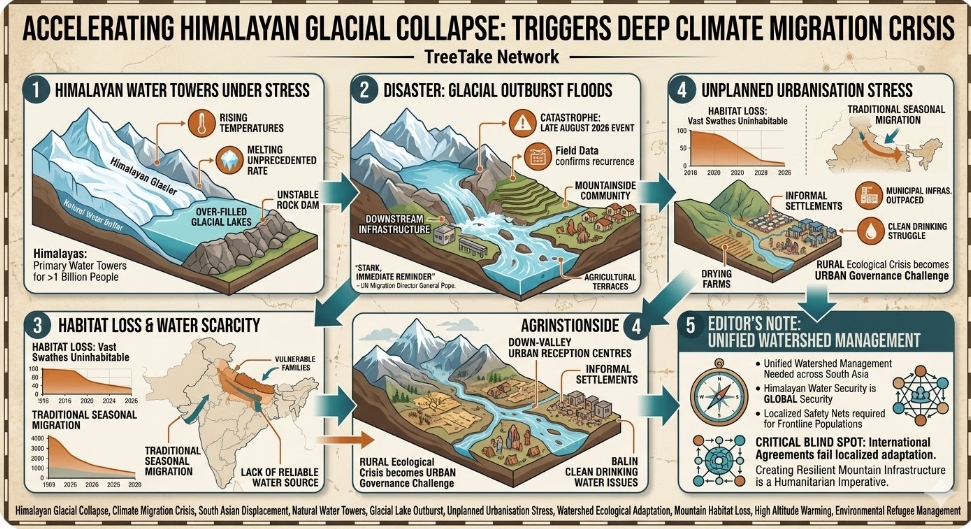
The high-altitude glaciers of the Himalayas serve as the primary water towers for South Asia, regulating life-sustaining river flows for over a billion people. However, rising temperatures have caused these ancient ice sheets to melt at an unprecedented rate, creating volatile, overfilled glacial lakes contained only by unstable mud and rock dams.
The catastrophic sudden rupture of these barriers in late August wiped out critical downstream infrastructure, agricultural terraces, and entire mountainside communities. Field data indicate that these recurrent natural disasters are actively rendering vast swathes of the high-altitude terrain completely uninhabitable, permanently breaking the localised water cycle that communities rely on for survival.
"The late August glacial collapse is a stark, immediate reminder that climate change is no longer a future threat; it is a contemporary driver of human displacement," stated UN Migration Director General Amy Pope during her policy brief. "The accelerated melting of these glacial systems is actively forcing families to abandon their drying farms, creating an unprecedented wave of climate-induced migration that requires coordinated regional infrastructure planning."
Unplanned urbanisation and local stress
The sudden exodus of mountain communities is creating severe logistical stress on the down-valley urban reception centres of the Indian subcontinent. As families migrate to escape rural water scarcity and flash flood vulnerabilities, small foothills and plains towns are experiencing rapid, unplanned population growth that vastly outpaces municipal infrastructure capacity. Local governments are struggling to provide basic amenities, clean drinking water, and waste processing services to these expanding informal settlements, converting a rural ecological crisis into a multi-layered urban governance challenge.
"Our monitoring shows that traditional seasonal migration patterns have broken down completely," observed regional migration analyst Dr Sonam Tsering. "People are not moving temporarily for winter work; they are moving permanently because the structural water security of their home valleys has dissolved. If we do not implement cross-border ecological adaptation frameworks immediately, the civil infrastructure of the receiving cities will face systemic failure."
Editor's Note
The escalating displacement of Himalayan communities highlights a critical blind spot in current global environmental policy. International climate agreements routinely focus on macro-level emissions targets while consistently failing to build localised economic and physical safety nets for the vulnerable frontline populations actively losing their habitats. Governments across South Asia can no longer treat glacial retreat as an isolated meteorological incident. The management of the Himalayan watershed must be unified with state urbanisation policies and cross-border migration frameworks. Preserving these high-altitude ecosystems and building resilient mountain infrastructure is a humanitarian imperative to prevent a wider, unmanageable regional migration crisis.



Leave a comment