

TreeTake Network
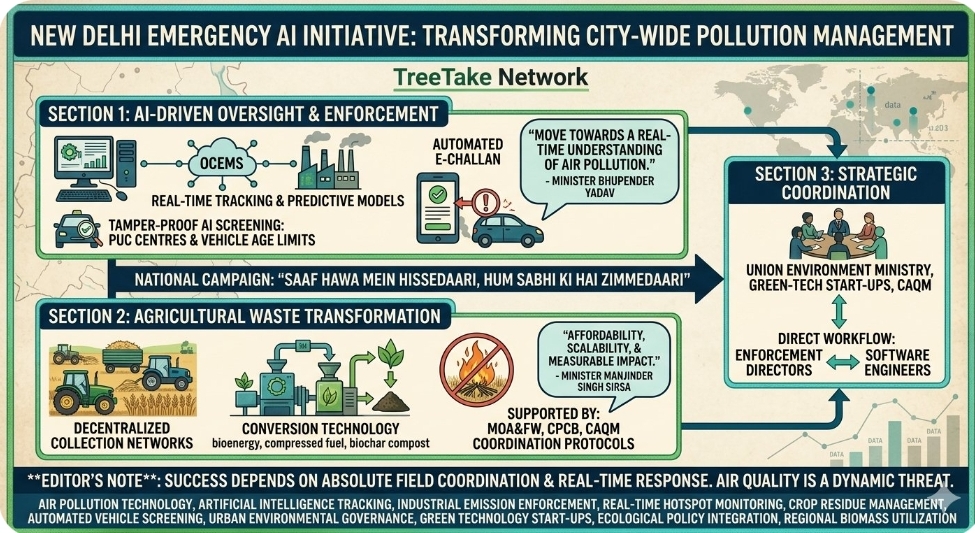
The Ministry of Environment, Forest and Climate Change has shifted its seasonal strategy against North India's winter smog from reactive containment to automated, technology-led enforcement. On October 17, 2026, Union Environment Minister Bhupender Yadav convened an emergency strategic convention in New Delhi with green-tech entrepreneurs, start-ups, and statutory bodies to integrate artificial intelligence (AI) directly into the capital's anti-pollution enforcement infrastructure. Moving under the national campaign 'Saaf Hawa mein Hissedaari, Hum Sabhi ki hai Zimmedaari', the interface establishes a direct workflow connecting independent software engineers with enforcement directors.
Automated tracking and enforcement modules
The technical framework targets multiple localized pollution vectors across the National Capital Region (NCR). Central to the new technological deployment is the implementation of real-time predictive models designed by local start-ups. These tools link live city-wide data arrays from Online Continuous Emission Monitoring Systems (OCEMS) directly with industrial plant-operation registries to catch data manipulation at its source.
Concurrently, municipal bodies are testing tamper-proof, AI-driven oversight systems for Pollution Under Control (PUC) centres. These automated systems are engineered to scan traffic flows, instantly flag commercial and private vehicles operating past their legal age limits, and issue electronic penalties to units operating without valid emissions certification.
"The interaction with start-ups is a novel, proactive initiative aimed at bridging the gap between policymakers and technology innovators," stated Union Environment Minister Bhupender Yadav during the post-convention press briefing. "The major focus of the interaction was on using artificial intelligence and other technologies to move towards a real-time understanding of air pollution."
Agricultural waste transformation models
The forum dedicated significant technical analysis to resolving open-field stubble burning through decentralized industrial mechanics. Rather than relying entirely on penalizing farmers, participating innovators demonstrated integrated collection networks capable of rapidly converting raw paddy straw into bioenergy, compressed biomass fuel, and organic biochar compost.
To support these regional networks, the ministry announced a coordinated protocol with the Ministry of Agriculture and Farmers Welfare, the Central Pollution Control Board (CPCB), and the Commission for Air Quality Management (CAQM) to build structured, in-situ crop-residue storage facilities across adjacent agrarian states.
"Delhi is focused on exploring practical, technology-driven proposed solutions forward, focusing on affordability, scalability, stronger enforcement, and measurable impact," remarked Delhi Environment Minister Manjinder Singh Sirsa, emphasizing that state and central bodies are aligning resources to isolate pollution hotspots before winter meteorological conditions trap airborne particulates.
Editor's Note
The implementation of automated, AI-driven enforcement marks an essential departure from legacy pollution management models that relied on manual, easily compromised checking procedures. By using predictive traffic flow management and automated emissions tracking, New Delhi is treating air quality as a dynamic, real-time threat rather than a seasonal inevitability. However, the ultimate efficacy of this technology will not be decided inside software labs; it depends on absolute field coordination. If local enforcement officers fail to act on real-time automated flags, or if the distribution channels converting agricultural waste into clean energy remain economically unviable for rural farming communities, even the most advanced machine-learning arrays will fail to clear the capital's skies.



Leave a comment