

TreeTake Network
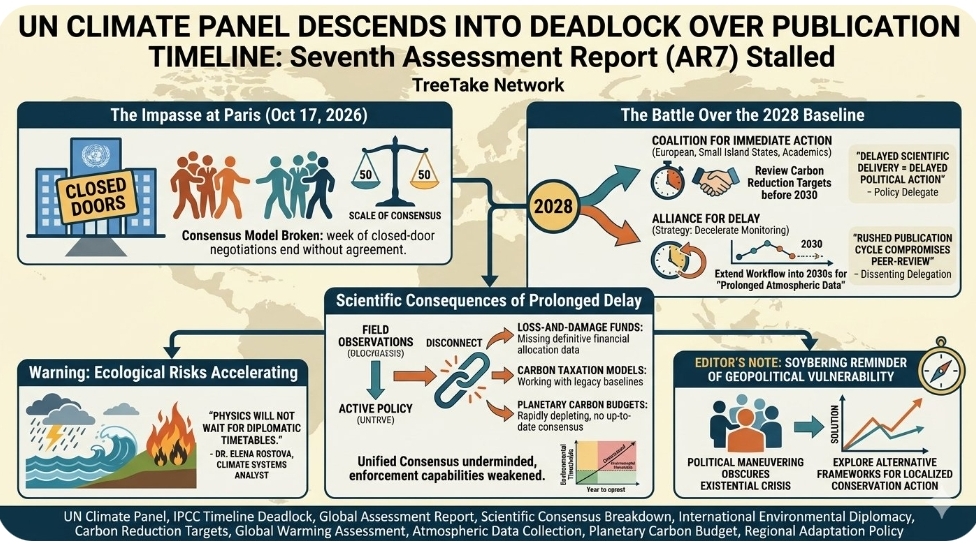
The international scientific roadmap for steering global climate policy has stalled following a deep diplomatic impasse inside the world’s premier climate advisory body. On October 17, 2026, a high-level summit hosted by the United Nations Intergovernmental Panel on Climate Change (IPCC) in Paris concluded a week of intense, closed-door negotiations without reaching a consensus on the official release schedule for its upcoming Seventh Assessment Report (AR7). The deadlock exposes a widening rift between delegations demanding immediate data to drive urgent environmental treaties and nations seeking to decelerate structural monitoring timelines.
The battle over the 2028 baseline
The central point of friction focused on whether the critical scientific synthesis report should be finalised and released by 2028. A powerful coalition consisting of European delegations, small island states, and leading academic institutions campaigned heavily for the accelerated 2028 timeline. They argued that global leaders require updated, definitive scientific evaluations to effectively review and adjust national carbon reduction targets before the end of the decade.
However, a small but strategically positioned alliance of nations successfully blocked the consensus required to adopt this schedule. These dissenting delegations maintained that a rushed publication cycle would severely compromise the thorough peer-review process of complex climate systems, arguing that standard global monitoring workflows should be extended well into the 2030s to allow for more prolonged atmospheric data collection.
"We are deeply concerned by the stalling of this timeline, as any delay in our scientific delivery directly translates to delayed political action on the ground," remarked an international policy delegate present at the Paris talks. "Without the authoritative backing of a newly synchronised IPCC report, global climate negotiations will be forced to rely on fragmented, unverified data sets during a period of accelerating ecological risk."
Scientific consequences of a prolonged delay
The scientific community has expressed profound alarm over the bureaucratic gridlock, warning that the delay will disconnect current field observations from active state policy. The IPCC's assessment reports serve as the foundational bedrock for international climate diplomacy, dictating the financial allocation mechanisms for global loss-and-damage funds and setting emission baselines for corporate carbon taxation models.
Furthermore, because the global climate system is rapidly approaching severe environmental thresholds, researchers stress that policymakers cannot afford to work from legacy scientific models. The impasse leaves international administrative bodies without a unified, up-to-date consensus on how fast planetary carbon budgets are depleting, directly undermining the enforcement capabilities of global conservation initiatives.
"The IPCC process relies entirely on scientific consensus, but when that process is used to delay the dissemination of urgent data, the mechanism itself becomes a barrier to survival," warned climate systems analyst Dr Elena Rostova. "The physics of the atmosphere will not wait for diplomatic timetables to resolve themselves. We need these reports finalized to implement immediate regional adaptation plans."
Editor's Note
The administrative paralysis within the IPCC is a sobering reminder that even the most prestigious international scientific frameworks are intensely vulnerable to geopolitical maneuvering. At a moment when global carbon sinks are destabilising and extreme weather events are continuously displacing frontline communities, delaying the release of global climate data is a dangerous step backwards. International climate panels cannot permit procedural technicalities to obscure the existential reality of the ecological crisis. Moving forward, scientific bodies must explore alternative, verified frameworks to deliver high-resolution environmental data directly to state governments, ensuring that localized conservation action is never held hostage by global diplomatic gridlock.



Leave a comment