

TreeTake Network
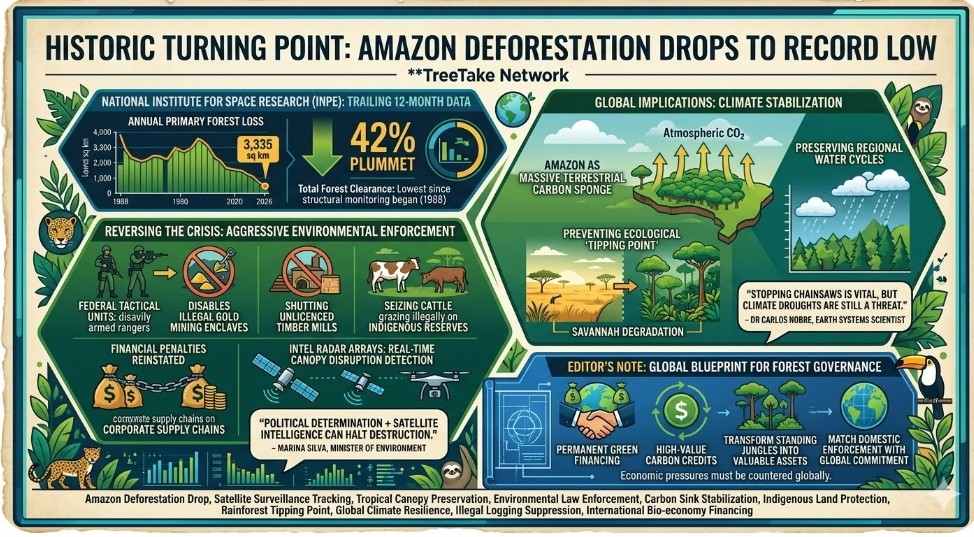
The Brazilian rainforest has reached a defining ecological turning point that provides major global leverage for tropical canopy conservation. On October 17, 2026, official satellite surveillance data compiled and verified by Brazil’s National Institute for Space Research (Inpe) confirmed that deforestation across the Amazon basin has plummeted by 42 per cent over a trailing 12-month sequence. Total forest clearance dropped to 3,335 square kilometres, marking the lowest documentation of annual primary forest loss recorded since automated, structural satellite monitoring metrics first began in 1988.
Reversing a decades-long crisis
The dramatic reduction in primary forest clearing is a direct consequence of a comprehensive restructuring of regional environmental policing. Over the past year, federal authorities deployed heavily armed tactical units to dismantle illegal gold mining enclaves, shut down unlicensed timber extraction mills, and seize cattle herds grazing unlawfully on protected indigenous reserves.
Concurrently, the reinstatement of heavy financial penalties against corporate agricultural supply chains trading in illegally deforested land effectively cut off international market access for rogue operators. Intelligence agencies also deployed real-time satellite radar arrays capable of detecting canopy disruptions through heavy cloud cover, allowing field rangers to intercept illegal logging operations before large-scale clearing could occur.
"This historic drop proves that political determination combined with real-time satellite intelligence can systematically halt the destruction of our planet’s vital carbon sinks," stated Marina Silva, Brazil's Minister of Environment and Climate Change. "We have successfully broken the momentum of powerful logging mafias. Our focus must now transition from pure tactical law enforcement to building sustainable bio-economies that keep the forest standing permanently."
Global implications for climate stabilisation
The stabilisation of the Amazonian canopy is a critical victory for planetary climate resilience. As the world’s largest tropical rainforest, the Amazon acts as a massive terrestrial carbon sponge, locking away billions of tonnes of atmospheric carbon dioxide.
Palaeoclimatologists and forest ecologists warn that decades of continuous burning and fragmentation had pushed sections of the eastern and southern Amazon dangerously close to an ecological "tipping point"—a threshold where the rainforest would permanently degrade into a dry, fire-prone savannah. The sudden, drastic suppression of logging activities buys critical time for natural forest regeneration and helps preserve the regional water cycles that fuel South American agriculture.
"The 42 per cent drop is a monumental achievement, but the rainforest is still under extreme stress from global climate anomalies," warned Dr Carlos Nobre, a leading Earth systems scientist. "Even as we stop the chainsaws, we are seeing severe, climate-driven droughts drying out Amazonian river networks. Protecting this ecosystem now requires a dual approach: absolute zero-deforestation policies combined with rapid global emissions reductions."
Editor's Note
The unprecedented decline in Amazonian deforestation provides an unassailable blueprint for global forest governance. It conclusively demonstrates that structural environmental degradation is not an unstoppable economic inevitability, but a policy variable that can be controlled through rigorous enforcement and clear political courage. However, this hard-won progress remains fragile. If international markets fail to reward conservation-driven nations with robust green financing, or if global consumption patterns continue to demand cheap, land-intensive commodities, the economic pressures to clear primary forests will inevitably return. The global community must match Brazil's domestic enforcement success by establishing permanent, high-value carbon credit frameworks that transform standing, living jungles into a nation's most valuable asset.



Leave a comment