

TreeTake Network
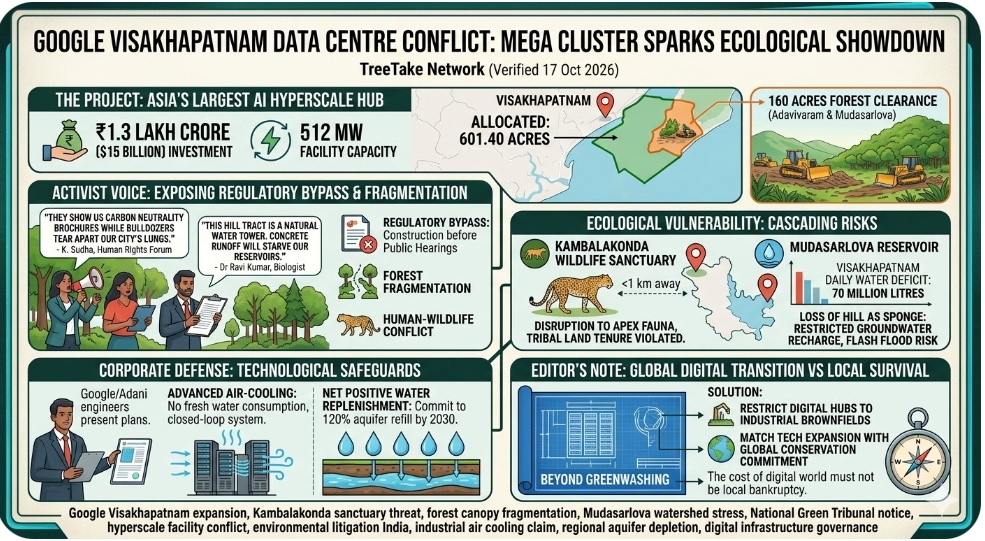
A sharp confrontation between rapid digital expansion and environmental preservation has intensified on the coastline of Andhra Pradesh. American technology giant Alphabet, parent company of Google, has commenced the construction phase of a massive 1.3 lakh crore rupee ($15 billion) Artificial Intelligence (AI) data centre and hyperscale cloud cluster in Visakhapatnam. The state government officially allocated a total footprint of 601.40 acres across the Visakhapatnam and Anakapalli districts for the industrial expansion, out of which 160 acres of dense, hilly forest terrain near Adavivaram and Mudasarlova villages is currently being systematically cleared. The large-scale flattening of these pristine hills has triggered intense resistance from regional wildlife conservation groups and local indigenous communities.
Threats to high value biodiversity corridors
The projected 512-megawatt (MW) hyperscale facility sits directly on the boundary of the ecologically fragile Kambalakonda Wildlife Sanctuary, located less than one kilometre from the designated Eco-Sensitive Zone (ESZ). Heavy earth-moving machinery has stripped native vegetation and centuries-old mango and cashew orchards, permanently fracturing vital migratory paths used by local wildlife.
Furthermore, the metropolitan area of Visakhapatnam already operates under a chronic structural water deficit, suffering a daily shortage of approximately 70 million litres. The project site is situated adjacent to the Mudasarlova Reservoir, the primary source of clean drinking water for the city. Local environmental assemblies warn that replacing the natural forest canopy with massive concrete, heat-generating server blocks will severely restrict groundwater recharge, drying up the watershed for future generations.
"We cannot consume data to survive; our communities require fresh water and breathable air. The administration has bartered away our long-term ecological heritage and agrarian livelihoods to multi-national technology firms for short-term economic metrics," declared local displaced farmers during a coordinated sit-in demonstration outside the industrial zone.
Activists expose regulatory bypass and environmental damage
On the ground, a broad coalition of environmental defenders, legal activists, and scientists have stepped up direct monitoring of the site, accusing developers of actively bypassing statutory ecological checks. Field investigators from the Human Rights Forum (HRF) documented that structural rock-blasting and heavy grading operations began before mandatory public hearings were properly concluded, directly violating local tribal land-tenure safeguards. Activists have also pointed out that the targeted hills serve as natural structural barriers, absorbing torrential monsoon precipitation and shielding downstream residential pockets from devastating mudslides and flash floods.
"What we are witnessing in Visakhapatnam is a textbook case of predatory greenwashing by tech billionaires," stated veteran environmental activist and HRF state committee member K. Sudha during an emergency press briefing. "They show us glossy brochures about carbon neutrality while their heavy bulldozers are physically tearing apart the lungs of our city. This hill tract is an irreplaceable natural water tower. If you replace these complex roots and topsoil with miles of flat concrete, the rainwater will simply run off as a destructive torrent, flooding the lowlands while starving our city reservoirs of essential ground seepage."
Local wildlife biologists have also raised alarms over the severe disruption to the sanctuary's apex fauna. "Kambalakonda is home to the endangered Indian leopard, the rusty-spotted cat, and rare avian populations," observed conservationist Dr Ravi Kumar. "These animals do not recognize bureaucratic property boundaries. By placing an immense, noisy, heat-generating data factory right on their territorial doorstep, we are triggering severe human-wildlife conflict that will force these animals directly into nearby human settlements."
Legal intervention and regulatory oversight
The accelerating environmental clearance operations have encountered immediate legal resistance across multiple judicial platforms:
- National Green Tribunal Action: On October 17, 2026, the Principal Bench of the National Green Tribunal (NGT) officially issued formal show-cause notices to central environmental ministries and state enforcement bodies following a petition filed by former municipal representative Boddu Ganga Rao. The application seeks a total stay on construction, asserting that the environmental clearance granted on June 10, 2026, violated statutory coastal and forest zoning rules.
- High Court Public Interest Litigation: The Human Rights Forum (HRF) alongside regional conservationists filed a Public Interest Litigation (PIL) in the Andhra Pradesh High Court, demanding an immediate halt to all rock-blasting operations and tree felling near the Kambalakonda boundary until independent environmental impact assessments are concluded.
Corporate mitigation strategies and state justification
As public criticism mounts, Alexander Smith, Head of Asia-Pacific Infrastructure and Energy for Google, issued a structural framework outlining the firm's technological safeguards. The company claims it is taking specialized steps to isolate the facility's footprint from the local environment:
- Advanced Air Cooling Infrastructure: To prevent the consumption of millions of litres of fresh water typically required by legacy liquid-cooled server clusters, the facility will implement specialized closed-loop air-cooling and industrial sound-dampening panels.
- Net Positive Water Replenishment: The corporation has committed to a binding target to artificially replenish 120 per cent of its operational water usage back into the local Visakhapatnam municipal aquifers by 2030.
- State Administrative Defense: The Andhra Pradesh Industrial Infrastructure Corporation (APIIC) submitted testimonies to the High Court stating the project is in the vital public interest, projecting the creation of over 87,000 indirect employment opportunities and establishing the region as a primary digital gateway.
Editor's Note
The crisis unfolding in Visakhapatnam serves as a stark warning about the hidden ecological costs of the global digital transition. Theoretical commitments to air-cooling technology or corporate promises of 120 per cent aquifer replenishment can never truly replace the lost biodiversity of a flattened mountain range or a fragmented wildlife sanctuary. Erecting massive, energy-intensive data complexes on the immediate perimeter of protected conservation areas introduces irreversible thermal stress and environmental vulnerability to an already water-scarce coastline. Modern infrastructure planning must mandate that digital hubs are restricted to degraded industrial brownfields rather than erasing primary forest buffers. If we continue to compromise the foundational natural systems that sustain human life simply to anchor virtual networks, we risk leaving future generations completely bankrupt of real-world resources.



Leave a comment