

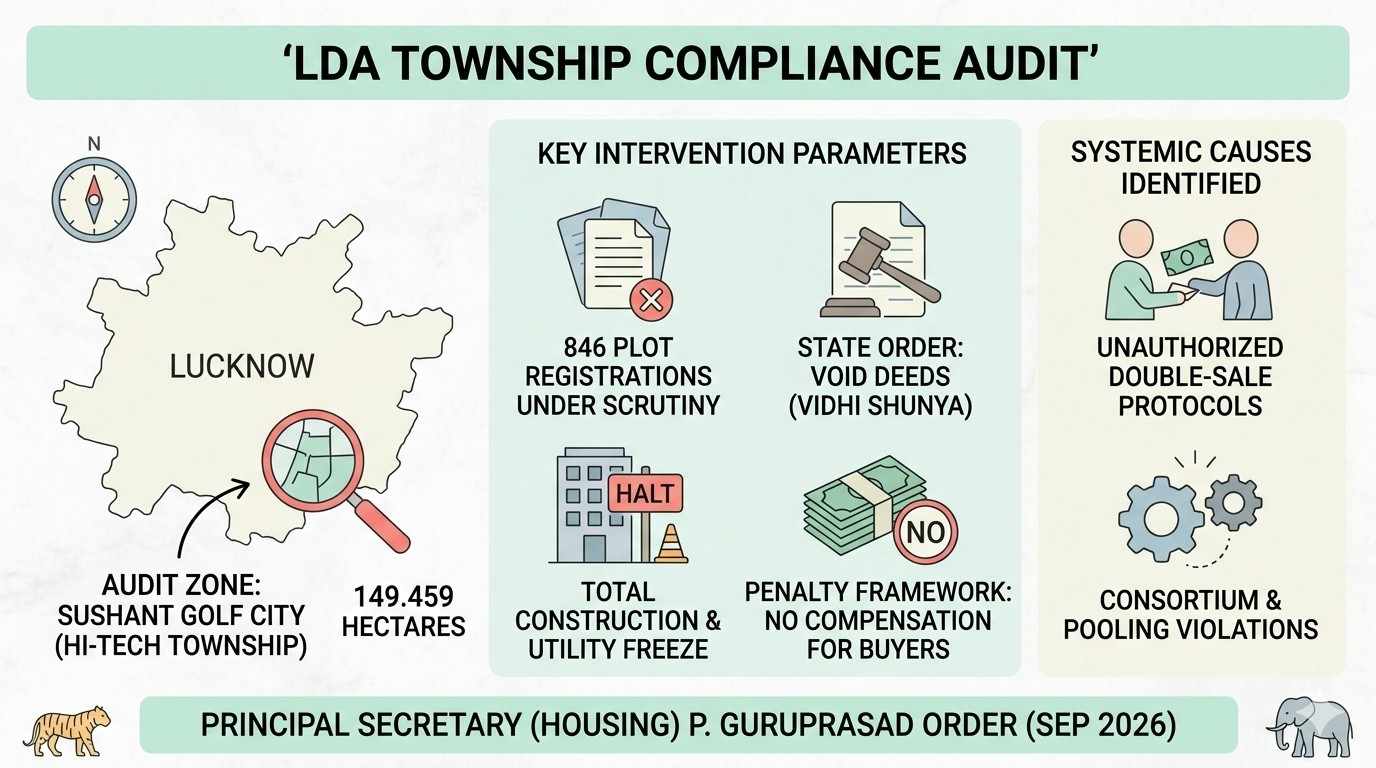
The administrative frameworks governing urban expansion in Uttar Pradesh's capital district have faced a significant regulatory intervention. The Lucknow Development Authority has officially launched a sweeping compliance audit, threatening the formal cancellation of 846 individual real-estate plot allocations across a premium residential corridor. The multi-billion rupee dispute targets systematic violations of the state's Hi-Tech Township Policy, exposing a double-sale scheme that has compromised large blocks of infrastructure land. TreeTake delivers a detailed operational report on this real-estate confrontation, detailing the specific corporate layout deviations, the legal gridlocks confronting third-party buyers, and the strategic planning reforms required to protect subcontinental land tenure systems.
A major regulatory crackdown has disrupted the property layout grids of northern India's fastest-growing urban periphery. The Lucknow Development Authority has initiated comprehensive legal proceedings to review, suspend, and potentially cancel 846 plot registrations spanning a highly publicised modern township layout. The aggressive enforcement sweep follows detailed field inspections that exposed a massive corporate and land-consortium dispute valued at over 1,000 crore rupees, revealing systematic double-sale protocols that completely bypassed central municipal clearance registries.
The Consortium Violations and the Spatial Footprint
The technical enforcement logs tracking urban landscape modifications underwent an immediate escalation as the authority's senior planning cells finalised their geographic audit of the township sector. The primary investigation focuses on a contiguous land block encompassing 149.459 hectares, originally integrated into a development arrangement under the state government's specialised Hi-Tech Township Policy. Under this administrative framework, private developers were granted permission to acquire large agricultural properties through an internal consortium model to engineer self-contained smart cities equipped with modern drainage, solar grids, and high-capacity transport links.
The core of the legal confrontation turns on a severe breakdown in corporate financial contracts and basic title transfers. Official audit papers show that while the primary developer, Ansal API, had executed formal agreements and disbursed substantial compensation packages to the original land-owning consortium members, those members subsequently circumvented the transaction records. Field monitoring units verified a deeply disturbing pattern where multiple consortium partners covertly resold the same land parcels to third-party individual buyers, collecting parallel capital inputs while creating an overlapping registry web that leaves hundreds of middle-class families without any legal right to physical possession.
The Administrative Freeze and Buyer Vulnerabilities
The enforcement bottleneck is heavily aggravated by a structural failure of local registration bodies to check basic encumbrance certificates before recording deeds. The Lucknow Development Authority has officially directed its engineering and property wings to freeze all construction clearances, boundary wall approvals, and utility connections across the contested 149.459 hectares until a high-level committee resolves the title histories. This total administrative freeze leaves third-party buyers facing immense financial risk, as they have already invested life savings into plots that are now legally designated as unauthorised structures built on disputed corporate land.
This regulatory insulation has faced firm resistance from citizen welfare groups and real-estate legal specialists who point out that allowing municipal registries to record land transfers without cross-referencing master developer allocations represents a total breakdown of state planning controls. Senior administrative planners close to the inquiry clarify that by allowing a parallel registry network to function unmonitored for months, local bureaus have permitted private cartels to inflate property prices artificially while concealing systemic financial deficits, proving that the public administration failed to prioritise automated land tracking over rapid urban expansion indices.
Strategic Paths to Urban Land Accountability
Dismantling the systemic failures gridlocking subcontinental real-estate development requires a total transformation of property registration protocols and municipal governance. The primary lesson to learn from this multi-billion rupee township breakdown is that paper-based land deeds cannot substitute for the real-time tracking of spatial title allocations. Municipal development frameworks must be statutorily banned from approving private consortium townships until the underlying land holdings are completely cleared of overlapping claims.
First, the Department of Revenue must legally mandate the integration of a centralised, blockchain-backed National Land Traceability Ledger, forcing all development authorities to map every single plot allocation onto unalterable geospatial grids that automatically block any secondary registration attempts on the same coordinate block. Second, the judiciary must implement strict statutory mandates that compel local development boards to finalise title verification processes within a maximum of thirty days post-dispute, ensuring that fraudulent sellers are held personally liable under criminal fraud acts while insulating innocent buyers from long-term litigation loops. Finally, the state government must introduce automated satellite monitoring arrays linked directly to an independent Real Estate Regulatory Authority portal, guaranteeing that no private developer can alter layout footprints or sell un-notified sub-plots without transparent central data tracking, thereby engineering absolute long-term accountability into the foundational tier of subcontinental urban planning.


.jpg?resize=120%2C90&ssl=1)



Leave a comment