

TreeTake Network
The fragile Himalayan eco-corridor has suffered its most severe ecological and infrastructural shock in decades. A massive border glacier collapse on the dividing line between Nepal and the Tibet Autonomous Region of China has triggered a sequence of catastrophic flash floods and intense debris flows. The surge has completely devastated downstream towns, wiped out international checkpoints, and trapped hundreds of infrastructure personnel.
The disaster has ignited a fierce environmental debate over the rapid, unchecked commercial expansion of riverine construction projects in highly unstable, climate-vulnerable alpine valleys.
The Scale of Human and Ecological Devastation
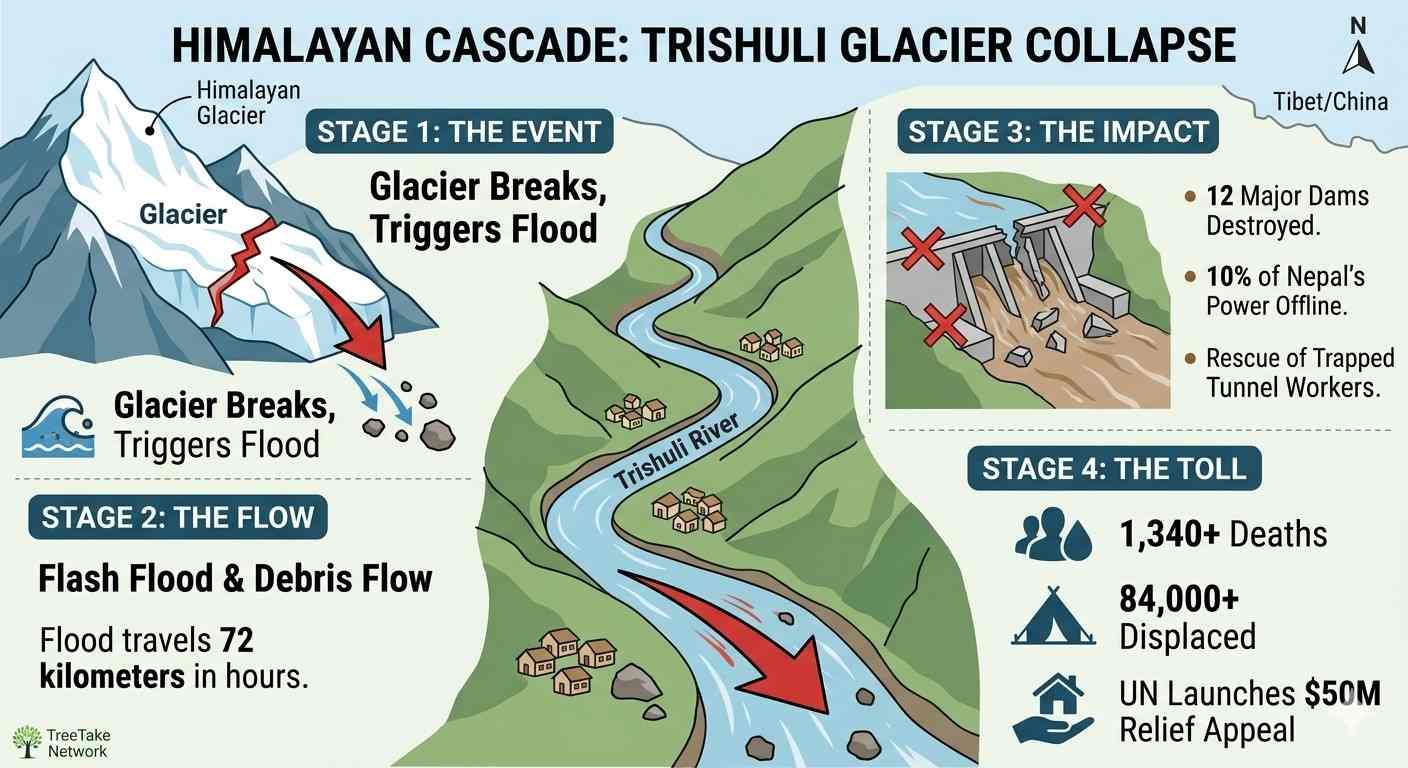
The rushing wall of water and rock travelled aggressively down a 72-kilometre stretch of the Trishuli River basin.
- Rising Demise: The official death toll has climbed steeply to 1,344 individuals as disaster rescue teams extract more bodies from heavily buried structures, while thousands remain missing.
- Amputated Recoveries: Highlighting the sheer physical force of the debris flow, police reports confirm that 501 of the recovered remains consist of amputated bodies pulled directly from the thick mud.
- Transnational Displacement: Over 84,000 people have been severely displaced by the flood wave. The United Nations has urgently launched a $49.6 million flash appeal to provide emergency survival relief to the devastated border communities.
The Infrastructure Standoff: Hydropower Vulnerability
The flash flood heavily compromised or entirely destroyed 12 major hydropower plants operating within the Trishuli River basin, instantaneously wiping out over 10% of Nepal's entire domestic electricity generation capacity.
- The Miracle Rescues: In high-risk, joint subterranean operations, the Nepalese military and international disaster units successfully extracted trapped tunnel workers after ten days of isolation under the mud, including a Chinese national at the Upper Trishuli-1 site and workers at the Trishuli 3A plant.
- The Energy Standoff: Government officials have scrambled to assure the public that the national energy supply grid remains functional. However, engineers admit they have no clear timeline for whether these multimillion-dollar, mud-choked concrete generation facilities can ever be structurally salvaged or safely restarted.
Official and Institutional Stances
The massive failure of riverine infrastructure has drawn sharp criticism from energy planners and environmental watchdogs alike, forcing a severe policy reckoning.
State-owned Nepal Electricity Authority Spokesperson Rajan Dhakal acknowledged that the structural baseline of regional engineering must fundamentally change.
"With climate-related disasters becoming more frequent, the time has come for a rethink of our hydropower policy," Rajan Dhakal stated, admitting that building static concrete facilities directly in active glacial pathways poses an existential economic risk.
From a local relief perspective, independent emergency organiser Hemanta Shrestha pointed out that formal administrative warnings failed to reach the most vulnerable riverbanks in time.
"Local social networks can be repurposed for disasters as phone trees, where one person alerts several others, complementing formal warning systems," Hemanta Shrestha observed, urging the government to decentralise crisis management and utilise community forestry groups to protect indigenous settlements rather than relying entirely on centralised technical forecasts.
The Transnational Crisis
The disaster has rapidly transformed into a complex cross-border humanitarian crisis, with security forces actively tracking missing travellers and missing migrant workers across international borders.
Indian Ministry of External Affairs Spokesperson Randhir Jaiswal confirmed that specialised evacuation operations have pulled 169 Indian nationals from the heavily affected Trishuli Bazaar area. However, 275 others remain unaccounted for in the flood zone.
As weather patterns stabilise over the damaged Nuwakot and Rasuwa districts, the long-term focus has turned to the structural viability of the entire Himalayan watershed. Activists are demanding immediate moratoriums on new commercial river dams, warning that treating alpine riverbeds as infinite corporate energy zones will inevitably invite further catastrophic ecological collapses.
Editor's Note
TreeTake Network continues to track the unfolding ecological crisis across the Trishuli River basin. The comprehensive structural damage sustained by the twelve compromised hydropower stations is currently being analysed by international engineering consortiums alongside the Nepal Electricity Authority. As multi-agency search and rescue operations remain active across difficult alpine terrain, final casualty assessments and infrastructure rehabilitation timelines are subject to change. Further field dispatches will be published as verified data is synchronised by our ground network.



Leave a comment