

INVESTIGATION
TreeTake Network
The high-profile resignation of senior environmental scientist Prof. Venkatesh Dutta from Lucknow’s District Ganga Committee has exposed a deep-seated governance crisis within the Ganga River basin footprint. Far from a sudden gesture, Dutta’s exit marks the culmination of a protracted battle fought alongside environmental advocates, citizen-led Public Interest Litigations, and grassroots protests. The flashpoint—administrative clearance for the 28-kilometre, four-lane Green Corridor highway planned over the Gomti River's eco-sensitive floodplain—highlights a systemic preference for engineering interventions over fluvial ecology. This investigative field report outlines how the destruction of the Gomti is not an isolated planning mishap, but part of a flawed, widespread template threatening the entire Ganga network.
The Ecologist’s Anatomy of a Dying Tributary
From a river-basin engineering perspective, treating a living, alluvial river as a fixed real estate asset destroys its natural hydrological cycle. The Gomti, which supplies billions of cubic metres of freshwater annually to the Ganga basin, relies entirely on groundwater and rain-fed systems to survive. Paving over active floodplains with high concrete embankments severs the hydrological connection between the river and its adjacent water table, blocking groundwater recharge during monsoons.
The proposed highway infrastructure restricts natural flood zones, artificially squeezing the channel. This forces monsoon runoff into a tight bottleneck, accelerating velocity, destroying downstream banks, and increasing urban flooding vulnerabilities. When natural riparian buffer wetlands are stripped and replaced with concrete, the river loses its ability to self-purify. Untreated municipal sewage remains stuck in stagnant stretches, sparking toxic algal blooms and dense hyacinth cover.
Echoes of 2015: From Aesthetic Channelisation to Highway Infrastructure
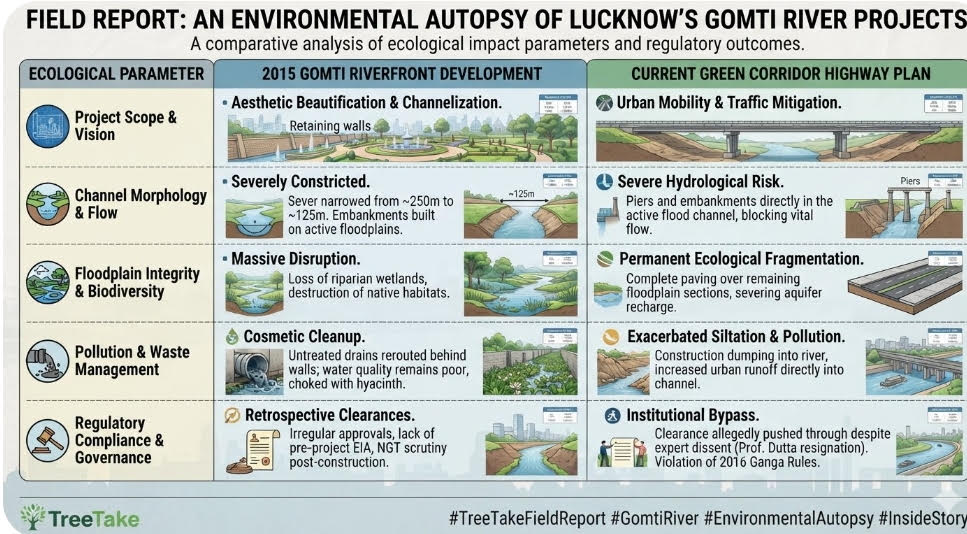
The current crisis cannot be understood without examining the historical engineering precedents that set this destruction in motion. In 2015, the state embarked on the massive Gomti Riverfront Development Project, an initiative that approached the river through a purely cosmetic lens. That project sought to create a manicured, European-style urban promenade by erecting massive concrete retaining walls that permanently narrowed the river’s active channel from 250 metres down to just over 100 metres. Millions were spent on musical fountains, paved pathways, and stadium seating, while the underlying problem of sewage injection went completely unaddressed. The 2015 intervention essentially turned a living river into a concrete-lined canal, destroying the local benthic ecosystem and creating a stagnant pool of toxic accumulation behind decorative facades.
Today’s Green Corridor highway plan represents an escalation of that same flawed philosophy, shifting the motive from aesthetic beautification to heavy transport utility. While the 2015 project commercialised the banks for leisure, the current plan treats the remaining unpaved floodplains as free, vacant real estate to build an elevated asphalt expressway. The 2015 project damaged the river’s edges, but the current highway plans threaten to permanently bury the river’s remaining aquifer recharge zones under thousands of tonnes of reinforced concrete pillars and bitumen.
Where the previous administration sought to mask ecological degradation with parks, the current master plan simply overwrites the ecosystem entirely to accommodate vehicular transit. Both projects share a fundamental refusal to recognise the floodplain as an indivisible, functional organ of the river system.
Inside Story: Retrospective Compliance and Rubber Stamps
Behind the official announcements lies a pattern of deliberate procedural avoidance. Dutta’s resignation letter notes that critical engineering plans, including Detailed Project Reports and Environmental Impact Assessments, were intentionally withheld from independent scientists until alignments were finalised and construction machinery arrived on-site. The practice of seeking post-facto or retroactive environmental clearance after heavy development has already degraded the floodplains has turned statutory committees into rubber stamps.
An environmental planner intimately connected to the state's urban development master plan shared insider insights on the condition of anonymity:
"The strategy is to create a state of administrative inevitability. Hundreds of crores are spent on initial earthwork, tree transplantation, and clearing activities before a single formal environmental review file reaches the committee desks. When independent members raise scientific objections, they are quietly told that halting progress at this stage means wasting public funds. The system treats scientists not as guides, but as legal liabilities whose signatures are required to avoid National Green Tribunal intervention."
This administrative manipulation has bred deep frustration among independent experts who feel their academic credentials are being used to shield destructive policies. Another senior ecologist who has consulted on several Ganga rejuvenation initiatives added on condition of anonymity:
"We are invited to these committees purely for optics. When we look at the maps, the highway pillars are already marked through active wetlands. If we point out that this violates the 2016 Ganga Protection Rules, the discussion is quickly steered toward engineering workarounds rather than alignment changes. The core belief among the bureaucracy is that nature can be engineered out of its natural constraints, which is a dangerous delusion."
Legal Resistance and the Citizen's Battle
The institutional bypass has forced environmentalists to seek relief through the judiciary. A comprehensive Public Interest Litigation filed by local citizen groups has challenged the project's alignment, bringing the conflict into the halls of the National Green Tribunal. The litigation highlights that the construction directly infringes upon the mandated construction-free buffer zones of the river.
A prominent environmental lawyer leading the legal challenge summarised the core argument:
"The government is exploiting legal loopholes by categorising an elevated highway as public utility infrastructure to circumvent strict floodplain protections. If the judiciary does not draw a hard line here, every riverbank in the state will be paved over for roads under the guise of public interest. This PIL is not just about saving Lucknow's waterfront; it is about preventing the legal erasure of floodplain protections across the entire country."
The legal petition argues that changing the physical and hydrological characteristics of a tributary directly impacts the main stem of the Ganga, making the local clearances granted by state boards legally suspect under federal environmental legislation.
The Government's Defence: Balancing Growth and Mobility
State planning authorities, development bodies, and municipal engineers strongly reject these ecological warnings, presenting a counter-narrative built on infrastructure modernisation and public welfare. In an official press statement, the urban development authority defended the strategic necessity of the project:
"The Green Corridor is a vital milestone in our master plan to modernise metropolitan infrastructure and resolve the city's severe traffic bottlenecks. By creating a continuous, signal-free bypass along the river periphery, we will divert thousands of idling vehicles from central corridors, significantly reducing daily vehicular emissions and improving air quality for millions of residents. Every necessary administrative protocol is being followed, and the project incorporates modern engineering safeguards to ensure structural safety without compromising the region's development goals."
Project engineers argue that concrete retaining walls provide essential flood protection for low-lying, densely populated urban colonies that were established near the banks decades ago. They maintain that economic realities require balancing environmental ideals with urban survival, asserting that Lucknow cannot attract modern enterprise or sustain its growing population without aggressive, large-scale transport infrastructure.
A Basin-Wide Crisis: The Present Scenario
The conflict unfolding along the Gomti mirrors a flawed infrastructure model being applied across the entire Ganga basin. From the heavy channelisation of the Yamuna in Delhi to the concrete interventions altering the Hindon and Varuna rivers, alluvial basins across northern India are being modified using identical, destructive engineering methods. The current situation along the Gomti is critical, with heavy earthmovers already altering the topography of the banks while the legal dispute remains unresolved.
Prof. Venkatesh Dutta's resignation stands as an objective warning from the scientific community. If city planners continue to treat floodplains as vacant real estate for highway expansions, the region risks permanently destroying its most vital freshwater lines, turning dynamic river systems into dead, concrete-jacketed drainage channels.
On-the-Record Historical References, Specific Names, and Formal Statements
Prof Venkatesh Dutta (River Ecologist and Professor at Babasaheb Bhimrao Ambedkar University, Lucknow)
The full scope of the dispute is defined directly by the text of the formal resignation letter submitted by Prof. Venkatesh Dutta to the District Ganga Committee. In his statement addressing District Magistrate Vishak G. and Divisional Forest Officer Sitanshu Pandey, Dutta wrote:
"I am officially stepping down from my position because the committee has repeatedly ignored scientific counsel and systematically withheld foundational project documents, including the Detailed Project Report and Environmental Impact Assessment, from independent review. The Green Corridor project introduces severe hydrological damage by erecting high embankments that will permanently constrain the river and disrupt critical groundwater-river interactions. It is distressing that instead of steering sustainable urban planning, the statutory clearance process is being pursued strictly as a retroactive formality after heavy construction work has already advanced across the floodplains."
Official Response from the District Ganga Committee (DGC Administration)
Administrative representatives responded to the public leak by stating:
"The administration has not formally processed or accepted any resignation through standard regulatory channels. The District Ganga Committee acts in full accordance with the environmental guidelines set by the state. The project alignment balances public transit necessity with standard urban engineering safeguards. The independent expert was part of scheduled evaluations and the current layout undergoes routine institutional verification."
Dr Sandeep Kumar (Lead Petitioner, Citizen Action Group for Alluvial Basins)
Citizen resistance and legal filings have been led by Dr Sandeep Kumar, who emphasised before the National Green Tribunal:
"Our legal petition argues that the current administration is actively violating the 2016 Ganga Protection Rules by allowing permanent asphalt infrastructure inside the river's construction-free buffer zone. We witnessed the devastating ecological fallout of the 2015 riverfront channelisation, which turned our river stagnant. The current highway initiative represents an even greater threat by burying the active floodplain. We have requested an immediate stay from the judiciary because continuing this work without independent scientific oversight will inflict irreversible ecological trauma on the entire Gomti basin."
Downstream Deprivation: The Agricultural Fallout of Gomti’s Ecocide on Rural Communities
While metropolitan planners view Lucknow’s riverfront as a canvas for transport infrastructure, rural communities living downstream see it as a life-support system in terminal decline. The Gomti River flows for roughly 500 kilometres after leaving Lucknow before merging with the Ganga near Varanasi. This downstream stretch forms the agricultural backbone of several agrarian districts, including Barabanki, Sultanpur, Jaunpur, and Ghazipur.
The heavy channelisation, floodplain destruction, and unmitigated urban sewage injection occurring upstream in Lucknow have altered the river's water chemistry. This shifts the crisis from an urban planning debate to a severe socio-economic threat for millions of rural farmers.
The Chemical Shifts: Toxic Irrigation and Soil Degradation
The conversion of the Gomti into a concrete-jacketed drainage canal inside Lucknow drastically reduces its natural dilution and self-purification capacity. When the river exits the metropolitan boundary, it carries concentrated loads of untreated municipal sewage, industrial effluents, and heavy metal residues.
- The Siltation Bottleneck: The heavy dumping of loose earth and construction debris from projects like the Green Corridor fills the riverbed downstream. This destroys natural deep-water pools, causing the river to dry up prematurely during summer months and forcing farmers to rely heavily on deep borewells.
- Electrical Conductivity and Salinity: The direct discharge of urban wastewater elevates the water's Electrical Conductivity (EC) and Total Dissolved Solids (TDS). Irrigating crops with high-EC water alters the soil structure over time, forming a hard crust that restricts water infiltration and leads to gradual soil salinisation.
- Heavy Metal Accumulation: Independent soil testing along the downstream banks reveals trace accumulations of cadmium, lead, and chromium. These toxins are absorbed by the root systems of essential food crops, including leafy vegetables, wheat, and paddy, posing a long-term threat to the regional food chain.
The Agrarian Toll: Disappearing Varieties and Yield Loss
The altered water quality has disrupted traditional farming systems that have existed along the Gomti basin for generations.
- The Collapse of Riparian Cultivation: Fragile, high-value crops traditionally grown on the moist riverbanks during the dry season—such as melons, gourds, and specific indigenous pulses—have largely vanished. The highly acidic and stagnant water rots seed varieties before they can take root.
- The Cost of Contamination: Farmers who use pump sets to draw water directly from the river report that the high chemical content corrodes metal irrigation pipes and pump impellers, doubling annual equipment maintenance costs.
- Forced Groundwater Dependency: As the river water becomes visibly black and foul-smelling, farmers are forced to abandon surface irrigation entirely. This drives a massive spike in rural electricity and diesel consumption as communities pump deeper into depleting underground aquifers.
On-the-Record Voices from the Field
Ram Baran Verma (Basin Farmer and Representative, Barabanki Agrarian Collective)
Speaking from his fields located 35 kilometres downstream of Lucknow, Verma described the visible changes in the river system:
"The river does not bring life anymore; it brings poison. Twenty years ago, we used the river water directly to irrigate our fields, and our paddy yields were abundant. Today, if that black water touches the crops, the roots rot within a week. The city builds highways on the banks, but down here, we are paying for their concrete with our livelihoods. We are forced to spend thousands of rupees on diesel pumps to draw groundwater because the river water has become completely unusable."
Dr Anjali Mishra (Agricultural Scientist and Soil Chemist, Regional Agrarian Research Station)
Dr Mishra explained the underlying environmental factors causing the agricultural decline:
"Our longitudinal soil sampling downstream of the Lucknow metropolitan exit shows a clear trend of structural degradation. The continuous application of water heavily laden with urban organic waste lowers the soil's dissolved oxygen levels and kills off beneficial microbial communities. We are observing a significant drop in multi-crop productivity across these districts. If the upstream floodplains are permanently paved over, the river will lose its seasonal dilution flow entirely, turning the downstream basin into an agricultural wasteland during the dry season."
The unfolding crisis demonstrates that river governance cannot be managed through isolated urban jurisdictions. Squeezing and polluting a river in the city directly degrades food security and rural livelihoods across the entire basin.
Silent Epidemic: The Human Cost of Gomti’s Contamination on Downstream Villages
As Lucknow’s urban planners continue to debate concrete infrastructure along the Gomti’s banks, a severe public health crisis is quietly unfolding across dozens of downstream villages. The loss of the river’s natural filtration systems upstream, coupled with the daily dumping of hundreds of millions of litres of untreated metropolitan sewage, has transformed this vital water source into a primary vector for infectious diseases.
For the rural communities of Barabanki, Sultanpur, and Jaunpur, the degradation of the Gomti is no longer just an environmental issue—it is a direct threat to human survival.
The Biological Breakdown: Pathogens and Pollutants
The biological self-purification capacity of an alluvial river depends entirely on its active, unpaved floodplains and healthy riparian wetlands. When infrastructure projects like the Green Corridor pave over these zones, the river loses its ability to dilute and break down human waste. The resulting water quality deterioration manifests in severe epidemiological hazards for downstream residents who rely on the river for washing, bathing, and livestock maintenance.
- Waterborne Pathogen Surges: The collapse of upstream dilution has caused faecal coliform levels downstream to spike thousands of times beyond permissible limits. This high bacterial concentration leads to chronic outbreaks of waterborne infections, including gastroenteritis, typhoid fever, and hepatitis A and E, particularly during the hot summer months when water levels drop.
- Aquifer Contamination: The heavy pollution load does not remain restricted to the surface. Over years of sustained toxicity, harmful chemicals and pathogens leach through the porous alluvial soil into shallow groundwater tables. This contaminates the localised hand pumps and open wells that serve as the sole source of drinking water for thousands of rural households.
- Vector Breeding Grounds: The combination of low flow velocities, heavy siltation, and thick hyacinth mats caused by nutrient-rich sewage creates ideal, stagnant breeding grounds for disease vectors. Downstream villages report a substantial increase in seasonal malaria and dengue cases compared to communities situated further away from the river banks.
The Societal Strain: Chronic Illness and Economic Drain
The burden of this environmental degradation falls heaviest on vulnerable, low-income agrarian families who lack access to advanced water filtration systems or affordable private healthcare.
- Childhood Stunting and Malnutrition: Chronic, recurring diarrheal diseases among children in these riparian belts prevent proper nutrient absorption. Local health workers link the high rates of early childhood malnutrition and school absenteeism directly to the use of contaminated groundwater.
- Dermatological Epidemics: Direct physical contact with the river water has become hazardous. Men and women who work in the fields or wash clothes along the banks suffer from chronic skin lesions, fungal infections, and chemical dermatitis that resist standard treatments.
- The Medical Debt Trap: For a typical marginal farming household, a single episode of severe waterborne illness requiring hospitalisation can wipe out an entire season's agricultural profit. Families are frequently forced into cycles of high-interest debt to pay for private medical consultations, clean bottled water, and prescription antibiotics.
Voices from the Frontline: On-the-Record Accounts
Savitri Devi (Community Health Worker, Primary Health Centre, Barabanki District)
Savitri Devi has spent over a decade tracking health trends in the villages lining the downstream banks of the Gomti. She described the systemic health issues affecting local residents:
"Every single household in this village has someone suffering from chronic stomach ailments or skin infections. The water coming out of our hand pumps smells bad and looks yellowish during the monsoon, but the people have no other choice. We see a sharp rise in severe jaundice and typhoid cases every summer. The city gets beautiful roads and riverfronts, but our children here are paying for that concrete with their health and their lives."
Dr Rajesh Tripathi (Epidemiologist and Public Health Researcher, Institute of Medical Sciences)
Dr Tripathi explained the direct link between urban planning decisions and rural public health outcomes:
"When you channelise a river and strip away its floodplains, you are destroying a natural water treatment plant. The Gomti can no longer handle the organic and chemical load coming out of Lucknow. What we are witnessing downstream is a classic example of environmental injustice. The shallow aquifers are showing high concentrations of nitrates and bacterial pathogens directly linked to upstream sewage disposal. Without immediate ecological restoration of the floodplains and a total halt to riverbed construction, this silent health crisis will spiral into an uncontrollable regional epidemic."
The ongoing degradation of the Gomti demonstrates that urban development cannot be planned in isolation. Paving over the river's upstream ecosystems directly impacts the health, well-being, and survival of millions of citizens living downstream.


Leave a comment