

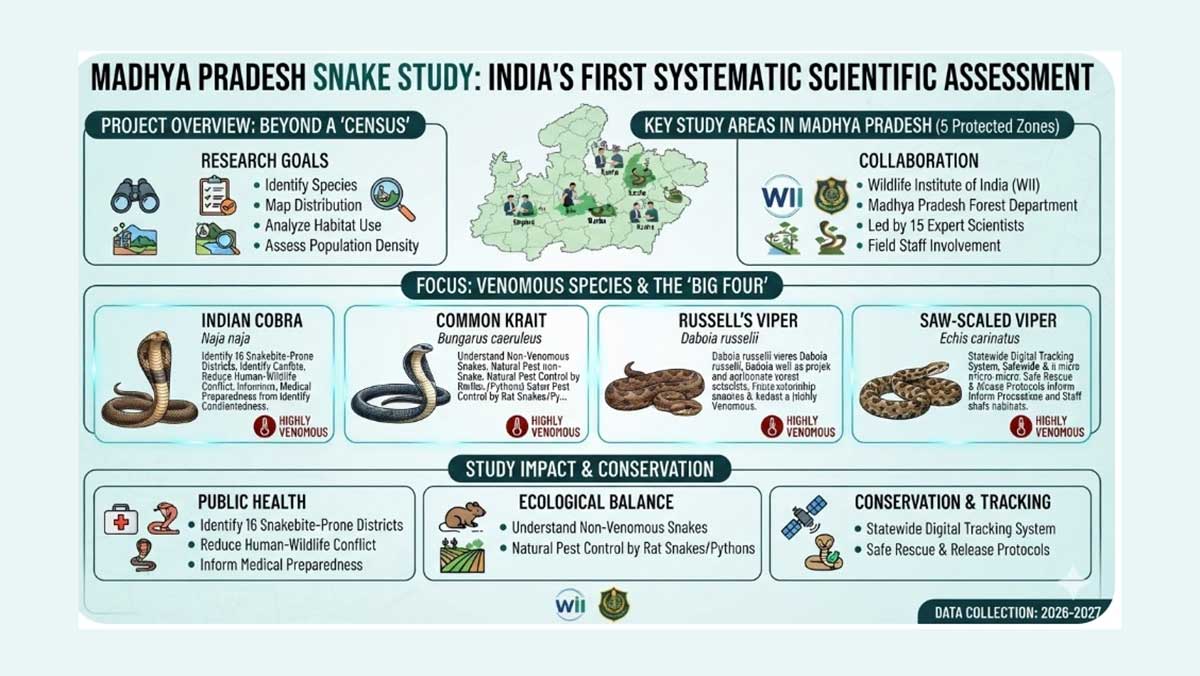
Madhya Pradesh has officially launched India's first systematic and scientific study focused entirely on snakes. While the groundbreaking exercise is widely referred to as a "snake census," forest officials clarify that this description is not entirely accurate. Researchers are not attempting to count every individual reptile across the state's 55 districts. Instead, the initiative serves as a highly targeted, structured research project to map habitats, understand species distribution, and mitigate a growing public health crisis.
The extensive study is a collaborative effort between the Wildlife Institute of India (WII) in Dehradun and the Madhya Pradesh Forest Department. Dr. Abhijeet Das, a prominent WII scientist supervising the project, explained that 15 specialized researchers are actively working alongside frontline forest staff across five protected areas. Highlighting the collaborative nature of the initiative, Additional Principal Chief Conservation of Forests (Wildlife) L. Krishnamurthy stated, "WII teams are executing the snake estimation project in selected locations, including the Satpura Tiger Reserve and Kanha Tiger Reserve, to map their distribution and density."
The primary scientific objective of this project is to discover which snake species occupy specific protected zones, evaluate how common they are, and observe how they utilize their natural habitats. Field teams are paying particular attention to venomous varieties. Out of roughly 50 snake species recorded in Madhya Pradesh, nine are venomous. This includes the highly dangerous "Big Four"—the Indian cobra, common krait, Russell's viper, and the saw-scaled viper. Researchers are trying to pinpoint where these medically significant venomous snakes are most abundant to answer critical ecological and safety questions.
A serious public health story drives this unusual forest experiment. The state has identified 16 snakebite-prone districts, including Chhatarpur, Sagar, and Damoh, where human-wildlife conflict remains exceptionally high. Delayed medical treatment and traditional faith-healing practices frequently lead to critical fatalities during the monsoon season. By gathering data on snake movements and habitat preferences, the government intends to establish a statewide digital tracking system and identify safe, scientifically viable zones where rescued snakes can be released without endangering nearby human settlements.
The extensive field survey began in early 2026 and is scheduled to continue through the end of 2027. Beyond public safety, the study highlights the vital ecological role that non-venomous snakes like rat snakes, pythons, and sand boas play in agricultural landscapes. These reptiles provide essential, natural pest control by regulating rodent populations. Ultimately, the data generated over the next two years will help wildlife biologists and health officials formulate a balanced framework for medical preparedness and sustainable human-snake coexistence.



Leave a comment