

TreeTake Network
Most animal and nature lovers are curious about exactly what happened in the massive wildlife trafficking case and how an environmental champion suddenly became the focus of a major investigation, so here is the complete, comprehensive report detailing the complex events that have shaken the global conservation community.
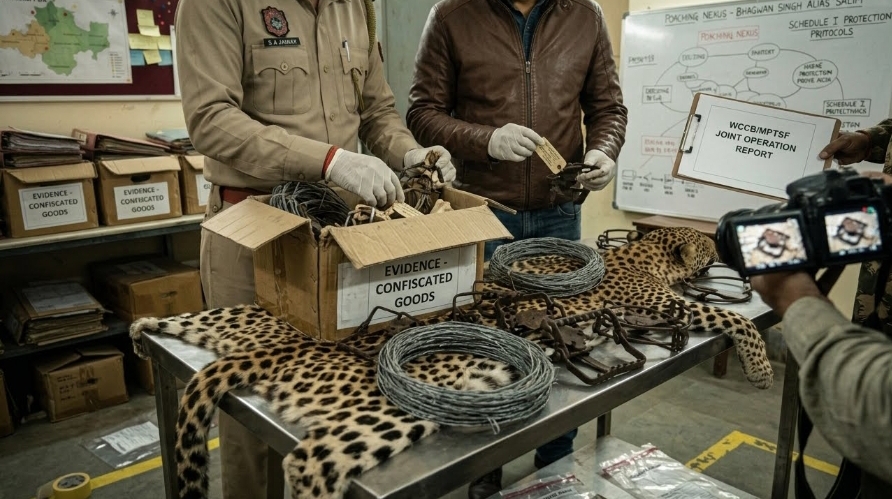
The entire scandal erupted following a major highway intercept on July 23, when enforcement authorities seized ten fresh leopard skins, animal skeletons, and three illegal leg-hold traps from four smugglers travelling along the Gwalior-Agra highway, an operation that the prominent Delhi-based non-profit Wildlife SOS immediately took public credit for via its specialised undercover intelligence wing known as Forest Watch. The entire narrative completely flipped when the Madhya Pradesh State Tiger Strike Force initiated a parallel tracking investigation to find where these leopards were being killed, leading to the August 11 arrest of a veteran wildlife trader named Bhagwan Singh, who operated using the fake identity Salim, and the August 13 arrest of his close accomplice Wasim Akram. During intense interrogation by state investigators, both men dropped a bombshell confession by revealing that they were not independent black-market criminals, but were actually long-time employees on the official monthly payroll of Wildlife SOS, with Wasim even serving at a director-level position within the non-profit organisation.
According to the Tiger Strike Force, the subsequent investigation uncovered an alleged proactive corporate conspiracy where an official vehicle belonging to Wildlife SOS was tracked driving directly into highly sensitive forest reserves to distribute lethal, iron leg-hold traps, which had been illegally smuggled across state borders from Haryana. Local traditional hunters were allegedly paid cash to deploy these indiscriminate traps inside the Kuno Wildlife Forest Division, the Sheopur Forest Division, and the National Chambal Sanctuary to guarantee a steady supply of dead big cats, allowing the organisation to stage spectacular, high-profile seizures. State investigators assert that the primary motive behind manufacturing these fake anti-poaching busts was to create an illusion of elite, high-stakes conservation success, which the organisation could then use to secure massive international grants and foreign funding from global donors. The urgency of the probe escalated drastically when forest officials realised that distributing these iron traps within the Kuno landscape posed a direct, catastrophic threat to India's highly protected, recently reintroduced cheetah population, given that poachers cannot control what animal walks into a hidden leg trap.
To build a foolproof case, the Tiger Strike Force has deployed advanced scientific and forensic methods, unearthing buried leopard carcasses from hidden dumping grounds in the Shivpuri and Morena forests and dispatching the remains to the Wildlife Institute of India for DNA matching to prove they belong to the exact hides seized on the highway. Concurrently, forensic accountants are auditing the organisation's bank accounts, text messages, and digital call records to see if the money trail directly correlates to the specific dates the leopards were slaughtered, while also reviewing a highly publicised 2023 tiger and leopard skin bust in Tamil Nadu's Sathyamangalam forest where both arrested employees were notably present.
Systematically, this case has brought the central Wildlife Crime Control Bureau and state forest departments into the picture, with fingers pointing toward potential institutional complicity. Investigators are executing a sweeping retrospective audit of all joint raids conducted with the non-profit over the past three decades, ensuring that any potential internal government collusion, administrative cover, or accidental departmental validation of staged operations to boost official success metrics is completely exposed. Under Schedule I of the Wildlife Protection Act, 1972, leopards are afforded the highest tier of absolute legal protection, meaning that if the digital and physical evidence holds up in court, the individuals involved face non-bailable criminal charges carrying a mandatory minimum prison sentence of three to seven years of rigorous imprisonment, alongside separate severe penalties under the Foreign Contribution Regulation Act for the fraudulent diversion of international conservation funds.
The core legal debate centres heavily on the Wildlife Crime Control Bureau's statutory guidelines governing undercover intelligence shared by external non-profit bodies. Under Indian law, while private organisations can act as whistleblowers or pass raw intelligence to state actors, they lack any legal mandate to carry out independent stings, handle contraband, or deploy specialised tracking gear without explicit, prior written approval from central or state authorities. Legally validating undercover work requires strict adherence to a pre-registered chain of custody and immediate bureaucratic notifications; otherwise, any active involvement in acquiring, transporting, or harbouring wildlife parts crosses the line from lawful intelligence gathering into punishable trafficking, rendering the NGO's "sting operation" defence legally invalid.
Conflicting arguments have emerged as the investigation progresses. Madhya Pradesh Chief Wildlife Warden Sameeta Rajoura confirmed coordination with the WCCB, stating that the accused are on the Wildlife SOS payroll and that "we will do everything it takes to secure our forests". Conversely, Wildlife SOS CEO Kartick Satyanarayan denied allegations, calling them a "travesty of justice" and expressing concern that legitimate anti-poaching efforts could be jeopardised. Highlighting the need for systemic change, WCCB Additional Director M Maranko noted that, similar to tiger protection, "a similar focus needs to be shifted to leopards now," advocating for technology-driven intelligence. Additionally, independent conservationist Pradip Kasyap urged a deeper investigation into the operations and funding of environmental non-profits, citing concerns over methods used to secure funding.
As investigations continue, the case centres on determining whether these actions represent a massive trafficking ring or a misunderstanding of undercover work.



Leave a comment