

Thinking Point
Sagari Gupta
The writer is a public policy researcher and author with over 8 years of experience in governance, development, political economy, climate governance, technology policy, energy transitions and AI governance. She has written for various publications and has worked with various prominent national think tanks and the Ministry of Consumer Affairs.
India is constructing the foundational infrastructure required to establish itself as a major artificial intelligence economy. The Union Cabinet approved the IndiaAI Mission in March 2024 with an outlay of Rs 10,371.92 crore. Computing capacity sits at the centre of this programme. The original target set out more than 10,000 GPUs for public AI infrastructure. By early 2026, that figure had more than tripled, and over 38,000 GPUs were already onboarded under the mission.
The strategic intent is transparent. India seeks domestic AI models, startups, research capacity and AI-enabled public services. What remains conspicuously absent from this discourse is a straightforward operational question: where will the water come from?
Every GPU generates heat. Every data centre must continuously dissipate that heat. In most facilities, water remains the primary cooling medium. As India accelerates AI infrastructure development, water may emerge as the most overlooked constraint on its digital future. This is not merely an environmental concern. It is a resource-management question positioned at the intersection of technology policy and water governance; an intersection India’s policy architecture has yet to adequately map.
Scale of data-centre water demand
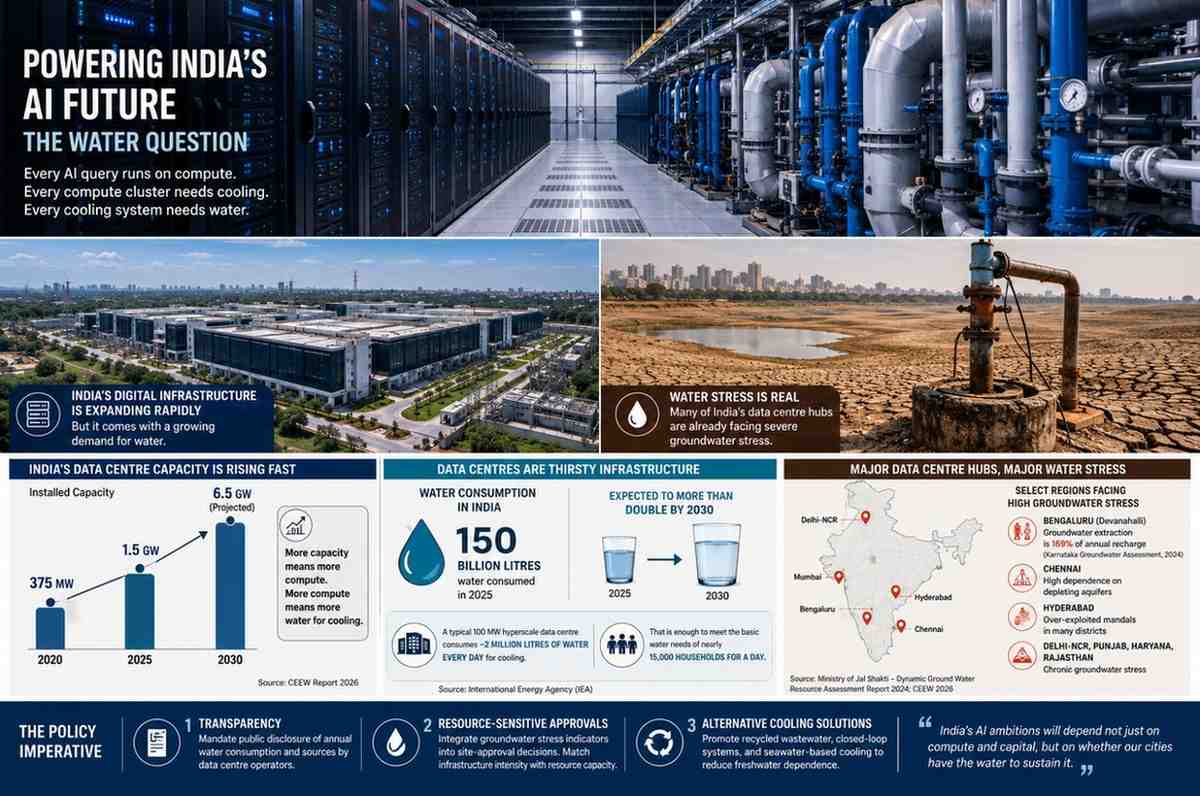
India’s data-centre sector has expanded with remarkable speed. Installed capacity increased from approximately 375 megawatts in 2020 to roughly 1.5 gigawatts by 2025, with projections suggesting it could reach 6.5 gigawatts by 2030. Cloud computing, digital payments, streaming services, e-commerce and artificial intelligence are all driving this expansion.
The resource footprint is substantial. According to a 2026 assessment by the Council on Energy, Environment and Water (CEEW), Indian data centres consumed around 150 billion litres of water in 2025. That consumption is expected to more than double by 2030.
When translated into operational terms, the scale becomes more tangible. The International Energy Agency estimates that a typical 100-megawatt hyperscale data centre consumes approximately two million litres of water daily for cooling operations. That volume meets the basic water requirements of nearly 15,000 households for a single day.
Yet water consumption barely registers in discussions about AI infrastructure development. Government announcements regarding the IndiaAI Mission emphasise compute capacity, innovation ecosystems, semiconductor development, startup support and talent creation. These priorities are substantive. However, the physical resources required to sustain AI systems receive minimal attention. Water remains largely invisible within national digital policy, despite being operationally essential to modern data centre functioning.
Geography as a binding constraint
The challenge intensifies when geography enters the analysis. India’s major data-centre clusters are concentrated in Mumbai, Chennai, Hyderabad, Bengaluru and Delhi-NCR. These locations offer superior connectivity infrastructure, established power networks and substantial pools of skilled workers. They are also regions already experiencing significant groundwater stress.
According to CEEW assessments, a considerable proportion of India’s data-centre capacity is sited in water-stressed regions. The Ministry of Jal Shakti’s Dynamic Ground Water Resource Assessment Report 2024 provides mixed signals nationally. Groundwater recharge stands at 446.90 billion cubic metres while annual extraction is estimated at 245.64 billion cubic metres, suggesting an aggregate extraction rate of 60.47 per cent—apparently sustainable at the national scale.
National averages, however, obscure local realities.
Groundwater depletion is concentrated in economically significant regions, including parts of Karnataka, Tamil Nadu, Telangana, Rajasthan, Punjab and Haryana. These are also areas where industrial and urban water demand continues to intensify. India’s water crisis is not a uniform national shortage. It is a problem of regional and local imbalance, specific geographies facing extraction rates that far exceed recharge capacity.
Bengaluru exemplifies this pattern with particular clarity. The city has consolidated its position as one of India’s foremost technology hubs and an increasingly attractive site for data-centre investment. Simultaneously, it faces a deepening water crisis. Water demand already exceeds available supply, driving greater reliance on groundwater extraction. Thousands of borewells across the region have ceased yielding water.
Groundwater levels continue to decline in multiple peripheral zones. The situation is more acute in Devanahalli, a rapidly developing infrastructure corridor that has attracted substantial data-centre investment. According to Karnataka’s 2024 groundwater assessment, the area’s groundwater extraction rate has reached 169 per cent of annual recharge. The assessment explicitly states that no net groundwater remains available for future use. Despite this critical designation, data-centre approvals continue to accumulate within the region.
This pattern raises a fundamental governance question: how should India balance the imperative of digital infrastructure expansion against the constraints of local water availability?
Regulatory disconnect
Currently, India’s regulatory architecture treats these issues as separate policy domains. The Ministry of Electronics and Information Technology advances digital infrastructure development and endeavours to streamline approvals. Water assessments are conducted by groundwater authorities and water-resource agencies.
The two systems operate in parallel rather than through an integrated decision-making framework. As a consequence, a region may be classified as highly water-stressed while simultaneously receiving policy encouragement to host additional water-intensive infrastructure. This asymmetry becomes more consequential as AI workloads intensify.
Artificial intelligence applications demand denser computing clusters and higher-performance processors. These systems generate greater heat and impose more substantial demands on cooling infrastructure. Unless cooling technologies advance rapidly, water demand is likely to scale alongside computing capacity.
Three policy interventions
The policy response must begin with transparency. Data-centre operators should be mandated to publicly disclose annual water consumption and identify supply sources, including groundwater, municipal systems and recycled water. Such disclosure is becoming standard practice in several international jurisdictions. Without reliable data, regulators cannot assess cumulative impacts on local aquifers or model sustainability trajectories.
Second, groundwater stress indicators should be directly integrated into site-approval decisions. Regions classified as critical or over-exploited should face stringent conditions before large-scale data-centre projects receive clearance. This does not require rejecting all investment; it requires matching infrastructure intensity to resource capacity.
Third, policymakers should systematically encourage alternative cooling strategies. Recycled wastewater, closed-loop cooling systems and seawater-based cooling technologies can substantially reduce freshwater dependence. India’s extensive coastline offers opportunities for coastal data-centre development that remain largely unutilised.
Absent water plan
Digital policy and water policy must begin functioning within a single analytical framework rather than operating in isolation. The IndiaAI Mission recognises the importance of computing infrastructure, datasets, innovation and skills. These priorities remain necessary. However, infrastructure does not operate abstractly. Every server requires electricity. Every cooling system requires water. Every new data centre occupies land within a specific ecological and hydrological context.
The government has articulated a plan, a startup plan and a skill plan for artificial intelligence. What it has not yet articulated is a water plan, an integrated assessment of how regional water availability constrains data-centre expansion and where alternative cooling technologies or coastal development strategies might relieve those constraints.
That omission matters because India’s AI ambitions will ultimately depend not only on processors, capital and software. They will depend on whether the cities expected to host this infrastructure possess sufficient natural resources to sustain it. India’s AI future is being constructed above ground. Its long-term viability may be determined by what remains below it.



Leave a comment