

Talking Point
Brij Khandelwal
What transpired at a ghat in Agra on the evening of May 12 this year was neither a mere coincidence nor a simple misfortune. Six youths who had come to celebrate a birthday ventured into the river and drowned. Despite rescue efforts lasting two hours, the bodies of four of them were recovered. The grief of the bereaved families is beyond imagination. The very Yamuna—whose banks are intertwined with our historical narratives, Aartis (rituals of worship), and deep-seated faith—is now witness to death. Just a few weeks before this incident, a boat capsized at Vrindavan’s Keshi Ghat, claiming the lives of 15–16 pilgrims. Overcrowding, absence of life jackets and a lack of oversight were cited as the primary causes.
Labelling these tragedies as mere ‘accidents’ is problematic, both legally and ethically. They are the result of systemic failure and widespread negligence—not just on the part of the local administration, but also involving state and central bodies. When the river itself is toxic, the scope for conservation has shrunk, and safety standards exist only in official announcements, and an increased risk to human life is inevitable. Despite government promises and expenditures, conditions on the ground have not changed.
To understand the current state of the Yamuna, consider some concrete facts. The river spans a total length of approximately 1,376 kilometres. Originating from the melting peaks of the Himalayas, it flows through Uttar Pradesh, Haryana and Delhi before traversing western Uttar Pradesh. Data from environmental monitors and the Central Pollution Control Board (CPCB) indicate that a significant portion of the total pollution is generated in the stretch near Delhi. Millions of litres of sewage are discharged into the Yamuna from Delhi daily; while there are numerous treatment plants, the reality often involves incomplete pipelines, limited plant capacity, or non-functional operations. Reports from the CPCB and state pollution control boards record high levels of Biochemical Oxygen Demand (BOD) and faecal coliform—parameters far exceeding the limits for water suitable for bathing. For instance, in some of Delhi's drains, faecal coliform counts ranging from thousands to hundreds of thousands per 100 millilitres have been recorded—levels many times higher than safety standards. These figures are documented in public and survey reports.
The pollution originates in Delhi and extends to Agra, Mathura, and Vrindavan. While religious activities draw massive crowds to the ghats in Mathura and Vrindavan, untreated drains discharge directly into the river at these very locations. In Agra, the state of the Yamuna near the Taj Mahal—often characterised by foam and filth—frequently makes headlines. Local citizens and environmentalists have long argued that the wretched condition of a river flowing past a historic monument is not only detrimental to tourism but also poses a serious threat to public health.
Encroachment and illegal construction further exacerbate the problem. Drone surveys and other earth-observation methods have revealed hundreds of illegal structures along Vrindavan’s floodplains and riverbanks. Surveys conducted around 2025 identified several hundred illegal structures within the flood zone. When the river's natural expanse shrinks, its flow is obstructed, and water stagnation increases. This leads to a decline in water quality and an accumulation of plastic, sewage and industrial waste. Encroachments often occur under the patronage of powerful local groups, hindering appropriate enforcement action.
Government schemes and expenditures also raise questions. Since the 1990s, various initiatives, such as the Yamuna Action Plan, programmes linked to the National Mission for Clean Ganga and other projects, have been implemented. Despite claims of billions of rupees being spent, treatment plants in many locations have proven ineffective due to incomplete pipelines, non-functional units, or inadequate operations. The consequences of this discrepancy are evident: the results have fallen short of the investment made. This prompts citizens to ask where the funds went, who monitored and audited the projects, and who is ultimately accountable.
The lack of real-time monitoring and disaster management systems has made fatalities a common occurrence. At locations like Agra’s Balkeshwar Ghat, there were deficiencies regarding ghat design, depth markings, safety barriers, the deployment of lifeguards, and emergency rescue arrangements. Standard operating procedures for vehicle or boat operations—such as the mandatory use of life jackets, boat fitness certification, capacity limits, and CCTV surveillance—are frequently ignored. Sand mining has rendered the riverbed uneven; unregulated extraction has created deep pits and whirlpools that remain hidden from the surface and prove fatal for swimmers. The scope of these issues extends beyond the technical realm to encompass administrative and legal dimensions.
A major challenge is the lack of coordination among various departments. Entities such as the Ministry of Jal Shakti, the state government, municipal corporations, development authorities and pollution control boards all have distinct responsibilities, yet a lack of synergy often leads to lax implementation. Preserving an ecosystem like the Yamuna requires a unified administrative framework featuring time-bound goals, transparent funding, and clear mechanisms for public audits. While the issue is often leveraged for election promises, long-term policies and monitoring mechanisms are conspicuously absent once the elections are over.
The role of courts and environmental tribunals has also been significant. The National Green Tribunal and high courts have issued periodic directives—ordering expanded sewage treatment, the removal of encroachments and river restoration measures. However, the problem is that these orders often remain merely on paper. Ensuring compliance requires regular monitoring, disciplinary action and adherence to timelines. Without strict enforcement, even formal notices amount to nothing more than empty declarations.
Three key demands of the River Connect Campaign
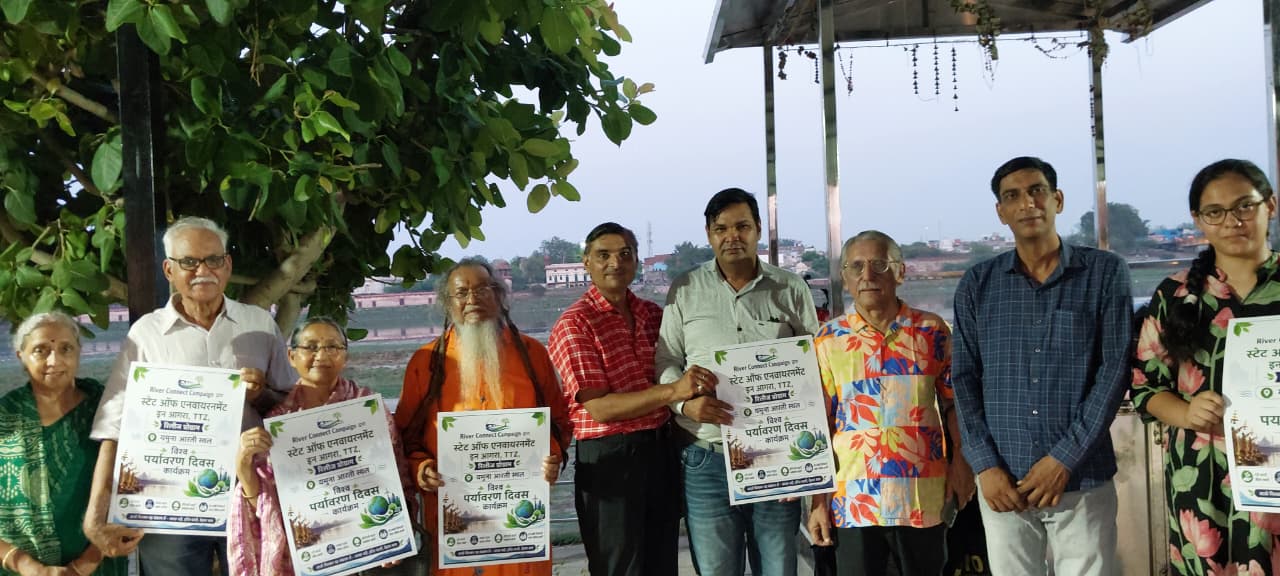
The Taj Mahal, one of the Seven Wonders of the World, is not merely a monument but a symbol of India's cultural identity. Yet, the very Yamuna River that breathed life into the Taj is today gasping for survival. The air that kept the marble gleaming for centuries is now turning it yellow. Released on the occasion of World Environment Day 2026, a report by the River Connect Campaign assesses the current environmental status of the Taj Trapezium Zone (TTZ). The Taj Trapezium Zone is an ecologically sensitive area spanning approximately 10,400 square kilometres, encompassing the districts of Agra, Mathura, Firozabad, Hathras and Etah in Uttar Pradesh, as well as the Bharatpur district in Rajasthan. This region safeguards over 40 historical monuments, including the Taj Mahal, Agra Fort, and Fatehpur Sikri.
First demand: The Taj Downstream Barrage at Nagla Prema must be completed within the next 12 months.
Second demand: 100% treatment of all drains discharging into the Yamuna within the TTZ region must be ensured by the year 2028.
Third demand: A real-time public dashboard for monitoring air, water, and noise pollution must be developed, and at least 15 new monitoring stations should be established.
According to environmentalist Brij Khandelwal, "Three decades ago, Supreme Court orders laid the foundation for saving the TTZ. Today, that foundation is cracking due to rising pollution and weak enforcement. The futures of the Yamuna and the Taj are intertwined. The Taj Downstream Barrage, Yamuna rejuvenation and transparent monitoring are no longer options but necessities."
The River Connect Campaign has appealed to the central and state governments, the TTZ Authority, the Uttar Pradesh Pollution Control Board, and the local administration to prioritise the TTZ as an environmental conservation zone of national importance and ensure time-bound action. Those present at the report release event included Goswami Nandan Shrotriya, Pandit Jugal Kishore, Abhinav Lala, Dr Debashish Bhattacharya, Dr Harendra Gupta, Dr Jyoti Khandelwal, Vishal Jha, Padmini Iyer, Chaturbhuj Tiwari, Dinesh Sharma, Mukesh Chaudhary, Meera Khandelwal, Shahtosh Gautam, Nidhi Pathak, and Deepak Rajput.



Leave a comment