

Travelogue
Revathy Parameswaran, Research assistant professor, University of Alaska Fairbanks, recalls her trip to the Andaman Islands…
It would be disingenuous if I did not acknowledge how much of my decision to switch fields from physics to geophysics was influenced by the motivation to travel and explore. The idea that travelling the world could be a part of my career ignited a hungry fire in me as a girl growing up in South India. The geosciences are vast, interdisciplinary and a perfect example of a subject that deeply values the often misquoted saying “A jack of all trades is a master of none, but often better than a master of one”. The discipline is so inextricably linked to the land, its geology and its people that it constantly implores one to evolve as a human being. Here, I write about one such trip during my graduate school life that remains forever etched in my memory.
The research focus of our group was to study earthquakes and how they affect landscapes and people. The world cannot easily forget the December 26, 2004, Mw 9.2 earthquake that occurred along the plate boundary south of the Andaman & Nicobar Islands. As a young scientific discipline, the world of geophysics did not have much experience studying such a large and exceptional earthquake when it occurred. Therefore, a few scientists from different parts of the world started working together to set up instruments and observe land changes in the Andaman Islands to monitor how this landmass changed over time. Our trip to the Andaman Islands was one such expedition.
In early 2014, after obtaining several travel permits, Prof John Paul Puchakayala (project lead from CERI, Memphis), Prof CP Rajendran (lead from IISc), and I set out from Bengaluru to the Andaman Islands. We were joined on the island by a local contact and field assistant I called Das Bhaiyya (name changed for privacy). After making a stop at Port Blair (now renamed Sri Vijaya Puram) to plan out the fieldwork, we decided to first travel to Rutland Island, off the southern coast of the Andaman Islands.
We set out for Rutland Island early in the morning in a cosy dinghy boat fitted with a small but effective motor. The boat belonged to Das Bhaiyya’s friend, whose services we had hired for the day. I still remember sitting in the front with the instruments for our fieldwork. We made our way through a channel that snaked through mangroves and slowly floated on to the sea connecting the Andaman Islands to Rutland. Emerging from the mangroves, we found the water standing so still that it became a reflective mirror. As we approached the northern end of Rutland Island, the water began to lose its calm. The Rutland beach held water that was vibrant and crystal blue. I couldn’t help but think back to the movie “Pirates of the Caribbean" that often showed such blue seas. I still recall that at that moment all I could think of was “I can’t believe I am here”.
The dinghy boat had to stop a little away from the actual beach because of the slightly rocky seafloor. So, we jumped off the boat into hip-deep water and carried the instruments onto the land, making sure nothing got wet. We then hiked a bit along the coast and diligently set up the instrument on a high rock just as we planned. Before we left the island, we walked around inspecting the coastal rocks for corals, flora and fauna. Changes in water level due to an earthquake can affect coral growth patterns. We took stock of the corals, made relevant notes, befriended a few local crab species and hung out with some of the tree debris along the beach. It was the perfect way to feel one with the island after spending a lot of time setting up an instrument. We returned to Andaman shortly afterwards and left the instrument running on the island for a few days (we would collect it after a set period with recorded data).
Over the next few days, we travelled by road towards the northern side of the island, stopping at select locations to set up more stations. One of the station locations was near Ramnagar, and we had to first drive through a dense, protected forest that is home to the indigenous people of the Jarawa community. Their ancestors have lived on these lands for centuries and are in many ways one with their ecology and environment. This community has a long history of passing down verbal knowledge across generations. Some records indicate that over the span of history, the community has survived several tsunamis by moving to higher ground inland when an earthquake occurs. I hope that one day we can incorporate verbal, ancestral knowledge into how we understand the science of a geological area.
After the drive, we had to hike through some more of the forest, pass by cave systems and wade through hungry leeches along the way. Let’s just say those blood-suckers were well-fed that day! The forest had its own sound system – from rustling tree tops, buzzing insects, chirping birds, occasional screeches from unknown animals and complete absence of human noise other than those from the four of us. These are restricted areas, accessible only with permission from the forestry department's chief warden. The only people who are allowed to move around in the forest are the tribal Jarawa people to whom this forest is home. Along the rarely traversed trail through the forest, there were small clearings with bamboo rest-stops, which I assume the Jarawa people use. We went to multiple other locations over the next few days, setting up stations at predetermined sites – one on the other side of the forest, one near a local farm, another on top of an old bunker by the beach and so on. We built a makeshift bamboo ladder to reach the bunker walls. I guess back then I was so excited about the opportunity that I forgot that I am usually afraid of heights.
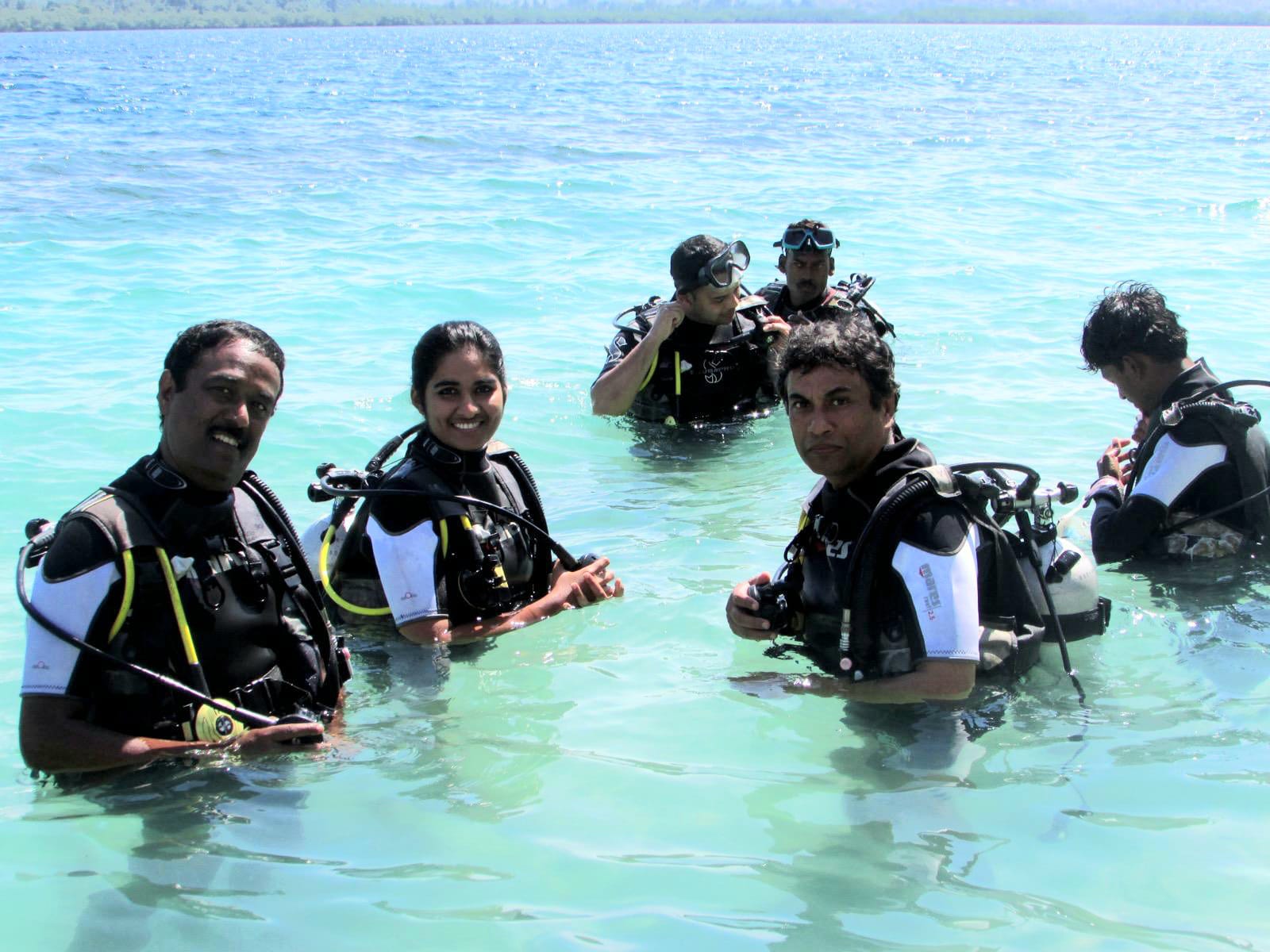
Towards the end of the fieldwork, when we headed back to the base camp in Port Blair and dropped Das Bhaiyya off at his home, his family cooked us a scrumptious meal in their warm and welcoming home. The fieldwork was intense and inspiring at the same time. To top it off, CP and John suggested a brilliant idea to celebrate the end of a successful fieldwork – sign up for a guided scuba diving class! I am unsure if I can do justice to the experience by describing it in words – letting the ocean carry you, aware of every single breath you take, witnessing an ecosystem that is as alive and thriving as the world we see around us daily, feeling happy and humble that I live on this planet. The trip to the Andaman Islands will always be a highlight in my life. It was a chapter that told me – “yes, keep going, you’re on the right path for you”.


Leave a comment