

Talking Point
TreeTake Network
As the world stands at a critical environmental crossroads, India is boldly driving a revolutionary shift in sustainable transportation by introducing its first fleet of cutting-edge zero-emission vehicles. Far beyond a routine transit update, this landmark deployment signals the dawn of a self-reliant energy ecosystem that bypasses traditional fossil fuels entirely. By utilising pioneering technology that produces nothing but pure water vapour from the exhaust, the nation is establishing a definitive global template for green mass mobility. This strategic transition not only underscores India's technological readiness but also reinforces its firm commitment to a cleaner, completely decarbonised future.
India is rapidly positioning itself as a global leader in the clean energy transition by aggressively introducing alternative fuel vehicles that challenge traditional fossil fuels. Moving far beyond standard battery-electric powertrains, the nation is actively experimenting with hydrogen fuel cell technology to completely revolutionise public mass transit systems. At the forefront of this profound green revolution is the national capital, serving as the primary launching pad for the country's first commercial zero-emission deployments. By creating a self-reliant, highly sustainable ecosystem for tomorrow's daily commuters, India is successfully decoupling rapid economic growth from carbon emissions. As noted by Hardeep Singh Puri, Union Minister of Petroleum & Natural Gas: "India has taken many steps towards low-carbon development through emerging fuels like hydrogen and biofuels."
Decoding the hydrogen technology
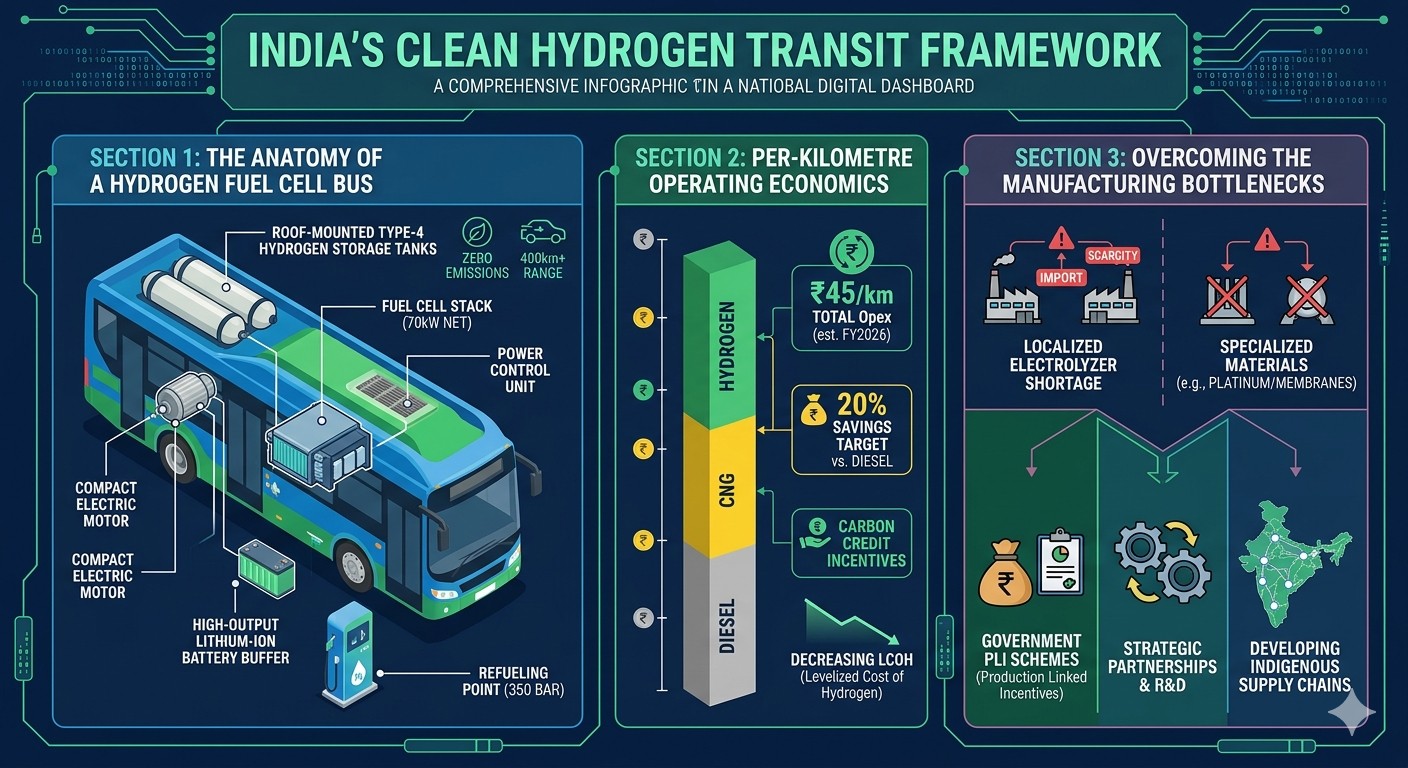
The technological centrepiece of this massive transportation transformation is the Green Hydrogen Fuel Cell Bus, developed through an extensive collaborative effort between Indian Oil Corporation Limited (IOCL) and Tata Motors. Unlike conventional internal combustion engines or standard battery-electric buses that require hours of grid charging, fuel cell vehicles utilise an intricate onboard electrochemical process. By mixing green hydrogen—produced via water electrolysis powered entirely by renewable energy—with ambient air, the fuel cell generates high-quality electricity to power the vehicle's motor. Highlighting the eco-friendly mechanics of this system, Union Minister Puri said that "the fuel cell utilises hydrogen and air to generate electricity to power the bus, and the only by-product is water."
Operational milestones in Delhi
The initial phase of this clean transit rollout made its highly anticipated public debut in New Delhi along the iconic Central Vista area and Kartavya Path. Operated in tandem with the Delhi Metro Rail Corporation (DMRC) to ensure optimal route integration, these next-generation shuttle buses feature roof-mounted cylinders capable of carrying 30 kg of hydrogen fuel safely. They offer a robust seating capacity for 37 passengers and deliver an impressive operational range of 250 to 300 kilometres on a single, rapid 10-to-12-minute refill. Refuelling is conducted efficiently at IOCL’s specialised hydrogen dispensing facility located in Faridabad. During the launch event, Union Minister Puri confidently remarked that "this green hydrogen-powered bus is going to transform the face of city transport in the country."
Manufacturing and infrastructure challenges
Establishing a reliable, domestic manufacturing base for hydrogen refuelling stations presents significant engineering and economic hurdles for Indian industries. As hydrogen is the lightest gas in the universe, stations require highly specialised metallurgy and high-grade carbon-fibre composites to manufacture compressors and storage tanks that can withstand extreme pressures of 350 to 700 bar without risk of embrittlement or leakage. Localising the production of high-capacity ion-exchange membranes, precision dispensers and advanced cooling systems remains highly capital-intensive, forcing a temporary reliance on expensive imported components. Pointing out the strategic gravity of this transition, domestic energy research experts say that "green hydrogen offers India a vital opportunity to mitigate emissions from the economy's hardest-to-abate sectors and reliably meet its net-zero emissions target."
Onboard safety standards and cylinders
Ensuring maximum passenger safety under highly demanding road conditions is a paramount engineering priority for India's growing hydrogen fleet. The onboard storage systems feature Type-IV carbon-fibre-wrapped polymer cylinders designed to easily withstand catastrophic impacts, high temperatures and intense mechanical stresses. These smart cylinders are coupled with ultra-sensitive, real-time gas leak detection systems and automatic thermal pressure relief devices that safely vent hydrogen in an absolute emergency. Evaluating the strict technological benchmarks under local operating environments, clean energy analysts affirm that "deploying these hydrogen-based vehicles on a pilot basis allows India to validate technical safety, test real-world operational durability and systematically secure public transit safety."
Per-km operating economics
While the environmental benefits are clear, the current financial model of hydrogen mobility faces an uphill battle against existing alternatives. Operating a hydrogen fuel cell bus in Delhi currently costs nearly Rs 100 per km, which is noticeably higher than a standard CNG bus operating at around Rs 60 per km and far outpaces a battery-electric bus at Rs 15 to Rs 30 per km. This price variance is primarily driven by the lack of local manufacturing scale and high green hydrogen production costs. Weighing in on the long-term economic shifts, Dr Christian Gasparic, a global head of mobility and sustainability expert, observed that "transportation is one of the key sources of greenhouse emissions and hydrogen technology in public transport would be an excellent contribution to reducing that."
Scaling up and future infrastructure
While the current operational footprint in Delhi provides a glimpse into a zero-emission future, India is scaling up data collection to evaluate performance across diverse operating conditions. Armed with the National Green Hydrogen Mission and an outlay of Rs 19,744 crore, the government aims to deploy additional test units across Delhi-NCR, Haryana and Uttar Pradesh. Overcoming production costs, fine-tuning high-pressure refuelling infrastructure, and building localised supply chains remain central focus areas. Emphasising the geopolitical impact of this transition, Union Minister Puri added that the "success of this project can catapult India from being a net importer of fossil energy to becoming a net exporter of clean hydrogen energy."
Domestic integration and energy security
The wider strategic roadmap involves blending hydrogen into existing energy networks to systematically reduce the carbon footprint across municipal and industrial sectors. Public sector undertakings are leading this charge by targeting the integration of green hydrogen within city gas distribution systems and heavy oil refineries across the subcontinent. This dual approach helps absorb the initial output from massive renewable hubs, providing immediate scale and economic viability to early-stage hydrogen generation projects. Government visionaries emphasise that "integrating hydrogen with urban utilities and heavy chemical manufacturing provides the demand security necessary to attract long-term private capital into the green energy value chain."
Global leadership and export potential
India’s forward-looking approach positions it to become a primary supply hub for green hydrogen and its eco-friendly derivatives, such as green ammonia, for international markets. Low-cost solar power combined with state-backed financial incentives through Production Linked Incentive (PLI) schemes is successfully lowering the domestic cost of hydrogen production toward competitive international benchmarks. Major global economies seeking to decarbonise their transport grids are increasingly looking at Indian manufacturing partnerships to secure their supply chains. Assessing this international momentum, trade specialists remark that "India's integrated renewable architecture offers an unmatched cost advantage, enabling the country to establish strategic export corridors with major international clean energy consumers."
Road to decarbonisation by 2030
As the transition accelerates, the focus is shifting from small-scale operational trials to building comprehensive green industrial corridors that bundle power generation, manufacturing and transport infrastructure together. The overarching national objective aims to achieve an annual production capacity of five million metric tonnes of green hydrogen by the end of this decade, significantly contributing to the nation’s final net-zero goals. This comprehensive engineering and policy push ensures that India remains completely self-reliant, secure and technologically advanced in a rapidly evolving global energy landscape. Summarising this long-term national trajectory, Union Minister Puri firmly said that "the transition to green energy will take place, and that is the real story which is unfolding across our great nation."



Leave a comment