

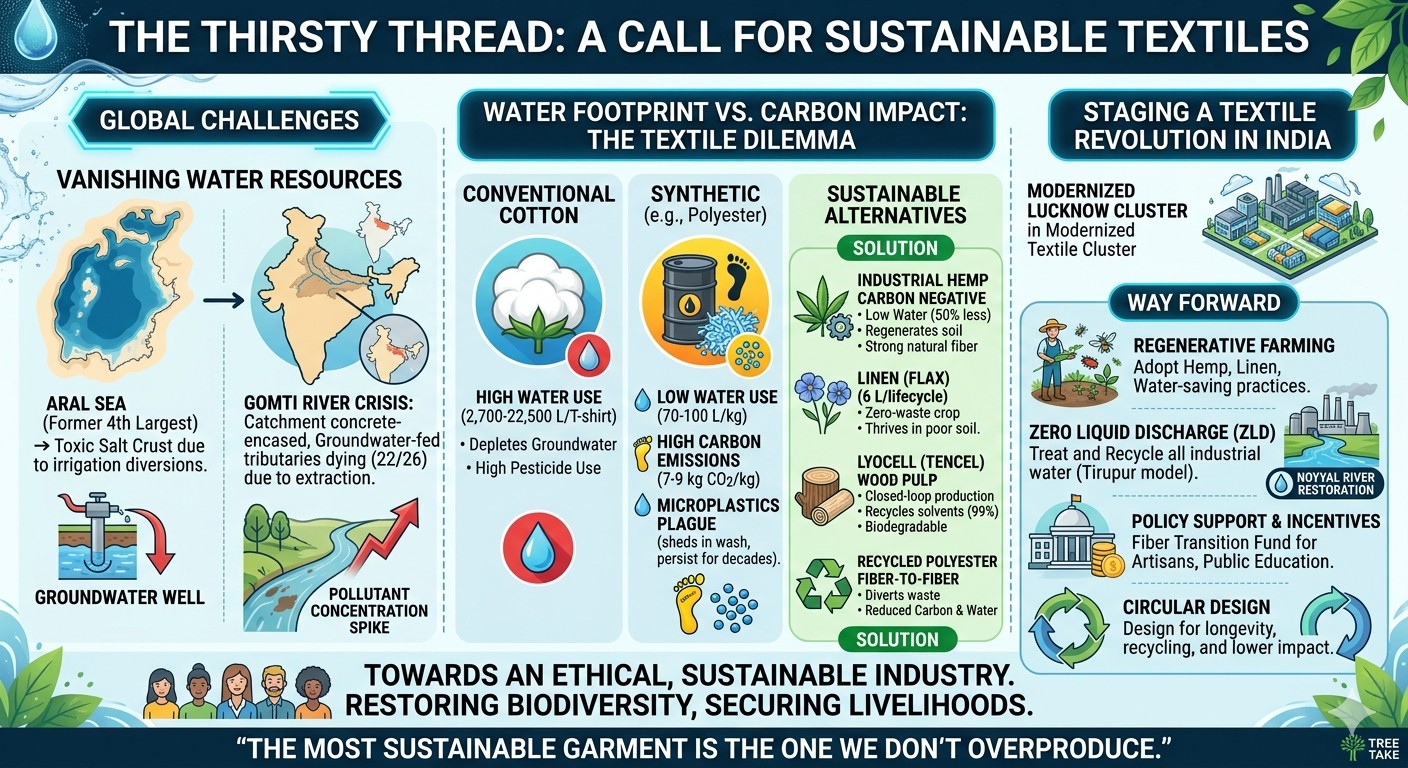
The environmental cost of our wardrobes is massive, from the vanishing Aral Sea to the shrinking banks of the Gomti, even as experts weigh the heavy price of ‘white gold’ and the miracle of ancient fibres. TreeTake takes a look …
In the historic looms of Chowk and the industrial heartlands of Tirupur, a silent environmental catastrophe is being stitched into the fabric of the nation. While India remains a global powerhouse for chikan and zardozi, documented research from the World Wildlife Fund (WWF) warns that the industry’s reliance on conventional cotton is pushing India’s groundwater levels to a terminal breaking point.
The ‘White Gold’ Debt: A National Crisis
The environmental cost of a single Cotton T-shirt has moved from an abstract statistic to a local emergency. According to the Water Footprint Network, it takes approximately 2700 litres of water to produce the cotton needed for just one conventional shirt—enough for one person to drink for two and a half years. In India, certain regions pushing for high yields in arid climates consume upwards of 22500 litres per kilogram of cotton.
Venkatesh Dutta, a professor of Environmental Science at Babasaheb Bhimrao Ambedkar University (BBAU) in Lucknow, has highlighted the severe impact of local development on the city's primary waterway. He noted that concrete embankments and reinforced walls have "deprived the Gomti of its catchment," disrupting the base flow of this groundwater-fed river. Professor Dutta warned that pollutant concentration had spiked due to a "decline in water level following widespread extraction of groundwater," resulting in the drying of 22 out of 26 tributaries of the Gomti.
An expert from the Department of Environmental Science at a leading state university, speaking on condition of anonymity, informed TreeTake that the situation in the local river basins was dire. "We are essentially exporting our liquid security in the form of cheap white gold," the expert warned. "In a city like Lucknow, where groundwater levels dip by nearly a metre every year, this thirsty model is no longer sustainable."
"We are witnessing a resource drain that mirrors the near-total disappearance of the Aral Sea," warned a senior environmental hydrologist based in Lucknow. "That disaster was driven by the need to irrigate Soviet cotton plantations. Today, it takes 2,700 litres of water to produce the cotton for just one conventional shirt—that is enough water for one Lucknowite to drink for two and a half years. As the Gomti’s water levels plummet every summer, we must realize that our 'White Gold' is essentially liquid debt.” Beyond the sheer volume of water, the ‘grey water’ footprint—the freshwater required to dilute pesticides and fertilizers—is poisoning the local groundwater that millions of residents rely on.
The Synthetic Paradox: Saving Water, Smothering the Earth
As local exporters look for alternatives, many have turned to synthetics, but experts warn this is merely swapping one disaster for another. Producing a kilogram of virgin polyester requires as little as 70 to 100 litres of water—nearly two orders of magnitude less than cotton. However, the trade-off is grim.
"Polyester is a double-edged sword," said a textile scientist in the Uttar Pradesh Institute of Design. "While cotton stores carbon as it grows, polyester emits between 7 and 9 kilograms of CO2 per kilogram of fabric. More importantly, unlike biodegradable cotton, which breaks down 89% in wastewater within 40 days, synthetic fabrics shed hundreds of thousands of microplastics per wash. These persist in our landfills and the Gomti’s sediment for decades."
The report highlights that even Recycled Polyester (rPET), which slashes carbon emissions by 32% and uses virtually no "blue water," still relies on a fossil-fuel infrastructure and continues the microplastic cycle.
The Carbon vs. Water Paradox: A Double-Edged Sword
As manufacturers pivot toward synthetics to save water they are falling into a ‘Carbon Trap’. Producing a kg of virgin polyester requires as little as 70 to 100 litres of water, but it emits between seven and nine kg of CO2—nearly triple that of cotton.
Abhishek Bansal, Head of Sustainability at Arvind Limited, has noted that while the industry is eager to reduce its water footprint, the transition to Zero Liquid Discharge (ZLD) is technically and financially demanding. Furthermore, synthetic fabrics shed hundreds of thousands of microplastics per wash.
A senior researcher from the Uttar Pradesh Institute of Design, also speaking anonymously, told TreeTake: "While polyester saves our rivers today, its petroleum-based roots accelerate the climate crisis tomorrow. Unlike biodegradable cotton, which can break down eighty-nine per cent in wastewater within 40 days, these plastics persist in the Gomti’s sediment for decades. We are swapping a water crisis for a plastic plague."
Investigative Spotlight: The Ghost of the Aral Sea
The Aral Sea disaster serves as a grim historical mirror. Once the world’s fourth-largest inland sea, it was decimated to irrigate Soviet cotton plantations. By the late nineteen nineties, its surface area had shrunk by 60 per cent, leaving behind a toxic salt crust.
Drawing a direct parallel to the Indian context, Ashwin Kak, a partner at Intellecap and specialist in the Circular Economy, observed a terrifying similarity in India: "No single canal destroyed the Aral Sea; each diversion appeared rational on its own. This is 'death by incrementalism'—the same form of policy failure we now see in the deteriorating groundwater tables of India's cotton and paddy growing regions".
The Tirupur Precedent: A Roadmap for Lucknow
For Lucknow to navigate this crisis, it must look south to Tirupur, Tamil Nadu. In 2011, the Madras High Court ordered the closure of over 700 dyeing units after the Noyyal River became a toxic wasteland. The crisis forced the industry to adopt Zero Liquid Discharge (ZLD) technology.
Sumeet Nath, managing partner at Raj Overseas, pointed out that the industry required stronger policy support to make these technologies viable for smaller players. "Infrastructure is the first step, but we need public education and financial incentives to ensure every unit, from Tirupur to Lucknow, follows these norms," he suggested.
The ‘Invisible’ Chemicals and the Miracle Crop
The textile industry uses over 8000 different chemicals. Dhruvsen Singh, a professor of Geology in Lucknow University, has corroborated findings that industrial wastes are "depositing fine sediments that are contaminated," preventing the Gomti from recharging.
The "Way Forward" may lie in hemp. Yash P. Kotak, co-founder of BOHECO (Bombay Hemp Company), advocated for the fibre's resilience: "The best part about hemp fabric is that it has the look of linen but the hand feel of cotton. It gets better with every wash and is the strongest natural fibre known to man. Women are the chief wage earners in our cooperatives. They collect wild-growing hemp and process the fibre into handloom products, turning a natural resource into a livelihood."
Beyond Cotton: Detailing Sustainable Alternatives
As the environmental toll of ‘White Gold’ becomes undeniable, the industry is looking to ancient fibres as the primary defence against water bankruptcy.
Industrial hemp: A carbon-negative powerhouse that produces more than double the fibre per hectare than cotton while requiring 50 per cent less water. Professor Dutta observed that hemp acted as a ‘phytoremediation’ tool, cleaning the soil as it grows.
Linen (Flax): Derived from the flax plant, this resilient alternative thrives in poor soil. A linen shirt typically uses only six litres of water over its entire growth cycle. Professor Dutta noted, "Flax doesn't compete with food crops for the best land, and every part of the plant—from seeds to fibres—is used. It is a true zero-waste crop."
Regenerated Cellulosics: Fibres like Lyocell (Tencel) and bamboo offer the softness required for Chikan work through closed-loop processes that recycle ninety-nine percent of solvents. The anonymous UPID researcher noted, "If we train artisans to embroider on these bases, we protect the Gomti without losing our aesthetic."
Circular Synthetics: Abhishek Bansal of Arvind Limited pointed out that moving toward fibre-to-fibre recycling was a necessary engineering challenge: "We are moving toward a future where an old garment is not waste, but raw material."
The ‘Miracle’ Alternatives: Hemp and Linen
The way forward for Lucknow’s artisans may lie in ‘bast fibres’—ancient crops like hemp and flax (linen) that offer a vastly improved ecological profile.
"Hemp is the 'miracle crop' Lucknow needs," claimed an ethical fashion entrepreneur working with local weavers. "It produces more than double the fibre per hectare than cotton while requiring 50% less water. It is naturally pest-resistant, eliminating the toxic chemicals that create huge grey-water footprints. Its deep roots even perform 'phytoremediation,' actually improving the health of our soil."
Similarly, linen (made from flax) is incredibly resilient. In temperate climates, it can grow with almost no irrigation beyond natural rainfall. A linen shirt might require only 6 litres of water over its entire growth cycle, compared to the thousands required for cotton. Both fibres are fully biodegradable and sequester significant amounts of carbon during growth.
The India Verdict: A Survival Mandate
As global demand for ethical fashion surges, India’s ‘Way Forward’ is a mandate for survival. Subindu Garkhel, Fairtrade's Senior Cotton and Textiles Lead, noted the systemic inequity: "Even though we, as consumers, pay a higher cost for organic cotton, often the farmers do not receive the higher price for their labour".
Murli Dhar, director of the Sustainable Agriculture Programme at WWF-India, concluded that a "fast track transformation" was required to restore biodiversity. The roadmap for India required an immediate reduction in water-pull through regenerative farming, the adoption of Zero Liquid Discharge, and a shift toward hemp and linen. "The grace of our heritage must be matched by the grace we show our environment," the academic expert concluded. "The most sustainable garment is the one we don’t overproduce."
Our Take
TreeTake recommends that the Uttar Pradesh government establish a Fibre Transition Fund to support Lucknow’s artisans in switching to these sustainable materials.
Corporate Accountability and the Lucknowi Response
Industry leaders like Patagonia and Eileen Fisher have already phased out conventional cotton for 100% organic and recycled alternatives, significantly lowering their blue water footprint. Luxury pioneers like Stella McCartney are setting a precedent that high-end fashion must be compatible with environmental stewardship through ‘circular’ polyester and regenerative cotton.
On the high street, giants like H&M and Zara’s parent company, Inditex, have committed to 100% sustainably sourced materials by 2030. However, the scale of the ‘fast fashion’ model continues to spark debate in hubs like Lucknow, where overproduction remains a core issue.
The Way Forward: A Sustainable Wardrobe
The transition requires a balanced middle ground. Organic cotton farming offers a bridge, reducing blue water consumption from lakes and rivers by as much as 91%.
"The textile industry remains responsible for 20% of global industrial water pollution," concluded Dr. Singh. "By integrating hemp, linen, and organic cotton into our local supply chains, Lucknow can move away from 'thirsty' fibres and persistent plastic waste. We must ensure that the grace of our chikan embroidery is matched by the grace we show our environment."
As global demand for sustainable fashion grows, Lucknow’s ability to pivot from thirsty natural fibres to low-impact alternatives will determine whether its 400-year-old craft survives the 21st century’s environmental reckoning.
Fish deaths in Gomti linked to industrial output
The silver-scaled surface of the Gomti river transformed into a floating graveyard between March 22 and 23 this year. Thousands of dead fish were discovered surfacing near Heerapuram in the Itaunja area of Lucknow, with additional sightings reported near the Gomti Barrage and the Gaughat stretch. The sight of the bloated fish, caught in thick, rotting carpets of water hyacinth, triggered a massive public outcry against a system that critics describe as "failed and nonchalant."
The crisis is inextricably linked to the region's industrial output. As documented in the study "The Thirsty Thread: Unravelling the True Environmental Cost of Our Wardrobe," the textile industry remains responsible for 20 per cent of global industrial water pollution. In India, the high-water and high-chemical use in conventional cotton farming and processing contribute heavily to this "grey water" footprint.
Science of Suffocation: A Dead Zone in the Making
Preliminary findings by environmental scientists indicate that Dissolved Oxygen (DO) levels in these stretches plummeted to a lethal one point five milligrams per litre, well below the four to six milligrams per litre required to sustain aquatic life. This "suffocation" is attributed to a lethal combination of high atmospheric temperatures and the discharge of approximately three hundred fifty million litres of untreated sewage and industrial effluents.
Dr Venkatesh Dutta of BBAU said the river was essentially holding its breath and losing. "Between the stagnant water under the hyacinth and the discharge of untreated waste from upstream sugar mills and distilleries, we have created a perfect 'dead zone,'" Professor Dutta warned. "This isn't just a fish kill; it’s a biological blackout. You can take a selfie by the riverfront, but you can't hold its water in your hands because it is so dirty."
Controversy: Illegal Dumping or Ecological Failure?
As the river remains covered in a foul-smelling layer of organic waste, a divide has emerged between local law enforcement and environmental experts. Shobran Singh, the SHO of Itaunja, suggested that the incident might be a localised rumour. "Police found that the fish seen floating had not died due to contamination but were allegedly dumped by a local engaged in the fish business," SHO Singh said, noting that the fish had reportedly died earlier in a personal pond.
However, the sheer scale of the mortality across multiple points—from Itaunja to the Gomti barrage—has led activists to dismiss the ‘dumping’ theory as an attempt to downplay a wider ecological failure. Renowned environmentalist Brij Khandelwal noted: "The problem is that our planners have treated rivers as mere canals or drains. Unless there is a dedicated minimum ecological flow ensured throughout the year, these mass fish kills will remain a seasonal shame for Uttar Pradesh."
The ‘Black Past’: A Predictable Annual Tragedy
The Gomti River, once the lifeline of Lucknow, has transitioned into a recurring graveyard. Historically, these incidents follow a seasonal pattern, peaking during the pre-monsoon months of April and May or following the first heavy rains of June. During these periods, the water level drops significantly, reducing the river's ability to dilute the massive volume of untreated sewage flowing from upstream districts like Sitapur and Lakhimpur Kheri. In 2017 and 2018, the river witnessed devastating kills near the Gomti Barrage, where stagnant water turned black overnight.
In 2021, a sudden release of toxic waste from sugar mills caused a massive surge in chemical oxygen demand near Kudiya Ghat. In 2013 and 202, mass mortality was triggered by the ‘flushing’ effect of early rains, washing accumulated city filth and pesticides into the riverbed. Dr Dhruvsen Singh corroborated these findings, stating that domestic and industrial wastes were "depositing fine sediments that are contaminated," preventing the Gomti from recharging its base flow. "The river has lost its natural resilience, transforming a seasonal transition into a recurring battle for biological survival," Professor Singh added.
Official Action and Current Status
The Lucknow District Administration and the Uttar Pradesh Pollution Control Board (UPPCB) have collected water and fish samples for forensic analysis. A formal probe led by the Additional District Magistrate (Revenue) is currently underway to identify specific industrial units in Sitapur and Lakhimpur Kheri that may have released toxic effluents.
An official in charge from the UPPCB, speaking on condition of anonymity, confirmed the systemic failure: "We are investigating the 'flushing' effect of tank cleaning at upstream distilleries. Strict action will be taken against any unit found bypassing Zero Liquid Discharge (ZLD) norms." Meanwhile, the municipal corporation has been tasked with the immediate removal of floating carcasses to prevent the spread of disease.



Leave a comment