

TreeTake Network
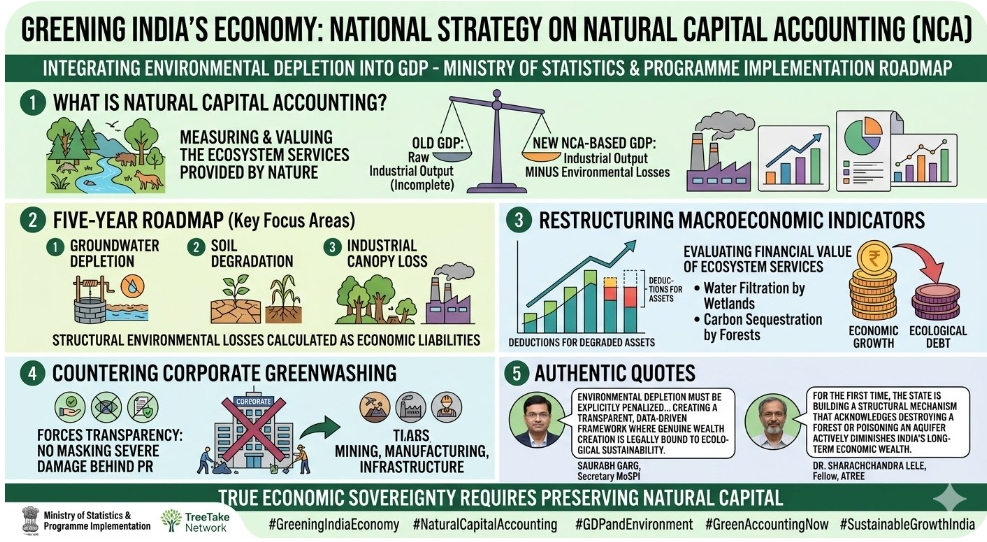
The Ministry of Statistics and Programme Implementation has officially enacted a comprehensive five-year national roadmap to standardise Natural Capital Accounting across all states and union territories. The landmark administrative framework mandates that structural environmental losses—including rapid groundwater depletion, severe soil degradation, and industrial canopy loss—must be calculated as direct economic liabilities and integrated into India's primary macroeconomic data. This administrative shift aims to fundamentally dismantle commercial greenwashing by forcing corporate balances and national gross domestic product figures to reflect the true, physical cost of ecological destruction.
Under the newly deployed system, economic performance indicators will no longer look exclusively at industrial output and raw manufacturing yields. Instead, central auditors will utilise advanced satellite metrics and regional ecological ledgers to deduct the financial value of degraded natural assets from reported economic growth rates. Economists state that by formalising this green accounting ledger, India becomes one of the first major developing economies to systematically treat intact natural ecosystems as non-negotiable national infrastructure rather than free, unaccounted resources for commercial exploitation.
Restructuring macroeconomic indicators
Financial experts and environmental statisticians have welcomed the implementation as a necessary correction to archaic economic modelling. The ministry's accounting framework establishes clear, measurable monetary values for vital ecosystem services, such as the natural water filtration provided by wetlands and the carbon sequestration performed by standing forests. Government planners say projects that cause severe environmental degradation will now show an immediate negative drag on localised economic performance data, severely restricting approval for ecologically reckless industrial corridors.
In an official policy address detailing the operational shift, Saurabh Garg, Secretary of the Ministry of Statistics and Programme Implementation, stated: "We cannot continue to measure macroeconomic progress using metrics that treat the exhaustion of our natural resources as pure economic gain. The National Strategy on Natural Capital Accounting ensures that environmental depletion is explicitly penalised within our national accounts, creating a transparent, data-driven framework where genuine wealth creation is legally bound to ecological sustainability."
Countering corporate greenwashing and resource abuse
The sweeping framework introduces stringent reporting requirements for core public and private sectors, heavily impacting mining, heavy manufacturing, and large-scale infrastructure developers. Independent economic analysts point out that corporations will be legally barred from claiming superficial sustainability credentials whilst simultaneously degrading regional water tables or clearing native scrublands. By anchoring environmental statistics directly within the national data pool, the state aims to establish an unalterable, transparent baseline that prevents companies from masking severe ecosystem damage behind corporate social responsibility public relations campaigns.
Highlighting the profound long-term impact on domestic development policies, Dr Sharachchandra Lele, a distinguished fellow in environmental policy at the Ashoka Trust for Research in Ecology and the Environment, commented during an economic forum: "This green accounting strategy marks a monumental departure from decades of ecological blindness in public planning. For the first time, the state is building a structural mechanism that acknowledges that destroying a forest or poisoning an aquifer actively diminishes India's long-term economic wealth. It forces both public ministries and private capital to recognise that ecological survival is the absolute foundation of any stable economy."
Editor's Note
The rollout of the five-year green accounting strategy represents an indispensable administrative leap toward realistic macroeconomic accounting. The way forward demands that the Ministry of Finance immediately link these natural capital metrics directly to state budgetary allocations and corporate tax structures, ensuring that resource conservation is actively rewarded with financial incentives. True economic sovereignty cannot exist on a foundation of depleted ecosystems, meaning future growth strategies must treat the preservation of natural capital as a mandatory statutory requirement rather than an optional ecological metric.



Leave a comment