

TreeTake Network
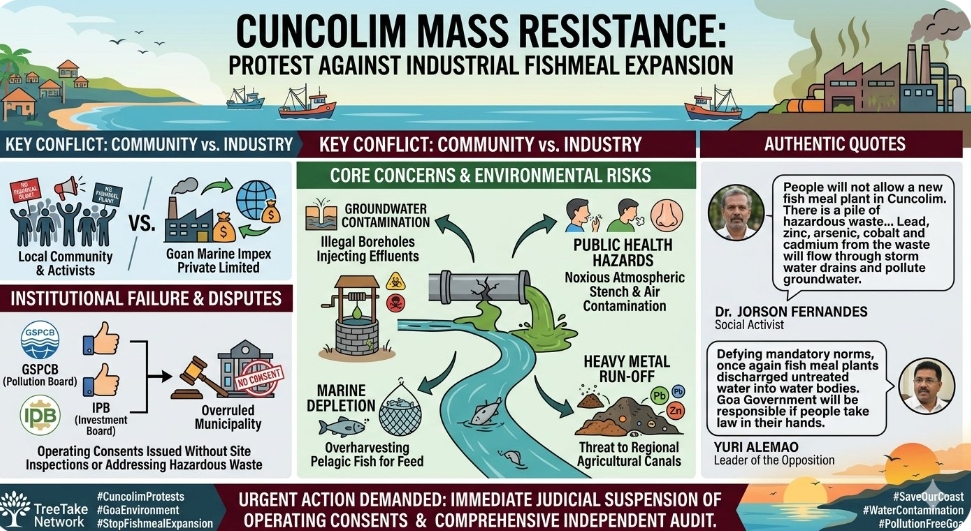
Public outrage and civil mobilisation have reached a boiling point in the town of Cuncolim, located along India’s southwestern coast in Goa, as resident groups and independent environmental advocates launch a unified offensive against the expansion of the industrial fishmeal and fish oil sector. The escalation stems from a highly contentious executive directive issued by state officials that overruled local municipal authorities, granting Goan Marine Impex Private Limited the regulatory clearances required to progress with a new commercial facility within the Cuncolim Industrial Estate. The decision has triggered immediate public resistance, with a formal legal intervention filed before the High Court of Bombay at Goa challenging the validity of approvals issued by the state investment promotion board and pollution authorities.
The industrial gridlock points to a severe systemic collapse of local environmental governance, with independent field inspections revealing deep public health hazards caused by existing infrastructure. Tensions intensified following international investigative findings confirming a history of extreme environmental non-compliance in the district, including the discovery of illicit, hidden boreholes used by processing operators to covertly inject toxic chemical effluents directly into groundwater networks, permanently spoiling regional wells. Local fishing networks argue that the modern aquaculture supply chain—which processes massive volumes of wild-caught, small pelagic fish to manufacture commercial feed for overseas shrimp farms—is actively driving marine depletion along the Goan coast whilst subjecting nearby residential zones to a noxious atmospheric stench and hazardous water contamination.
Institutional failures and public health anxieties
The institutional dispute highlights growing friction between state-driven industrialisation models and municipal regulatory autonomy. Local groups maintain that the Goa State Pollution Control Board issued vital operating consents without conducting mandatory, transparent site inspections or addressing historical soil contamination at the industrial site. Civil leaders have warned that hazardous waste stockpiles containing critical heavy metals, including lead, zinc, and cadmium, sit completely exposed adjacent to the proposed processing facility, presenting an immediate threat of stormwater run-off into regional agricultural canals.
In a formal address to protesting residents, prominent social activist and Cuncolim resident, Dr Jorson Fernandes, stated: "People will not allow a new fish meal plant in Cuncolim. The opposition will build into a people's movement. The approval was given without a site inspection. There is a pile of hazardous waste there, and immediately on its southern side is the proposed site. Lead, zinc, arsenic, cobalt and cadmium from the waste will flow through storm water drains and pollute groundwater."
Geopolitical gridlock and macroeconomic priorities
The expansion of domestic fishmeal manufacturing reflects a broader macroeconomic push to position India as a leading global supplier of farmed aquaculture products. However, economic analysts and ecologists point out that this export-oriented model externalises severe ecological costs onto vulnerable traditional coastal communities. The persistent discharge of raw, untreated processing wastewater into public water bodies has effectively unified municipal representatives and local residents, who have issued a formal ultimatum to central ministers demanding the immediate revocation of the project's licence.
Expressing sharp criticism of the current regulatory framework, Leader of the Opposition and Cuncolim representative, Yuri Alemao, noted: "Defying mandatory norms, once again fish meal plants situated in Cuncolim Industrial Estate discharged untreated water into water bodies. Goa Government failed to take action against them, which has irked the Cuncolkars. Goa Government will be responsible if people take law in their hands."
Editor's Note
The escalating environmental resistance in Cuncolim exposes the critical flaws of an industrial aquaculture model that prioritises export revenue over localised ecological survival. The way forward requires an immediate judicial suspension of the disputed operating consent to facilitate a comprehensive, independent health and environmental audit of the entire industrial estate. Sustainable development cannot occur while oversight bodies bypass municipal governance, meaning future policies must mandate zero-liquid-discharge engineering and comprehensive waste remediation before any further industrial expansions are sanctioned.



Leave a comment