

TreeTake Network
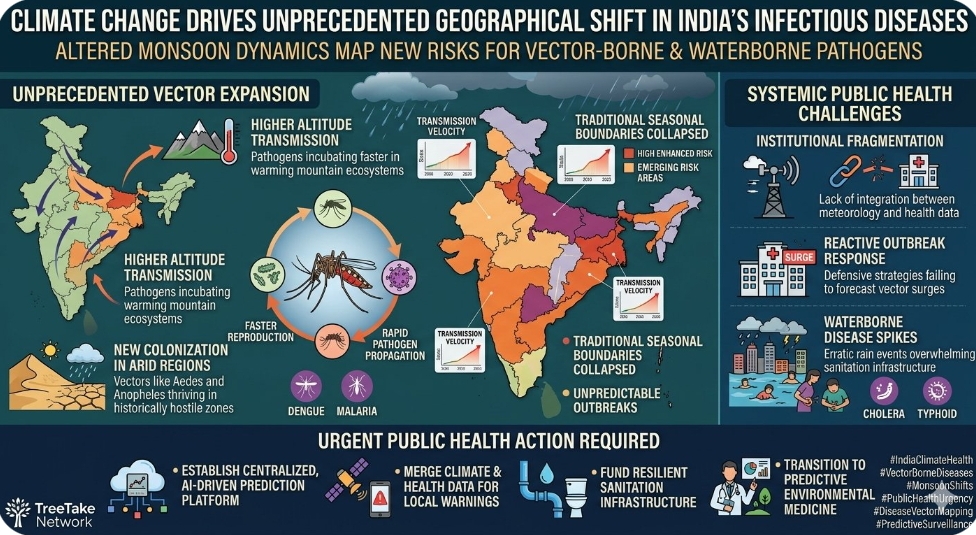
A comprehensive multi-institutional risk investigation spearheaded by India's leading epidemiologists and meteorological scientists has revealed a profound ecological disruption, proving that volatile climate shifts are actively remapping the geographical boundaries of vector-borne and waterborne diseases across the subcontinent. The collaborative report demonstrates that unprecedented changes in southwest monsoon patterns—characterised by intense, localised cloudbursts interspersed with prolonged, humid drought intervals—have created highly optimised microclimates in high-altitude and historically arid regions. This environmental transformation has allowed primary disease vectors, such as the Anopheles and Aedes mosquitoes, to permanently colonise and thrive in areas previously considered naturally hostile to their reproductive cycles.
The empirical data logs under review indicate an alarming escalation in dengue, malaria, and Japanese encephalitis transmission rates throughout montane zones, including sub-Himalayan districts, and semi-arid sectors of western India. Public health authorities state that the traditional administrative concept of "seasonal disease boundaries" has effectively collapsed. The rapid warming of high-altitude ecosystems has drastically shortened the extrinsic incubation period of dangerous pathogens within mosquitoes, meaning vectors become infectious much faster, accelerating transmission velocities within vulnerable human populations that possess zero historical herd immunity to these tropical illnesses.
Systemic fragmentation in public health surveillance
The deep-dive environmental audit highlights an institutional failure to integrate real-time meteorological data with localised public health infrastructure. While India operates under the comprehensive framework of the National Action Plan for Climate Change and Human Health, field researchers note that the state's defensive deployment strategies remain heavily reactive. Because regional weather monitoring networks do not automatically feed data into localised epidemiological databases, medical teams are consistently unable to forecast vector surges, leaving healthcare centres overwhelmed by sudden, unpredicted outbreaks of waterborne cholera and vector-borne pathogens following erratic rain events.
Stressing the absolute necessity of structural administrative integration, Dr Soumya Swaminathan, former Chief Scientist of the World Health Organisation, remarked during a national health conclave: "We can no longer afford to view climate change and public health as separate challenges. The geographical expansion of malaria and dengue into the higher reaches of India is a direct consequence of shifting monsoon dynamics. Our health surveillance systems must be fundamentally restructured to utilise real-time climate modelling; otherwise, we will remain perpetually behind the curve of these climate-driven outbreaks."
Accelerated pathogen propagation and waterborne risks
Beyond mosquito vectors, the investigation details a worrying expansion in waterborne bacterial pathogens due to rising sea surface temperatures and altered riverine flows. Unpredictable flooding cycles have repeatedly compromised municipal water treatment infrastructure in urban and peri-urban corridors, leading to significant spikes in acute diarrheal diseases and typhoid. Ecologists warn that the compounding biological toll of these shifting climate baselines is systematically degrading the socio-economic stability of rural agrarian communities, who face dual crises of agricultural loss and escalating medical liabilities.
Underscoring the environmental mechanics behind the surge, Dr Nitish Dogra, a prominent environmental health researcher and co-author of several treatises on climate-health links, noted during a scientific symposium: "The erratic monsoons are completely rewriting India's epidemiological map. When you have extreme downpours followed immediately by severe heat, you create an absolute paradise for vector breeding and bacterial replication. The data proves that our existing health frameworks are being outpaced by the sheer velocity of these climate-driven changes, requiring an immediate transition toward predictive, environment-based medicine."
Editor's Note
The comprehensive disease mapping report exposes a critical vulnerability in India's national health security, proving that climate change is a powerful multiplier of infectious diseases. The way forward demands the immediate establishment of a centralised, AI-driven prediction platform that dynamically merges satellite meteorological data with grassroots public health logs to issue localised outbreak warnings three weeks in advance. True climate adaptation requires the state to aggressively fund resilient sanitation infrastructure and permanent vector-control measures, transforming our healthcare model from emergency containment to active environmental prevention.



Leave a comment