

TreeTake Network
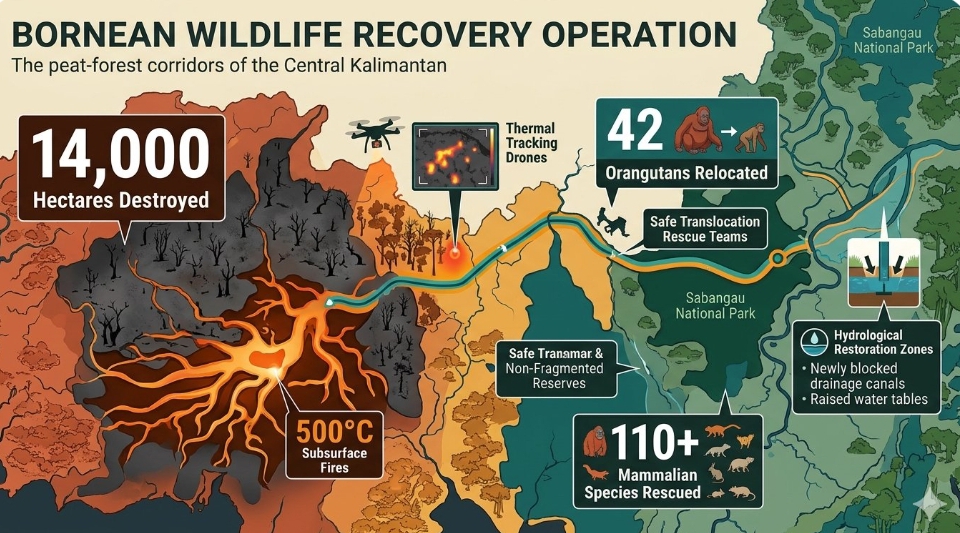
An international conservation consortium has successfully finalised a critical field rescue and translocation operation across the charred peat-forest corridors of Central Kalimantan, shifting hundreds of highly vulnerable mammalian species into secure, non-fragmented biological reserves. The emergency intervention, which concluded on November 29, 2026, followed weeks of aggressive subsurface smouldering that destroyed approximately 14000 hectares of primary tropical habitat. Forest protection authorities, working alongside local non-governmental organisations, have established extensive migratory cordons to ensure rescued populations can adapt to their new environments without experiencing acute physiological shock.
The field operation targeted heavily impacted zones where active canopy loss and toxic smoke haze had completely severed historic feeding routes. Vet teams deployed deep within the shifting peatlands have systematically treated displaced individuals for severe respiratory distress and smoke inhalation. Environmental monitoring systems indicate that while the open flames have been completely suppressed, the underlying carbon-rich peat structures continue to release significant volumes of particulate matter, requiring permanent habitat monitoring arrays to protect surviving wildlife populations from long-term chemical exposure.
Dismantling thermal traps in the peat ecosystem
The primary logistical challenge stemmed from the unique structural behaviour of peat fires, which burn covertly below the surface at temperatures exceeding 500 degrees Celsius. These subterranean fire networks burn through tree root structures, causing sudden canopy collapses that trap slower-moving arboreal mammals. To locate surviving groups, field tracking personnel utilised thermal imaging drones to map out unburnt forest patches within the broader disaster zone.
The regional administration has committed extensive funding to establish permanent ecological corridors connecting the isolated rescue zones to the larger Sabangau National Park network. This infrastructure protection framework aims to prevent genetic bottlenecks among the translocated populations. Discussing the complex spatial dynamics of the rescue drive, Dr Bambang Suryono, Regional Director of the Kalimantan Biodiversity Conservation Bureau, stated:
"The operational complexity of this intervention was unprecedented because the subsurface peat fires completely destabilised the ground structure. Moving heavy veterinary equipment across collapsing terrain required specialised tracked vehicles and precise satellite mapping. We have successfully relocated 42 critically endangered Bornean orangutans and over 110 auxiliary mammalian species. Still, the long-term focus must immediately pivot to restoring the local hydrological balance to prevent these peat matrices from reigniting during the next seasonal dry spell."
Addressing the multi-layered ecological trauma
The extensive loss of old-growth dipterocarp trees has triggered a profound shift in the localised microclimate, stripping away the dense protective canopy that regulates ground moisture and temperature. This canopy depletion has exposed the fragile forest floor to direct solar radiation, accelerating the drying of the remaining peat layers and leaving the ecosystem highly vulnerable to secondary invasive flora.
Wildlife specialists have noted that the sudden introduction of translocated predators into new territorial blocks could temporarily disrupt resident ecosystem hierarchies. To mitigate these risks, conservationists are systematically monitoring territorial boundaries using automated camera traps. Highlighting the ecological consequences of these habitat shifts, Prof Susan Cheyne, Co-Director of the Nature Conservation and Peatland Research Group, observed:
"Data from our field stations show that the microclimatic temperature within the burnt zones has increased by four degrees Celsius compared to undisturbed areas. This thermal variance completely alters native wildlife behaviour, forcing nocturnal species to forage during unusual windows. While the immediate evacuation phase has been executed flawlessly, simply moving these animals does not resolve the structural crisis. We are witnessing the progressive fragmentation of Bornean biodiversity, and without aggressive, large-scale reforestation programmes, these translocated populations will face intense territorial strain within the decade."
Editor's Note
The completion of the post-fire mammalian rescue operation in Kalimantan underscores the limits of reactive conservation strategies in the face of escalating climate anomalies. Peatland degradation cannot be solved through emergency translocations alone, as habitat fragmentation continues to outpace the natural recovery rates of these highly specialised ecosystems. The strategic way forward demands that international environmental bodies and regional governments transition from localised wildlife rescues to aggressive, landscape-level peat re-wetting and restoration initiatives. By blocking artificial drainage canals, raising the water table, and enforcing strict legal boundaries against industrial agricultural encroachment, the global community can protect the remaining Bornean carbon sinks and secure the survival of its irreplaceable biodiversity.



Leave a comment