

TreeTake Network
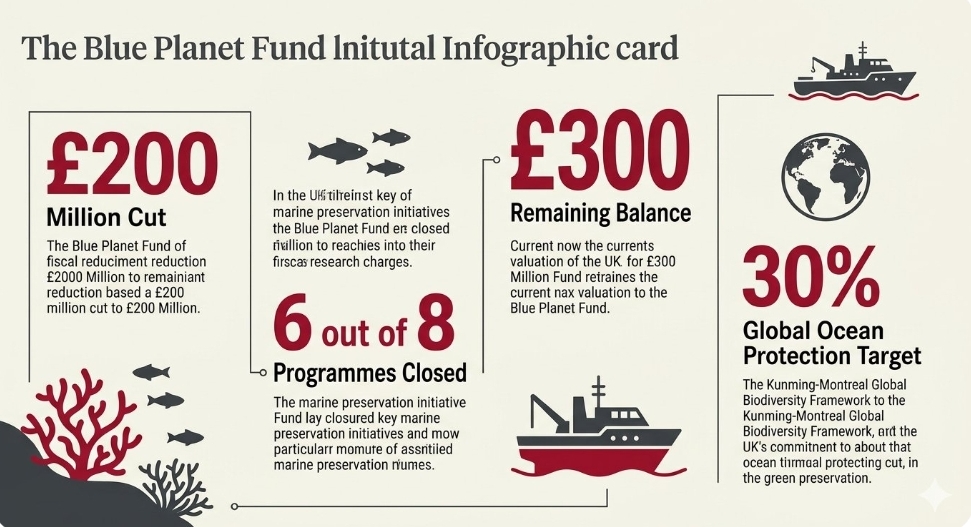
The United Kingdom is facing severe institutional criticism from global conservation frameworks following the uncovering of a substantial 200 million pound budgetary reduction to the Blue Planet Fund, a flagship international marine environment development programme. Analysis of central government accounts and recent administrative data finalised on November 29, 2026, reveals that approximately 100 million pounds in overseas environmental commitments have been abruptly cancelled, with an additional 100 million pounds omitted entirely from forward-looking state allocations. The funding contraction has triggered emergency responses from international non-governmental organisations, who warn that the sudden withdrawal of financial support will severely compromise attempts to protect critical marine ecosystems across developing nations.
The flagship fund, jointly managed by the Department for Environment, Food and Rural Affairs and the Foreign, Commonwealth and Development Office, was originally established in 2021 during the G7 summit in Cornwall with a clear mandate to reach a valuation of 500 million pounds by 2030. However, the newly verified fiscal adjustments have effectively slashed the programme down to approximately 300 million pounds. Internal administrative ledgers indicate a systemic winding down of key marine preservation initiatives, with six out of eight active conservation programmes within the fund either closed completely, entering formal exit phases, or stripped of future financial allocations.
Dismantling the international marine support network
The sudden contraction of the funding framework comes at a critical moment for global ocean governance, directly threatening collaborative programmes across Asia, Africa, and Latin America. According to current fiscal declarations, the remaining operational capital has been heavily restricted, with less than 50 million pounds allocated for the current annual cycle, a significant portion of which is explicitly earmarked to cover institutional exit strategies rather than new conservation field deployments. For instance, the Global Plastic Action Partnership has been allocated a final 5 million pounds purely as a termination buffer, while the comprehensive Ocean Programme faces total defunding following a concluding 14 million pound transitional payout.
The lack of fiscal transparency surrounding these quiet cuts has drawn sharp rebukes from diplomatic and environmental leaders who argue that the decision undermines the UK's formal pledge to support the Kunming-Montreal Global Biodiversity Framework, which mandates the effective conservation of 30 per cent of the world's oceans by 2030. Commenting on the severe operational fallout of the budget reductions, Adrian Gahan, Ocean Lead at the Campaign for Nature, stated:
"The decision to quietly diminish this critical resource is profoundly short-sighted and directly compromises international maritime safety frameworks. The Blue Planet Fund represents a vital global lifeline for developing economies struggling to modernise their sustainable fisheries and combat industrial plastic pollution. It is clear the government has not budgeted to fulfil its international commitments but will not publicly admit it, and we urge ministers to immediately reverse these closures and ensure the remaining 200 million pounds is delivered in full."
Cascading risks for global biodiversity and coastal stability
Marine specialists emphasise that the sudden withdrawal of British climate aid will trigger immediate disruptions to coral reef preservation initiatives and community-led coastal adaptation networks across small island developing states. The biological strain is expected to accelerate habitat degradation across vulnerable marine sanctuaries, leaving coastal human populations exposed to heightened thermal stress and severe weather vulnerability.
National security experts have also expressed growing alarm over the cuts, noting that the destruction of sustainable marine infrastructure directly fuels cross-border instability. Elucidating the systemic security implications of international nature funding cuts, Dr Amy McDonnell, Co-Director of the Zero Hour climate and nature campaign, observed:
"Our intelligence and security chiefs have explicitly warned that widespread biodiversity collapse and the destruction of global marine stocks pose a direct national security risk to the United Kingdom by sparking mass migration and food supply shocks. Slashing international funding designed to protect these vital ecosystems is entirely counterproductive to long-term border security. If the administration officially recognises that ecosystem collapse threatens structural stability, it is completely illogical to dismantle the very programmes engineered to prevent it."
Editor's Note
The severe fiscal reduction targeting the Blue Planet Fund exposes a critical disconnect between international environmental rhetoric and domestic fiscal execution. Attempting to balance state accounts by defunding overseas marine conservation does not eliminate ecological risk; it merely exports it back to domestic borders in the form of accelerated climate migration, collapsed global fisheries, and disrupted supply chains. The strategic way forward requires a complete reorganisation of how nature finance is categorised within state budgets, treating international biodiversity spending as a foundational pillar of national security rather than an optional development handout. The government must immediately re-establish transparent, non-negotiable funding rings for natural infrastructure, utilizing public-private partnerships to bridge the 200 million pound deficit before irreparable ecological damage occurs across vulnerable global coastlines.



Leave a comment