

TreeTake Network
India has reinforced its structural commitment to the global climate pact on ozone layer protection by initiating a comprehensive regulatory and technical framework to systematically reduce the production and consumption of hydrofluorocarbons. Operating under the stringent mandates of the Kigali Amendment to the Montreal Protocol, the Ministry of Environment, Forest and Climate Change has locked in baseline allocations using verified manufacturing data across the country. The primary focus of the national apparatus is to execute a phased transition that eliminates high-global-warming-potential gases from commercial cold chains and residential cooling machinery without disrupting industrial growth.
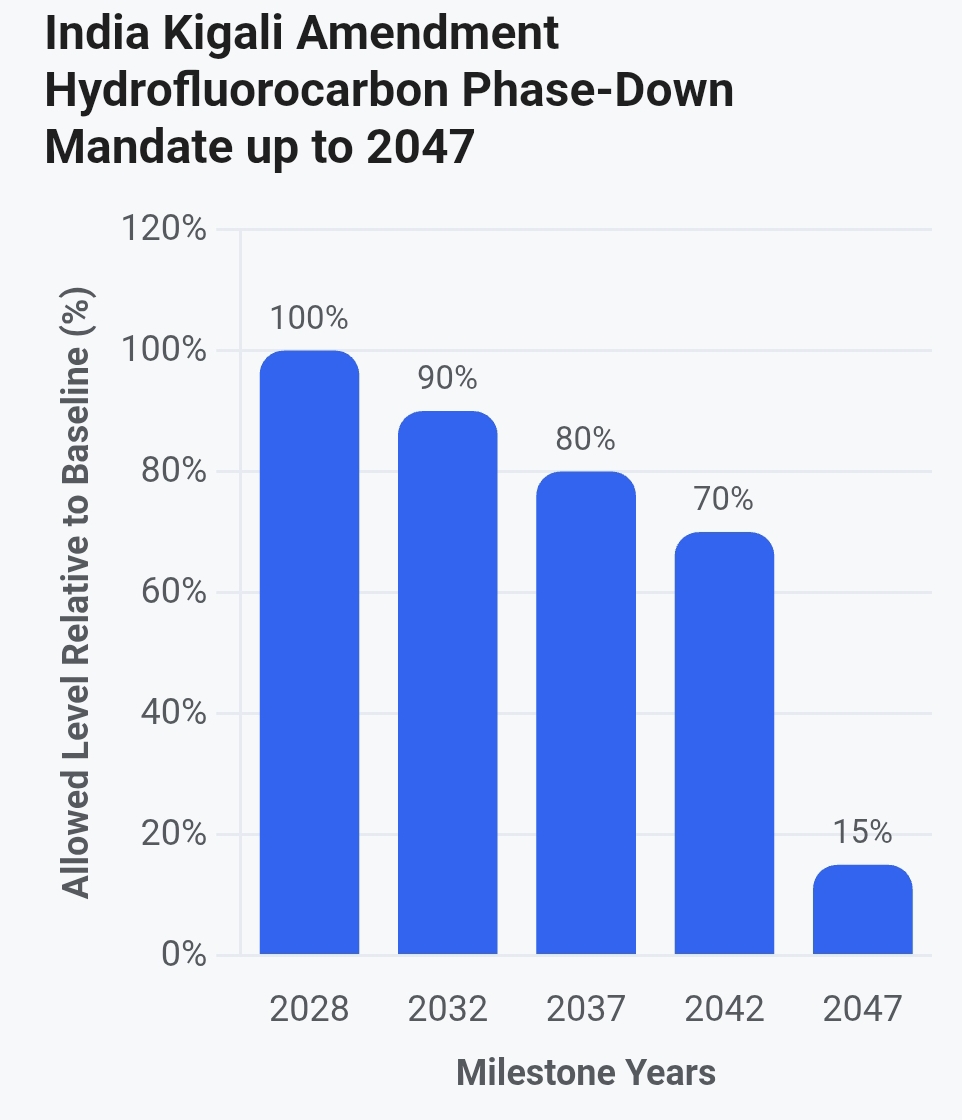
The government has completely synchronised its domestic legal framework with international schedules, mandating that the baseline for hydrofluorocarbon production and consumption will freeze effectively on January 1, 2028. This critical baseline is derived from the verified average data of the calendar years 2024, 2025, and 2026. Following the initial freeze, the nation is bound to enforce four definitive reductions, culminating in an 85 per cent cumulative cut by 2047. Having successfully phased out several generations of ozone-depleting substances ahead of global deadlines, administrative bodies are now pushing for the rapid adoption of natural refrigerants and ultra-low-warming chemical alternatives across all industrial sectors.
Enforcing the chemical freeze matrix
The baseline trajectory relies heavily on heavy administrative oversight to prevent the market infiltration of unregulated gases. According to the Directorate General of Foreign Trade, import and export licensing systems have been strictly updated on November 29, 2026, to monitor large-scale chemical consignments across major shipping terminals. The national consumption curve, which expanded from 24300 metric tonnes in 2018, is projected to hit between 166000 and 181000 metric tonnes by 2038 under standard growth models, making immediate interventions vital.
The official schedule mandates a 10 per cent reduction from the baseline by 2032, followed by a 20 per cent cut by 2037, and a 30 per cent target by 2042. Explaining the rigorous administrative framework required to achieve these targets, Dr Rajashekar Shastry, an independent chemical policy analyst, stated:
"The transition cannot simply mirror previous efforts because hydrofluorocarbons are deeply integrated into India's infrastructure. To achieve a 10 per cent reduction by 2032, the monitoring apparatus must oversee thousands of micro-enterprises that rely on affordable chemical refills. We are looking at a complete restructuring of chemical manufacturing lines within less than 24 months to prevent a sharp spike when the 2028 freeze activates."
Addressing the persistent chemical dilemma
A major operational hurdle in the national transition plan is the emergence of secondary environmental hazards associated with specific chemical replacements. Hydrofluoroolefins, which boast low global warming metrics and zero ozone-depleting properties, are under intense institutional scrutiny because they degrade into trifluoroacetic acid. This highly persistent chemical falls under the category of per- and polyfluoroalkyl substances, often termed chemicals forever.
Certain chemical blends have also been found to react inside the upper atmosphere to generate hydrofluorocarbon-23, an extremely destructive greenhouse gas with a global warming potential of 14600. Highlighting these intricate chemical vulnerabilities, Prof. Meenakshi Sundaram from the Indian Institute of Science observed:
"Data reveals that specific replacements like hydrofluoroolefin-1234yf convert entirely to trifluoroacetic acid upon atmospheric degradation. By mass, this can yield up to five times more persistent toxicity than the older hydrofluorocarbons we are attempting to replace. India must avoid a technological trap where it trades an atmospheric heating crisis for a long-term water and soil contamination disaster."
Transitioning to sustainable cooling infrastructure
To bypass the complex patent controls and high import tariffs maintained by multinational corporations over synthetic replacements, domestic research centres are leaning towards natural refrigerants. Hydrocarbons, ammonia, and carbon dioxide are being integrated into large commercial installations and vaccine transport networks. This shift coincides with the extended objectives of the India Cooling Action Plan, which aims to optimise energy efficiency by 2038 while lowering total coolant dependency across the economy.
The fiscal support network has been expanded to insulate small manufacturers from the financial shock of equipment modernisation. Customs and excise duty exemptions are being systematically provided to factories that dismantle older hydrochlorofluorocarbon lines to install natural-refrigerant architectures. Commenting on the logistical challenges of this industrial shift, Dr Inger Andersen, Executive Director of the United Nations Environment Programme, remarked:
"India's proactive policy integration under the Montreal Protocol serves as a vital blueprint for large developing economies. However, because cooling demand is projected to more than double by 2035, the real test lies in scaling natural refrigerants across the residential sector. International funding mechanisms must step up to ensure that technology transfers remain affordable, transparent, and rapidly deployable."
Editor's Note
The enforcement of the Kigali Amendment mandates that India must act decisively to balance its massive industrial expansion with non-negotiable climate boundaries. Relying heavily on synthetic hydrofluoroolefins introduces a secondary layer of chemical contamination via persistent acids, which could compromise freshwater systems over the coming decades. The strategic way forward requires the central government to heavily subsidise and standardise pure natural refrigerants, such as propane and carbon dioxide, particularly within domestic air-conditioning manufacturing. By leapfrogging directly to natural options, India can insulate its domestic supply chains from international patent bottlenecks, lower industrial power consumption, and eliminate both ozone depletion and chemical accumulation risks simultaneously.



Leave a comment