

TreeTake Network
The Union Ministry of Environment, Forest and Climate Change has formally inaugurated a state-of-the-art Centre of Excellence on Human-Wildlife Conflict at the Wildlife Institute of India–Sálim Ali Centre for Ornithology and Natural History campus in Coimbatore, Tamil Nadu. Operationalised on November 28, 2026, this dedicated research and deployment installation has been launched in tandem with the nationwide rollout of the National Human-Wildlife Conflict Portal, a unified digital platform engineered to standardise field telemetry, tracking analytics, and emergency relief distribution. The establishment of this administrative hub represents the fulfilment of a strategic directive outlined during the seventh meeting of the National Board for Wildlife, aimed at creating structured, evidence-based interventions to manage escalating interface friction between expanding rural infrastructures and critical migratory corridors.
The institutional framework will consolidate data from regional forestry departments to map hotspots across the subcontinent, focusing on territories impacted by habitat fragmentation. By monitoring the movement of apex predators outside tiger reserves, alongside wild elephants and leopards, the platform serves as an early-warning infrastructure to safeguard agricultural communities whilst ensuring the survival of vulnerable wildlife populations.
"Our approach should be solution-oriented, instead of being problem-oriented, utilising modern technological advances," stated Union Environment Minister Bhupender Yadav during his keynote address at the inaugural workshop. "Coexistence and harmony must be our guiding principle. We must modernise our field capabilities, ensuring that local forest administrative units are seamlessly integrated with national spatial databases to minimise encounters and protect rural livelihoods."
Emphasising the scale of community engagement required to support these digital protocols, Union Minister of State Kirti Vardhan Singh stressed the importance of public education. "There is an urgent requirement to conduct mission-mode awareness campaigns in both urban and rural areas," noted Minister of State Singh. "We must foster a deeper public understanding of animal behaviour and local migration cycles, which is why the ministry has released the comprehensive new text, Current Status of Human-Wildlife Conflict in India: An Overview, to serve as an operational blueprint for local panchayats and municipal bodies."
Planetary surface anomalies breach critical baselines
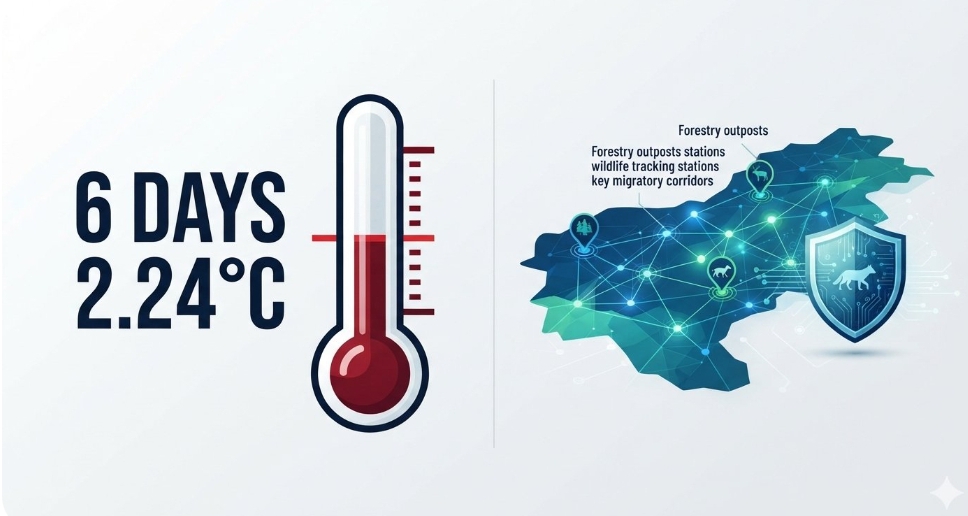
This national conservation milestone occurs against a backdrop of severe global climate warnings, as international atmospheric monitoring grids confirmed that global surface temperatures have broken historical baselines, remaining more than two degrees Celsius warmer than preindustrial averages for six consecutive days. This unprecedented temporal sequence marks the first time in recorded meteorological history that the planetary average has sustained such an elevated thermal amplitude for nearly a week. Regional tracking networks recorded a peak anomaly hitting 2.24 degrees Celsius, driven by the compounding effects of long-term greenhouse gas saturation and intense marine heatwave cycles across the major ocean basins.
Atmospheric researchers have clarified that whilst this multi-day breach does not constitute a permanent violation of the long-term limits defined under international climate accords, it represents a physical acceleration of systemic planetary heating.
"We are observing anomalies that are defying standard statistical baselines," warned Dr Inger Andersen, Executive Director of the United Nations Environment Programme, during an emergency briefing on the monitoring metrics. "This six-day sequence is a loud warning from the climate system. It underscores that every fraction of a degree of warming multiplies the frequency of hydrological extremes and severely destabilises the natural carbon sinks that protect our biosphere."
Regional water basin agreements face legislative evaluation
In response to these accelerating thermal anomalies, the United Nations Climate Change Secretariat has advanced multi-lateral partnership initiatives ahead of winter legislative reviews. These frameworks seek to enforce the Baku Declaration on Water for Climate Action, a transnational policy designed to integrate river basin preservation directly into national climate adaptation strategies.
Detailing the structural risks that these temperature spikes impose on natural ecosystems, Prof Jim Skea, Chair of the Intergovernmental Panel on Climate Change, highlighted the narrow window remaining for cross-border conservation. "Our tracking confirms that global heating is driving rapid structural shifts across entire biomes," stated Prof Skea. "Experiencing consecutive days at 2.22 degrees Celsius and 2.24 degrees Celsius above preindustrial baselines demonstrates that our margin for error has evaporated. If industrial emissions are not completely minimised within this decade, these extreme spikes will become our standard baseline, causing widespread habitat loss and irreversible biospheric collapse."
Editor's Note
The simultaneous implementation of India's national conflict mitigation portal and the historic breach of global thermal thresholds highlight the undeniable connection between local landscape management and macro-climate destabilisation. Local conservation strategies can no longer operate in isolation from global atmospheric realities; habitat fragmentation is actively worsened by climate-driven changes in vegetation and water availability. Moving forward, governments must treat human-wildlife coexistence as a core component of climate adaptation, allocating regional resources to reinforce ecological buffers and protect biodiversity from rapid habitat shift.



Leave a comment