

Talking Point
TreeTake Network
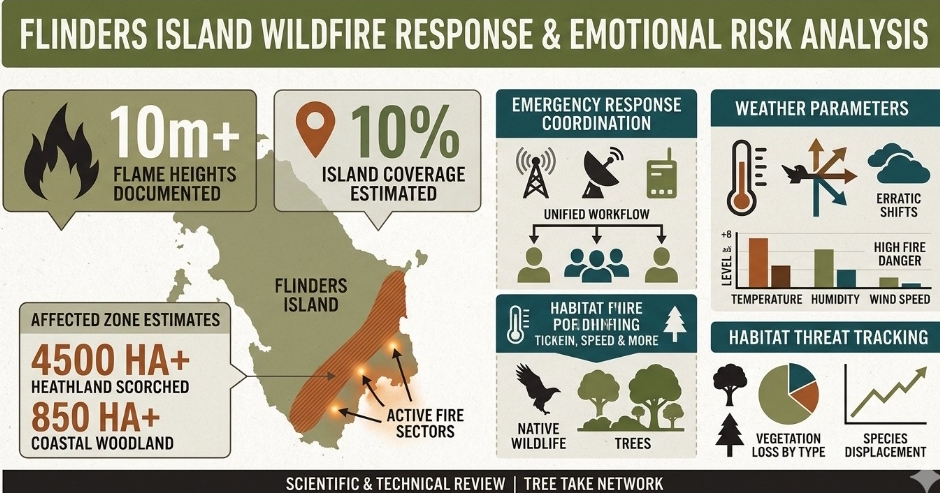
On November 26, 2026, emergency management agencies escalated operational alerts to critical levels as a series of fast-moving bushfires breached containment lines across the southeastern sector of Flinders Island. The uncontained blazes, fueled by a volatile combination of high temperatures, low relative humidity, and erratic wind shifts, have rapidly scorched an extensive corridor of native heathland and coastal woodland. Regional disaster management teams have mobilised aerial water-bombing assets and specialised ground units to establish defensible perimeters around vulnerable rural settlements.
The incident commander reported that flames exceeding 10 metres in height have compromised primary transportation routes, forcing authorities to implement immediate road closures across the affected districts. The localised fire behaviour has proven exceptionally challenging for emergency personnel, as dense smoke plumes severely restrict visibility for both ground vehicles and low-altitude observation aircraft. Wildlife monitoring groups have expressed grave concerns for the island's unique ecosystems, which serve as vital sanctuaries for several rare and endemic marsupial populations.
To protect public safety, the state fire service has deployed automated early warning notifications instructing residents within the high-risk zones of Palana, Leeka, and Mount Tanner to activate their pre-prepared bushfire survival protocols. Incident management specialists are coordinating closely with meteorological bureaus to predict the exact path of a projected southwesterly wind change that could further intensify the fire fronts. Incident control hubs have successfully established emergency evacuation shelters to accommodate displaced residents and transient tourist populations.
"The sheer velocity of the fire spread combined with extreme topographic constraints has severely limited our ability to execute direct frontal attacks on the active flanks today," stated a senior operations controller coordinating the regional emergency response. Meteorological experts have emphasised that prolonged seasonal rainfall deficits have left regional fuel loads exceptionally dry and highly susceptible to rapid ignition. Field forces are continuing to monitor thermal signatures to prevent the blazes from penetrating deeper into adjacent national park reserves.
Editor's Note: The escalating wildfire crisis on Flinders Island highlights the acute vulnerability of isolated island ecosystems to climate-driven extreme weather anomalies. Moving forward, authorities must systematically strengthen decentralised firefighting infrastructure and implement mandatory, community-led land management strategies to protect isolated habitats from catastrophic habitat loss.



Leave a comment