

TreeTake Network
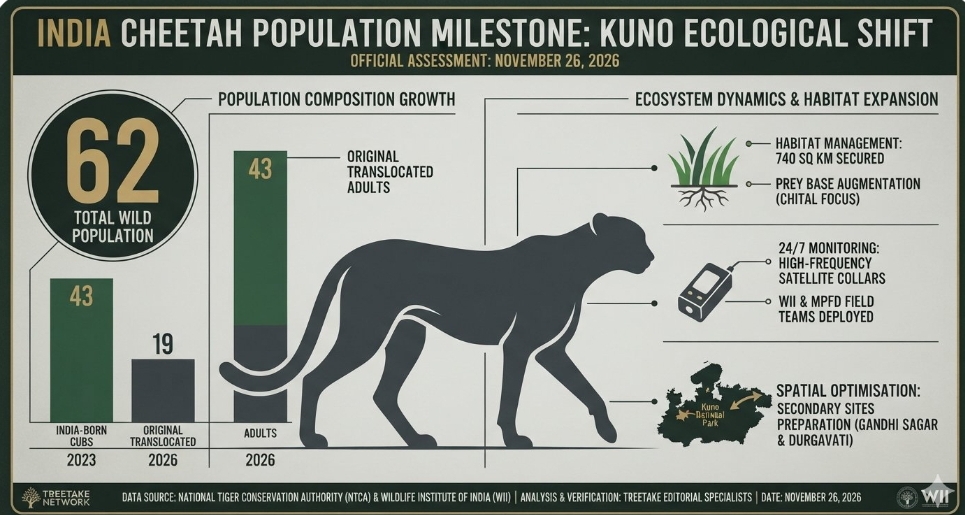
India has achieved a historic milestone in its ambitious grassland recovery programme as the total cheetah population scaled to 62 individuals following two successive wild litters at Kuno National Park in Madhya Pradesh. The official assessment released on November 26, 2026, confirmed that India-born cubs now account for nearly 70pc of the entire population base, fundamentally shifting the project from an experimental translocation framework to a self-sustaining biological reality. This explosive population growth has prompted the National Tiger Conservation Authority to mandate immediate advancements in tracking technology and physical monitoring infrastructure to mitigate escalating territorial pressures.
The expansion accelerated dramatically following back-to-back reproductive successes within the protected open forests of Sheopur district. A 32-month-old India-born female, categorised as KJP21, gave birth to five healthy cubs, effectively introducing a vital Botswana genetic lineage into the landscape through her mate. This was closely followed by a second litter of four cubs born to a separate translocated female, bringing the total number of cubs born on Indian soil to 43. Field monitoring teams comprising specialists from the Wildlife Institute of India and the Madhya Pradesh Forest Department have significantly intensified round-the-clock physical surveillance and distance sampling along fixed transects to monitor the physical condition, adaptation metrics, and prey consumption patterns of the newborn cubs.
To sustain this expanding population over the coming decades, administrative bodies are aggressively advancing long-term habitat management measures. The Ministry of Environment, Forest and Climate Change has initiated extensive grassland restoration programmes, water management matrices, and prey augmentation drives focused heavily on chital, which currently constitutes three-quarters of recorded cheetah kills. Furthermore, to alleviate spatial constraints within Kuno National Park, field operations are actively expanding to prepare secondary release sites, including the Gandhi Sagar Wildlife Sanctuary and the Veerangana Durgavati Tiger Reserve, ensuring safe dispersal corridors for the growing wild metapopulation.
The successful natural propagation of these apex predators underlines the immense dedication of our field veterinary teams and local tracking personnel who have worked tirelessly to harmonise wildlife protection with community development. While the survival of these cubs in the open landscape represents an encouraging milestone, the next 12 months will remain critical as we monitor their transition into independent hunters. We are actively incorporating high-frequency satellite collars, advanced camera traps, and community-led anti-poaching networks to ensure these magnificent animals can thrive safely without inducing severe human-wildlife conflicts in the surrounding villages.
Editor's Note
The rapid demographic rise of India's cheetahs highlights the undeniable success of the initial translocation phase but simultaneously signals a critical transition towards a landscape-level management crisis. As Kuno National Park reaches its ecological carrying capacity for large carnivores, the primary focus must swiftly shift from individual animal welfare to expansive corridor security and institutional risk mitigation. Establishing connected, contiguous conservation zones across state lines and securing active local community stewardship are the only viable pathways to prevent fatal territorial disputes and guarantee the long-term genetic viability of this historic conservation experiment.



Leave a comment